Three dead after cyclone batters Bangladesh and India / Photo: MUNIR UZ ZAMAN - AFP

 Indians living in Japan on stand-by to house Asian Games athletes

 Trump signs bill authorizing sweeping Russia sanctions

 Protesters form human chain at Kennedy Center after Trump threat

 Death toll from attack at police HQ in Pakistan rises to 31

 Trump says Denmark to give US 'permanent control' over Greenland security

 Kennedy Center: future unclear for iconic Washington arts hub

 Trump claims 'infinite' Greenland security deal with Denmark

 Helicopters battle wildfire threatening Ecuador's capital

 Brentford batter Chelsea to undo Alonso's promising start

 Kane hits Bundesliga century as Bayern rout Union

 Trump says CNN, MS NOW, Politico banned from White House

 Hushing and hedging: US companies retreat on climate

 Springboks to face Fiji before 2027 Rugby World Cup

 Nigeria miners struggled to breathe in cell before 37 died: survivors

 McIlroy on the charge at PGA Championship as Reed withdraws

 McIlroy on the charge at PGA Championship

 Crisis-wracked Volkswagen warns of 10-bn-euro hit to profits

 Costa Rica's Grynspan tops third informal poll for UN chief: diplomat

 Stock markets retreat after central bank rate hikes

 Russia labels director of Cannes Grand Prix winner a 'foreign agent'

 Macron warns of Russian 'hybrid' threat after meeting presidential hopefuls

 UN holds third informal poll for new chief

 Kulusevski return can spark Spurs: De Zerbi

 Shakira to cap off world tour with Madrid 12-gig run

 Isolated Syrian-Druze city blames Damascus for shortages

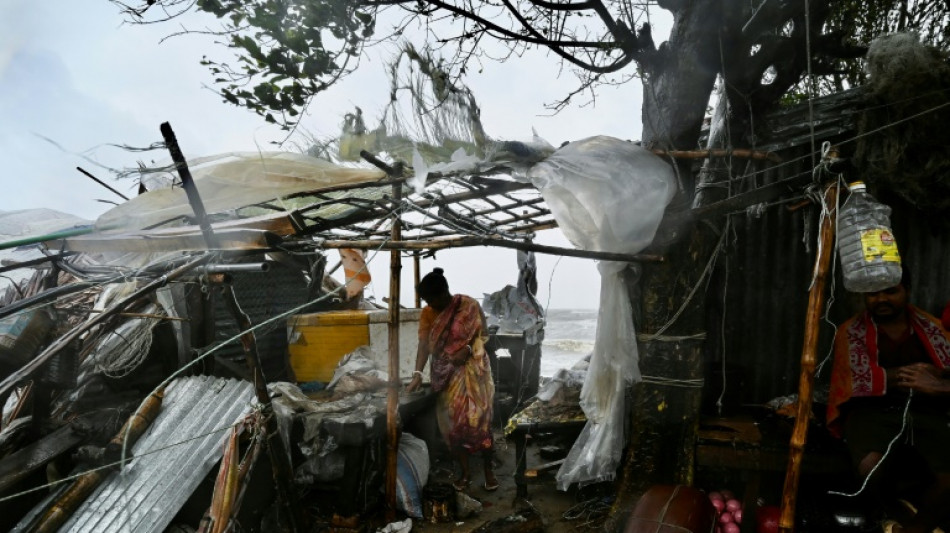
Residents of low-lying areas of Bangladesh and India surveyed the damage on Monday as an intense cyclone that lashed the coast weakened into a heavy storm after killing at least three people, damaging homes and uprooting trees.
Fierce gales and crashing waves battered the coast as Cyclone Remal made landfall on Sunday night, but by midday on Monday, the winds had eased.
"At least three people have died in the cyclone," Zahid Hossain Khan, a spokesman of the disaster management ministry, told AFP
Communications have been limited by the storm, with power lines ripped down.
Cyclones have killed hundreds of thousands of people in Bangladesh in recent decades, but the number of superstorms hitting its densely populated coast has increased sharply, from one a year to as many as three, due to the impact of climate change.
At its peak, Remal's wind speeds hit 111 kilometres (69 miles) per hour, said Muhammad Abul Kalam Mallik, senior weather forecaster at the state-run Bangladesh Meteorological Department.
"The cyclone has unleashed heavy rains in many parts of Bangladesh," Mallik told AFP, adding that it was weakening and turning into a storm.
An AFP reporter in the affected area said there had been heavy rain with extreme wind since Sunday evening, battering tall buildings, uprooting trees and tearing the tin roofs off homes.
While scientists say climate change is fuelling more storms, better forecasting and more effective evacuation planning have dramatically reduced the death toll.
Around a million people in Bangladesh and neighbouring India took shelter, fleeing inland for concrete storm shelters away from the dangerous waves.
Most of Bangladesh's coastal areas are just a metre or two (three to six feet) above sea level, and high storm surges can devastate villages.
Sumita Mondal, 36, who hunkered down overnight inland away from India's coast, said she had fled with only what she could carry.
"My three-year-old son is crying for food," she told AFP by telephone.
- 'Villages are flooded' -
Kamrul Hasan, secretary of the disaster management ministry, said there were no immediate reports of major damage, but said "embankments in several places have been breached or submerged, inundating some coastal areas".
In India's West Bengal, the "cyclone has blown off the roofs of hundreds of houses" and "uprooted thousands of mangrove trees and electricity poles", senior state government minister Bankim Chandra Hazra told AFP.
Electricity was off across large parts of the affected areas.
"Storm surges and rising sea levels have breached a number of embankments," Hazra added. "Some island villages are flooded."
At least 800,000 Bangladeshis fled their coastal villages, while more than 150,000 people in India also moved inland from the vast Sundarbans mangrove forest, where the Ganges, Brahmaputra and Meghna rivers meet the sea, government ministers and disaster officials said.
Mallik, the Bangladeshi weather expert, said the expansive mangrove forests helped dissipate the worst of the storm.
"Like in the past, the Sundarbans acted as a natural shield to the cyclone," he said.
But Abu Naser Mohsin Hossain, Bangladesh's senior forest official for the Sundarbans, said the storm surge had swamped crucial freshwater areas with salt water.
"We are worried," said Hossain. "These ponds were the source of fresh water for the entire wildlife in the mangroves -- including the endangered Bengal tigers."
L.E.Campos--PC