In Iraq's summer, residents of Kurdistan's Arbil ache for water / Photo: Safin HAMID - AFP

 Indians living in Japan on stand-by to house Asian Games athletes
 Trump signs bill authorizing sweeping Russia sanctions

 Protesters form human chain at Kennedy Center after Trump threat

 Death toll from attack at police HQ in Pakistan rises to 31

 Trump says Denmark to give US 'permanent control' over Greenland security

 Kennedy Center: future unclear for iconic Washington arts hub

 Trump claims 'infinite' Greenland security deal with Denmark

 Helicopters battle wildfire threatening Ecuador's capital

 Brentford batter Chelsea to undo Alonso's promising start

 Kane hits Bundesliga century as Bayern rout Union

 Trump says CNN, MS NOW, Politico banned from White House

 Hushing and hedging: US companies retreat on climate

 Springboks to face Fiji before 2027 Rugby World Cup

 Nigeria miners struggled to breathe in cell before 37 died: survivors

 McIlroy on the charge at PGA Championship as Reed withdraws

 McIlroy on the charge at PGA Championship

 Crisis-wracked Volkswagen warns of 10-bn-euro hit to profits

 Costa Rica's Grynspan tops third informal poll for UN chief: diplomat

 Stock markets retreat after central bank rate hikes

 Russia labels director of Cannes Grand Prix winner a 'foreign agent'

 Macron warns of Russian 'hybrid' threat after meeting presidential hopefuls

 UN holds third informal poll for new chief

 Kulusevski return can spark Spurs: De Zerbi

 Shakira to cap off world tour with Madrid 12-gig run

 Isolated Syrian-Druze city blames Damascus for shortages

The taps have run dry, and the wells are almost empty. In the capital of Iraq's autonomous Kurdistan region, 80-year-old Babir hasn't bathed in weeks and impatiently waits for trucked-in water deliveries.
"There is nothing worse than not having water," said Babir, who gave only his first name, in his modest house in Arbil's Darto suburb.
As in several other densely populated areas of Arbil and its suburbs, Babir and his neighbours rely on groundwater as their primary water source.
But for years, they have dreaded summer, when relentless drought, a lack of wells and power outages that bring pumps to a halt leave them cut off the supply of water.
For everything from bathing to watering plants, cooking and washing, they have been forced to depend on trucked-in water.
Usually "we bathe once every fortnight," said Babir, dressed in traditional Kurdish sarwal trousers.
From the roof of his house, he shouted for a water truck as it drove up into the street, then hurried downstairs to request a refill for his home.
This time, the truck belonged to a local aid group. When such assistance is unavailable, the retiree has to pay from his meagre pension or rely on family for water and other essentials.
Over the years, residents of several districts have taken to the streets many times to demand solutions, but Babir said appeals to officials had fallen on deaf ears. He said he was considering moving "to a place with water."
- Dried wells -
Iraq is known in Arabic as the Land of the Two Rivers, referring to the once mighty Tigris and Euphrates. But the rivers' water levels have plummeted and the UN classifies the country as one of the most impacted by some effects of climate change.
Authorities blame the drought as well as dams built upstream in neighbouring Turkey and Iran.
Arbil relies on 1,240 wells dotted across the city alongside the Ifraz water station that draws from the upper Zab River, which has its source in Turkey and joins the Tigris in Iraq.
Its governor, Omed Khoshnaw, told reporters earlier this month that "more than 25 percent of wells have dried up this year," adding that Arbil should rely less on groundwater.
Amid the crisis, the city's local authorities say they have allocated 1.5 billion Iraqi dinars ($1.1 million) to help solve it, including by digging new wells and providing power via generators and the electricity grid.
Local official Nabz Abdul Hamid said that power outages have heavily impacted pumps for wells in residential areas.
"We have now provided an uninterrupted electricity supply to most of the wells," he told AFP, adding that officials were working to fix the broader problem including by improving the Ifraz plant supply.
- 'Radical solutions' -
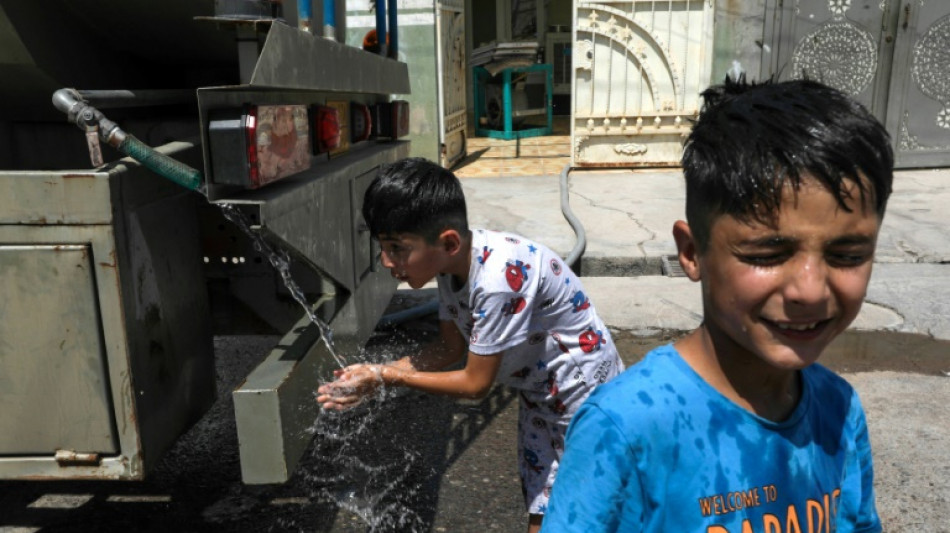
In the Darto district, one person skillfully manoeuvred the aid truck's hose as a torrent of water gushed into a tank.
A young girl waited to fill plastic bottles while other children joyfully splashed water on their faces, finding relief from the relentless heat.
But when it comes to washing, Surur Mohamad, 49, said that for anything more than basic clothes he goes to a nearby village where they have a steady water supply.
Trucked-in water from aid organisations "is not a solution," he said, adding that overcrowding has put further pressure on the water system while poor pipe infrastructure has exacerbated the problem.
"The government must find radical solutions as relying solely on wells" is no longer viable, especially considering the drought, he said.
His neighbour, Mahya Najm, said the lack of water had stopped her children and young families from visiting her.
"We cannot wash, cook or even receive guests," she said.
"We are in dire need of water. This is not a life," she added.
P.Cavaco--PC