Mideast sandstorms snarl traffic, close schools, harm health / Photo: Fayez Nureldine - AFP

 Trump's beef policies irk Texas ranchers, testing their loyalty

 Nvidia, OpenAI CEOs to attend Xi dinner at White House

 Anthropic picks Accenture for in-house AI safety evaluation

 Balogun returns as Monaco beat Lens to continue strong Ligue 1 start

 'Pause' on overt repression in Venezuela, but reforms still needed: HRW

 Global stocks mixed as yen falls despite Bank of Japan rate hike

 Cuba hit with seventh major blackout of the year

 Murray out with concussion so Wentz will start for Vikings

 UN chief 'deeply regrets' US visa refusal to Abbas for annual meeting

 England quick Carse to face no charges over alleged nightclub assault

 Mancini brings nine newcomers into the first squad of his Italy comeback

 Czechs level Davis Cup tie against USA as South Korea eye Finals

 New France boss Zidane confirms Mbappe as captain after naming first squad

 California governor signs order to explore AI 'kill switch'

 Head leads run spree as Australia win Zimbabwe ODI series

 In-form Raphinha wants to finish career at Barcelona

 Warren Buffett steps down as Berkshire Hathaway chairman

 Carrick confident Man Utd can 'work through' tough time

 Mbappe ends Nike partnership to join Swiss brand On

 Liverpool boss Iraola puts Bournemouth love affair on hold

 'A disaster' if Man City do not win says Maresca after flawless start

 Kerry James Marshall: American 'blackness' painter celebrated in Europe

 Spain coach De la Fuente offers 'full support' to people of Ceuta

 Russia seizes assets of Nestle, French firms over West's Ukraine support

 England can build on World Cup 'spirit', says Tuchel

Sandstorms across the Middle East have delayed flights, closed schools and hospitalised thousands -- a phenomenon experts say could worsen as climate change warps regional weather patterns.
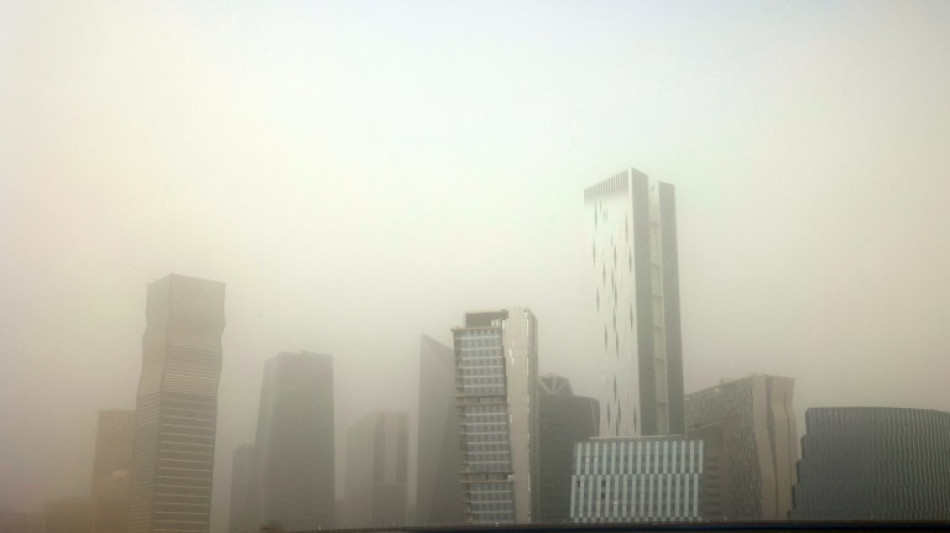
Saudi Arabia on Tuesday became the latest country blanketed with dust that slowed traffic and made iconic towers in the capital difficult to see from more than a few hundred metres (yards) away.
Electronic signs along Riyadh's highways warned drivers to reduce their speed because of the lower visibility, even as life largely went on as usual in the kingdom.
The national meteorology centre predicted that "surface dusty winds" originating in the east and bringing a thick grey haze would continue west towards the Muslim holy cities of Mecca and Medina.
Other countries have been grappling with the problem for longer: Neighbouring Iraq has experienced eight sandstorms since mid-April, fuelled by soil degradation, intense droughts and low rainfall linked to climate change.
The country's latest sandstorm on Monday enveloped the capital Baghdad in an orange glow, sent at least 4,000 people to hospital with breathing problems and led to the closure of airports, schools and public offices across the country.
Iran announced that it, too, was closing government offices and schools Tuesday, citing "unhealthy weather" conditions and sandstorms.
Average airborne concentration of the finest and most hazardous particles (PM2.5) was at 163 microgrammes per cubic metre Tuesday in Tehran, according to a government website.
That is more than six times the World Health Organisation's recommended maximum of 25 microgrammes per cubic metre.
In Kuwait, meanwhile, air traffic at the main airport was suspended for an hour and a half due to a dust storm Monday, and marine traffic in all three ports remained suspended as of Tuesday afternoon.
Kuwait's ministry of education said classes were suspended on Tuesday but would resume the following day.
- Response needed 'urgently' -
The Middle East has always been battered by dust and sandstorms, but they have become more frequent and intense in recent years.
The trend is associated with overgrazing and deforestation, overuse of river water and more dams.
Unseasonable masses of dry, cold air help explain the recent proliferation of sandstorms in eastern Syria and Iraq and "their transmission to the Arabian Peninsula", Hassan Abdallah from the WASM meteorological centre in Jordan told AFP.
By the time the sandstorms reach Saudi Arabia they tend to be less intense, he added.
Sandstorms are worsening regionally because of factors including low water levels in the Tigris and Euphrates rivers, large fluctuations in annual rainfall and disintegrating soil, he said.
In central Riyadh on Tuesday, sand layered cars and buildings, and residents struggled to keep it out of their homes.
"Working outside is very difficult because of the dirt," a Pakistani construction worker who gave his name as Kalimullah told AFP as he installed tiles.
"I try to wash my face from time to time," the 30-year-old added, wrapping a piece of cloth around his face to block the sand.
Saudi office worker Abdullah Al-Otaibi, 39, said he was grateful he works indoors.
"Dust storms are part of our culture and we are used to it, but some of them are severe," he said, rubbing his eyes as he hurried inside.
A.F.Rosado--PC