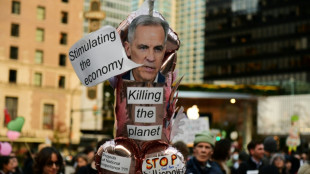
Steel at heart of new Trump trade war / Photo: Daniel Munoz - AFP/File

 Mutual fund returns show shifting leaders across market-cap categories

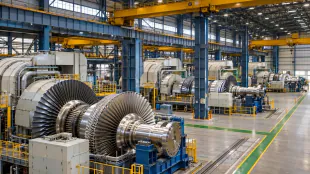 BHEL wins Adani Power projects valued at up to ₹28,000 crore

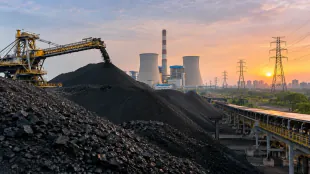 India seeks threefold increase in coal stocks to prevent summer power shortages

 Indian companies report mixed second-quarter results on November 4

 KKR secures Indian regulator approval for Gentari Renewables investment

 Bharti Airtel revenue expected to grow at double-digit pace in second quarter

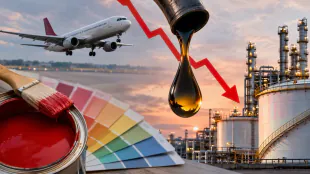 Indian crude-sensitive shares gain after 13% oil-price decline

 Stocks and dollar fall as Democratic election gains reshape markets

 Kuwait marks key events and anniversaries from national history

 Trump congratulates Democrats and signals willingness to cooperate

 Qatar prime minister advances mediation through diplomatic calls

 Greenland parliament approves security agreement with United States

 Qatar envoy meets incoming UN General Assembly president

 Trump Signals Willingness to Work With Democrats After Midterm Defeat

US President Donald Trump's new tariffs on steel promise to further complicate a strategic industry already destabilised by Chinese overproduction and Europe's stuttering blast furnaces.
Recently returned to the White House, the mercurial Republican's long-promised trade war will on Monday forge a new front with an expected 25-percent levy on aluminium and steel imported into the United States.
Trump imposed similar tariffs during his first term of office to protect US producers faced with what he complained to be unfair competition.
Who exports steel to the US?
Global steel production hit 1.89 billion tonnes in 2023, according to the latest figures from trade body World Steel.
World leader China's 1.02 billion tonnes represents more than half of that tally, with the United States trailing far behind on 81 million.
The United States meanwhile imported 26.4 million tonnes of the alloy in 2023, making it the second-largest market for foreign steel behind the European Union.
Canada tops the list of Washington's favoured steel providers with the United States importing 5.95 million tonnes from its northern neighbour in 2024, according to the US Department of Commerce.
Brazil and the EU followed with 4.08 million and 3.89 million tonnes exported to the United States respectively, ahead of Mexico on 3.19 million and South Korea on 2.5 million.
China however exported only around 470,000 tonnes to the United States.
Why is Trump complaining?
Global overproduction of the alloy has caused steel prices to plummet in the past year.
Where the steel economy of the past half-century cycled through periods of shortage and plenty, today it faces a structural problem of too much steel being produced,experts say.
That steel surplus varies around half a billion tonnes, according to the Organisation for Economic Co-operation and Development.
"The majority comes from China which is flooding the world markets," a European steel industry figure told AFP on condition of remaining anonymous.
Historically, European and US production capacity was on the whole balanced and in tune with domestic needs, the source said.
"But in southeast Asia (production) far exceeds demand".
And new planned steel factories in the region should add another 100 million tonnes of production capacity -- "80 percent of which comes from Chinese players" -- on top of the existing surplus, they added.
Moreover, Beijing has long been suspected of indirectly subsidising its steel production, driving down prices and putting the traditional European and US players on the back foot.
As a result under-fire US Steel has been the subject of a takeover bid by Japanese rival Nippon Steel, which was blocked by then-president Joe Biden.
With low prices squeezing profits, Germany's ThyssenKrupp announced it will lay off thousands of people working at its furnaces.
Why does steel matter?
Steel, so key to the second industrial revolution of the late 19th and early 20th century, remains a strategic industry around the world.
It is the foundational girder on which many traditional industrial sectors rest.
Just over half of the steel produced in 2023 was still destined for construction, while 12 percent of the rest went to automobile manufacturers.
Weapons manufacturers, railways and other transport sectors likewise feature among the alloy's top consumers.
But its use in wind turbines means steel is likewise essential for the transition to renewable energy.
It is also necessary to build the data centres used to house the vast quantities of information key to the development of artificial intelligence.
- Does green steel exist? -
The manufacturing process, which involves burning coal to smelt steel from iron ore, makes the industry largest emitter of planet-warming greenhouse gases.
Some steel furnaces have attempted to limit their environmental impact by recycling more scrap metal, switching to electric furnaces or building gas and hydrogen installations to phase out the use of highly polluting coal.
In Europe in particular vast sums of money were planned to be poured into decarbonising the industry.
But those investments have currently been put on ice due to Trump's looming threat of a trade war, the global surplus and the continent's declining steel consumption.
E.Borba--PC