World energy methane emissions near record high in 2024: IEA / Photo: JOE RAEDLE - GETTY IMAGES NORTH AMERICA/AFP/File

 Ed Sheeran returns to stage after Palestinian controversy

 Asian Games to open in Japan after troubled build-up

 Drone owners rush to offload devices ahead of Beijing ban

 Trump's beef policies irk Texas ranchers, testing their loyalty

 Nvidia, OpenAI CEOs to attend Xi dinner at White House

 Anthropic picks Accenture for in-house AI safety evaluation

 Balogun returns as Monaco beat Lens to continue strong Ligue 1 start

 'Pause' on overt repression in Venezuela, but reforms still needed: HRW

 Global stocks mixed as yen falls despite Bank of Japan rate hike

 Cuba hit with seventh major blackout of the year

 Murray out with concussion so Wentz will start for Vikings

 UN chief 'deeply regrets' US visa refusal to Abbas for annual meeting

 England quick Carse to face no charges over alleged nightclub assault

 Mancini brings nine newcomers into the first squad of his Italy comeback

 Czechs level Davis Cup tie against USA as South Korea eye Finals

 New France boss Zidane confirms Mbappe as captain after naming first squad

 California governor signs order to explore AI 'kill switch'

 Head leads run spree as Australia win Zimbabwe ODI series

 In-form Raphinha wants to finish career at Barcelona

 Warren Buffett steps down as Berkshire Hathaway chairman

 Carrick confident Man Utd can 'work through' tough time

 Mbappe ends Nike partnership to join Swiss brand On

 Liverpool boss Iraola puts Bournemouth love affair on hold

 'A disaster' if Man City do not win says Maresca after flawless start

 Kerry James Marshall: American 'blackness' painter celebrated in Europe

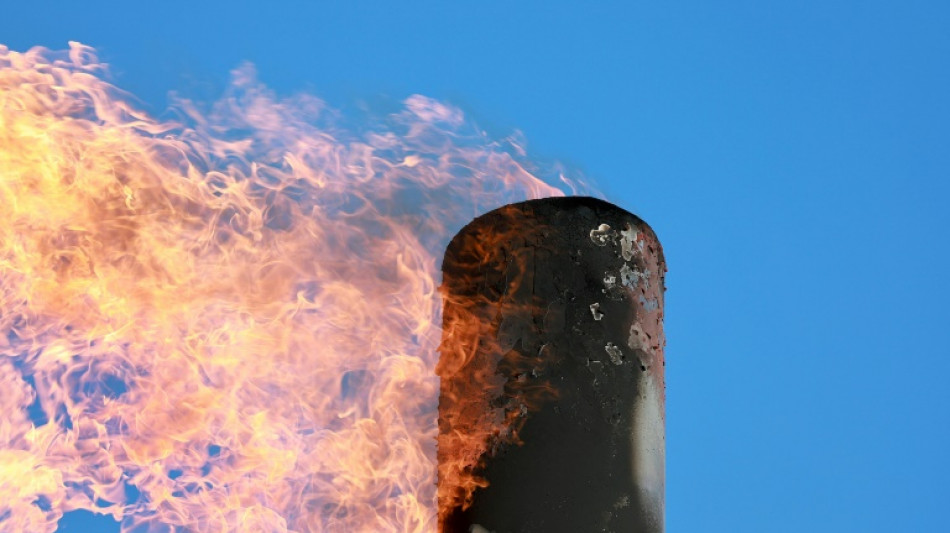
Record fossil fuel production kept planet-heating methane emissions near historic highs last year, the International Energy Agency said Wednesday, warning of a surge in massive leaks from oil and gas facilities.
Slashing emissions of methane -- second only to carbon dioxide for its contribution to global warming -- is essential to meeting international targets on climate change and one of the fastest ways to curb temperature rise.
But the IEA warned that countries are considerably underestimating their energy sector methane pollution, estimating that emissions are around 80 percent higher than the total reported by governments to the United Nations.
The energy sector is responsible for around a third of the methane emitted by human activities.
It leaks from gas pipelines and other energy infrastructure, and is also deliberately released during equipment maintenance.
Tackling this is considered one of the easiest ways to lower emissions because plugging leaks can often be done at little or no cost.
"However, the latest data indicates that implementation on methane has continued to fall short of ambitions," said IEA Executive Director Fatih Birol.
- 'Super-emitters' -
The IEA's Global Methane Tracker report said over 120 million tonnes was released from the fossil fuel sector in 2024, close to the record high in 2019.
China has the largest energy methane emissions globally, mainly from its coal sector.
The United States follows in second, driven by its oil and gas sector, with Russia third.
The IEA said its figures are based on measured data where possible, compared to emissions reported by governments, which can be outdated or estimated using information from the energy sector.
Global methane emissions are becoming easier to monitor from space, with more than 25 satellites tracking gas plumes from fossil fuel facilities and other sources.
The IEA said that Europe's Sentinel 5 satellite, which just sees the very largest leaks, showed that "super-emitting methane events" at oil and gas facilities rose to a record high in 2024.
These huge leaks were observed all over the world, but particularly in the United States, Turkmenistan and Russia.
Abandoned oil and gas wells, and coal mines are also significant sources of methane leaking into the atmosphere, the IEA said in new analysis for this year's report.
When taken together they would be the "world's fourth-largest emitter of fossil fuel methane", accounting for some eight million tonnes last year.
- 'Tremendous impact' -
Some 40 percent of methane emissions come from natural sources, mainly wetlands.
The rest are from human activities, particularly agriculture and the energy sector.
Because methane is potent but relatively short-lived it is a key target for countries wanting to slash emissions quickly.
More than 150 countries have promised a 30 percent reduction by 2030.
Oil and gas firms have meanwhile pledged to slash methane emissions by 2050.
The IEA estimated that cutting methane released by the fossil fuel sector would significantly slow global warming, preventing a roughly 0.1 degree Celsius rise in global temperatures by 2050.
"This would have a tremendous impact -– comparable to eliminating all CO2 emissions from the world's heavy industry in one stroke," the report said.
Around 70 percent of annual methane emissions from the energy sector could be avoided with existing technologies.
But only five percent of global oil and gas meets "near-zero" emissions standards, the IEA said.
Energy think tank Ember said the fossil fuel industry needs to reduce methane emissions by 75 percent by 2030 if the world is to meet the target of reducing overall emissions to net zero by the middle of this century.
In particular, methane from coal was "still being ignored," said Ember analyst Sabina Assan.
"There are cost-effective technologies available today, so this is a low-hanging fruit of tackling methane. We can't let coal mines off the hook any longer."
S.Pimentel--PC