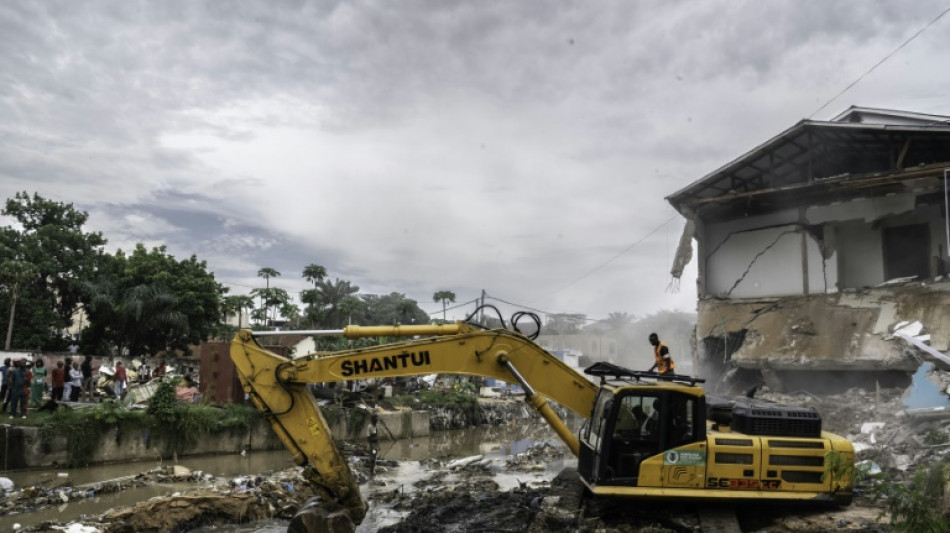
Kinshasa deploys excavators against illegally built homes / Photo: Glody MURHABAZI - AFP

 Ed Sheeran returns to stage after Palestinian controversy

 Asian Games to open in Japan after troubled build-up

 Drone owners rush to offload devices ahead of Beijing ban

 Trump's beef policies irk Texas ranchers, testing their loyalty

 Nvidia, OpenAI CEOs to attend Xi dinner at White House

 Anthropic picks Accenture for in-house AI safety evaluation

 Balogun returns as Monaco beat Lens to continue strong Ligue 1 start

 'Pause' on overt repression in Venezuela, but reforms still needed: HRW

 Global stocks mixed as yen falls despite Bank of Japan rate hike

 Cuba hit with seventh major blackout of the year

 Murray out with concussion so Wentz will start for Vikings

 UN chief 'deeply regrets' US visa refusal to Abbas for annual meeting

 England quick Carse to face no charges over alleged nightclub assault

 Mancini brings nine newcomers into the first squad of his Italy comeback

 Czechs level Davis Cup tie against USA as South Korea eye Finals

 New France boss Zidane confirms Mbappe as captain after naming first squad

 California governor signs order to explore AI 'kill switch'

 Head leads run spree as Australia win Zimbabwe ODI series

 In-form Raphinha wants to finish career at Barcelona

 Warren Buffett steps down as Berkshire Hathaway chairman

 Carrick confident Man Utd can 'work through' tough time

 Mbappe ends Nike partnership to join Swiss brand On

 Liverpool boss Iraola puts Bournemouth love affair on hold

 'A disaster' if Man City do not win says Maresca after flawless start

 Kerry James Marshall: American 'blackness' painter celebrated in Europe

A mother watched in despair as an excavator demolished her Kinshasa home, part of a campaign to clamp down on unauthorised buildings after deadly floods.
Flash flooding in the overcrowded megalopolis, which sits on the banks of the mighty Congo River, killed dozens of people early last month.
Authorities have begun demolishing riverside constructions built without permits, where the death toll is often high with each deluge in the vast Democratic Republic of Congo.
"Our homes destroyed, and our belongings stolen, where will we go?" asked Passy, in vain.
"Authorities, have pity on us, why treat us like this?"
Provincial urban development and public works minister Alain Tshilungu came to oversee the demolition in northwestern Ngaliema district.
Passy's home was among 15 plots earmarked for demolition -- a small fraction of the sprawling shantytowns on the outskirts of the city of 17 million people.
"You condemn the state by saying that it doesn't act. Now we want to act," the minister told reporters.
A day earlier, Kinshasa officials had announced the start of operations in the campaign, originally unveiled in November.
The excavator moved on to an apartment block built illegally along the river.
- 'Don't have much left' -
Its occupants hastily got out.
A mother, her young son and two little girls hugged each other, looking tired, next to a small pile of belongings, saved from the excavator and scattered on the ground.
The young woman said she did "not have the strength" to comment on the authorities' decision.
After around a dozen blows, the walls caved in and the building collapsed under a thick cloud of dust.
A dog darted out from the rubble.
Shortly after, local residents descended on the premises and looted whatever they could: doors, windows, sinks and even toilet bowls.
Augustin Masudi, who lived in the building, watched the events unfold before his tearful eyes.
The father of six managed to save a mattress, freezer and a few other items from the place he called home for three years.
"We don't have much left, everything has been looted. The authorities should give us one or two weeks' notice," he said, his voice hoarse.
Another victim of the demolition, Dady Kasongo, looked frozen behind his black glasses.
He said he had poured "thousands of dollars" into buying materials to build his house, which was being pulled down in front of him before it had even been finished.
The plots were "registered properly" with the state authorities, he said, adding that he hoped to receive compensation.
"What we are doing is not a malicious demolition, but rather recovering the public authority of the state," Tshilungu, the provincial minister, said, emphasising that building on riverbanks and riverbeds is illegal.
In a country ranked among the poorest in the world and where corruption is rife, some owners obtained "fraudulent" building permits, local authorities say.
Kinshasa has undergone successive, similar demolition campaigns for decades.
But the sprawling city continues to battle problems of congestion and a lack of infrastructure in keeping with its rapid demographic growth.
Across vast areas of Africa, climate change has thrown weather patterns into disarray and made flooding much more severe.
Experts estimate that by 2030, up to 118 million Africans already living in poverty will be exposed to drought, floods and intense heat.
E.Ramalho--PC