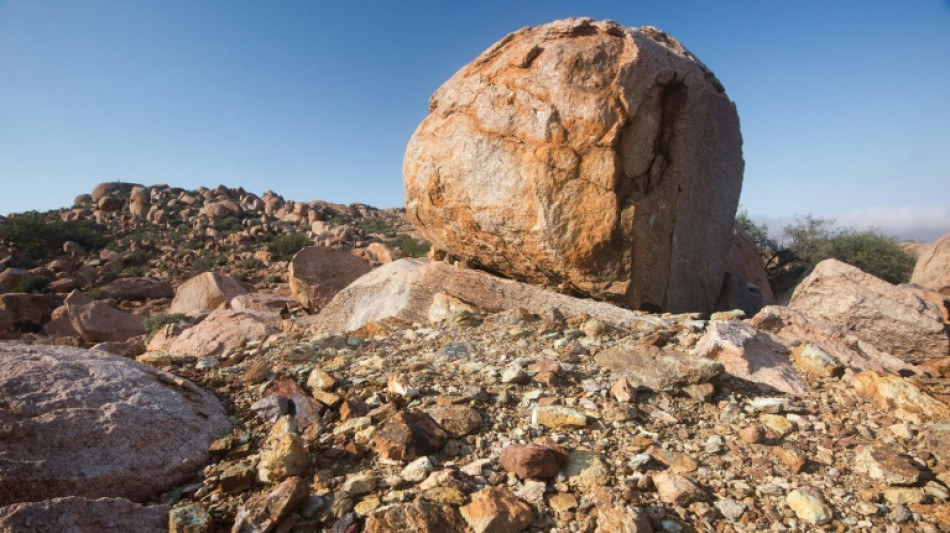
Rare earth production outside China 'major milestone' / Photo: RODGER BOSCH - AFP/File

 Ed Sheeran returns to stage after Palestinian controversy

 Asian Games to open in Japan after troubled build-up

 Drone owners rush to offload devices ahead of Beijing ban

 Trump's beef policies irk Texas ranchers, testing their loyalty

 Nvidia, OpenAI CEOs to attend Xi dinner at White House

 Anthropic picks Accenture for in-house AI safety evaluation

 Balogun returns as Monaco beat Lens to continue strong Ligue 1 start

 'Pause' on overt repression in Venezuela, but reforms still needed: HRW

 Global stocks mixed as yen falls despite Bank of Japan rate hike

 Cuba hit with seventh major blackout of the year

 Murray out with concussion so Wentz will start for Vikings

 UN chief 'deeply regrets' US visa refusal to Abbas for annual meeting

 England quick Carse to face no charges over alleged nightclub assault

 Mancini brings nine newcomers into the first squad of his Italy comeback

 Czechs level Davis Cup tie against USA as South Korea eye Finals

 New France boss Zidane confirms Mbappe as captain after naming first squad

 California governor signs order to explore AI 'kill switch'

 Head leads run spree as Australia win Zimbabwe ODI series

 In-form Raphinha wants to finish career at Barcelona

 Warren Buffett steps down as Berkshire Hathaway chairman

 Carrick confident Man Utd can 'work through' tough time

 Mbappe ends Nike partnership to join Swiss brand On

 Liverpool boss Iraola puts Bournemouth love affair on hold

 'A disaster' if Man City do not win says Maresca after flawless start

 Kerry James Marshall: American 'blackness' painter celebrated in Europe

An Australian firm's production of a heavy rare earth, a first outside of China, is a "major milestone" in diversifying a critical supply chain dominated by Beijing, experts say.
But the announcement by Lynas Rare Earths also illustrates how much more needs to be done to broaden the supply of elements critical for electric vehicles and renewable technology.
What are rare earths?
Rare earth elements (REE) are 17 metals that are used in a wide variety of everyday and high-tech products, from light bulbs to guided missiles.
Among the most sought-after are neodymium and dysprosium, used to make super-strong magnets that power electric car batteries and ocean wind turbines.
Despite their name, rare earths are relatively abundant in the Earth's crust. Their moniker is a nod to how unusual it is to find them in a pure form.
Heavy rare earths, a subset of overall REE, have higher atomic weights, are generally less abundant and often more valuable.
China dominates all elements of the rare earths supply chain, accounting for more than 60 percent of mining production and 92 percent of global refined output, according to the International Energy Agency.
What did Lynas achieve?
Lynas said it produced dysprosium oxide at its Malaysia facility, making it the only commercial producer of separated heavy rare earths outside of China.
It hopes to refine a second heavy rare earth -- terbium -- at the same facility next month. It too can be used in permanent magnets, as well as some light bulbs.
It "is a major milestone," said Neha Mukherjee, senior analyst on raw materials at Benchmark Mineral Intelligence.
The announcement comes with China's REE supply caught up in its trade war with Washington.
It is unclear whether a 90-day truce means Chinese export controls on some rare earths will be lifted, and experts say a backlog in permit approvals will snarl trade regardless.
"Given this context, the Lynas development marks a real and timely shift, though it doesn't eliminate the need for broader, global diversification efforts," said Mukherjee.
How significant is it?
Lynas did not say how much dysprosium it refined, and rare earths expert Jon Hykawy warned the firm faces constraints.
"The ore mined by Lynas contains relatively little of the heavy rare earths, so their produced tonnages can't be that large," said Hykawy, president of Stormcrow Capital.
"Lynas can make terbium and dysprosium, but not enough, and more is needed."
The mines most suited for extracting dysprosium are in south China, but deposits are known in Africa, South America and elsewhere.
"Even with Lynas' production, China will still be in a position of dominance," added Gavin Wendt, founding director and senior resource analyst at MineLife.
"However, it is a start, and it is crucial that other possible projects in the USA, Canada, Brazil, Europe and Asia, also prove technically viable and can be approved, so that the supply balance can really begin to shift."
What are the challenges to diversifying?
China's domination of the sector is partly the result of long-standing industrial policy. Just a handful of facilities refining light rare earths operate elsewhere, including in Estonia.
It also reflects a tolerance for "in-situ mining", an extraction technique that is cheap but polluting, and difficult to replicate in countries with higher environmental standards.
For them, "production is more expensive, so they need prices to increase to make any seriously interesting profits," said Hykawy.
That is a major obstacle for now.
"Prices have not supported new project development for over a year," said Mukherjee.
"Most non-Chinese projects would struggle to break even at current price levels."
There are also technical challenges, as processing rare earths requires highly specialised and efficient techniques, and can produce difficult-to-manage waste.
What more capacity is near?
Lynas has commissioned more processing capacity at its Malaysia plant, designed to produce up to 1,500 tonnes of heavy rare earths.
If that focused on dysprosium and terbium, it could capture a third of global production, said Mukherjee.
The firm is building a processing facility in Texas, though cost increases have cast doubt on the project, and Lynas wants the US government to pitch in more funds.
US firm MP Materials has also completed pilot testing for heavy rare earth separation and plans to boost production this year.
Canada's Aclara Resources is also developing a rare earths separation plant in the United States.
And Chinese export uncertainty could mean prices start to rise, boosting balance sheets and the capacity of small players to expand.
"The Lynas announcement shows progress is possible," said Mukherjee.
"It sends a strong signal that with the right mix of technical readiness, strategic demand, and geopolitical urgency, breakthroughs can happen."
G.Teles--PC