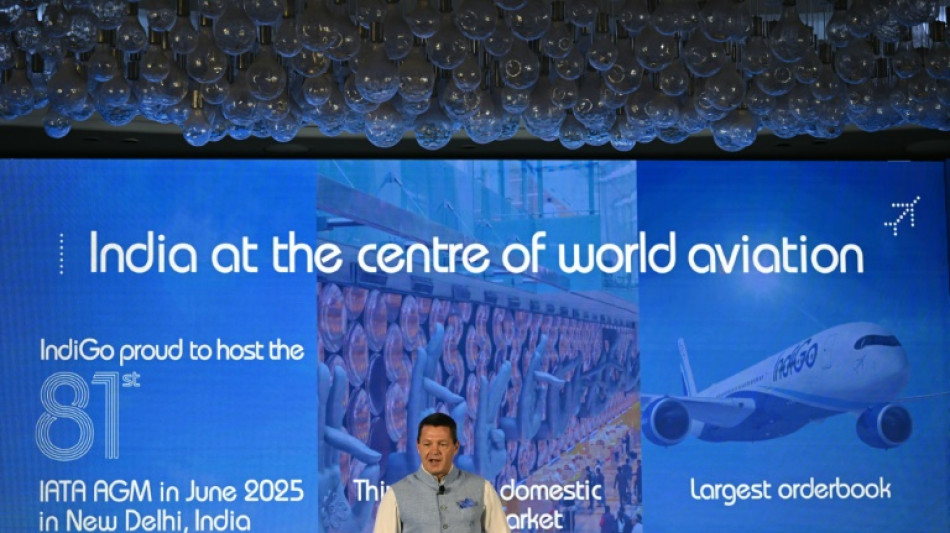
Key climate target of airline decarbonisation 'in peril': IATA / Photo: Money SHARMA - AFP

 Drone owners rush to offload devices ahead of Beijing ban

 Trump's beef policies irk Texas ranchers, testing their loyalty

 Nvidia, OpenAI CEOs to attend Xi dinner at White House

 Anthropic picks Accenture for in-house AI safety evaluation

 Balogun returns as Monaco beat Lens to continue strong Ligue 1 start

 'Pause' on overt repression in Venezuela, but reforms still needed: HRW

 Global stocks mixed as yen falls despite Bank of Japan rate hike

 Cuba hit with seventh major blackout of the year

 Murray out with concussion so Wentz will start for Vikings

 UN chief 'deeply regrets' US visa refusal to Abbas for annual meeting

 England quick Carse to face no charges over alleged nightclub assault

 Mancini brings nine newcomers into the first squad of his Italy comeback

 Czechs level Davis Cup tie against USA as South Korea eye Finals

 New France boss Zidane confirms Mbappe as captain after naming first squad

 California governor signs order to explore AI 'kill switch'

 Head leads run spree as Australia win Zimbabwe ODI series

 In-form Raphinha wants to finish career at Barcelona

 Warren Buffett steps down as Berkshire Hathaway chairman

 Carrick confident Man Utd can 'work through' tough time

 Mbappe ends Nike partnership to join Swiss brand On

 Liverpool boss Iraola puts Bournemouth love affair on hold

 'A disaster' if Man City do not win says Maresca after flawless start

 Kerry James Marshall: American 'blackness' painter celebrated in Europe

 Spain coach De la Fuente offers 'full support' to people of Ceuta

 Russia seizes assets of Nestle, French firms over West's Ukraine support

The airline industry's flagship goal of decarbonising by 2050 is now "in peril" due to climate-sceptic policies, including those of US President Donald Trump, the leading airline association IATA warned on Sunday.
The emergence of leaders favouring fossil fuels and recent regulatory rollbacks are "obviously a setback... it does imperil success on the 2050 horizon", Marie Owens Thomsen, the International Air Transport Association's senior vice president for sustainability, told reporters.
"But I don't think it's going to halt or reverse progress. I think it will just slow progress," she said at the IATA annual industry conference in India.
Trump's Republican administration is supporting the development of fossil fuels in contrast to his Democratic predecessor Joe Biden, who had massively supported the production of renewable aviation fuels through tax credits.
UN aviation agency members, from the International Civil Aviation Organization (ICAO), have set the year 2050 as their goal for achieving net-zero carbon emissions for air travel -- an industry often criticised for its outsized role in climate change.
- 'Entirely achievable' -
The air transportation industry has faced growing pressure to deal with its contribution to the climate crisis.
Currently responsible for 2.5 percent to three percent of global CO2 emissions, the sector's switch to renewable fuels is proving difficult, even if the aeronautics industry and energy companies have been seeking progress.
To achieve net-zero emissions, airlines rely on non-fossil sources known as Sustainable Aviation Fuel (SAF).
However, SAF biofuels are still three to four times more expensive than petroleum-based jet fuel.
"Another problem, which is related, is the fact that oil is so cheap," Owens Thomsen said. "I think that also diminishes the sense of urgency that people have."
A barrel of Brent North Sea crude, the international benchmark, stands below $65 as a result of Trump's tariffs, his call to "drill baby drill" and especially a decision by OPEC+ to hike crude output quotas.
This represents an immediate boon for airlines, whose fuel costs represent between a quarter and a third of operating expenses.
SAF is seen as a crucial ingredient in hitting emissions targets. The biofuel produces lower carbon emissions than traditional jet fuel and is made from plant and animal materials such as cooking oil and fat.
European Union rules require carriers to include two percent of SAF in their fuel mix starting this year, rising to six percent in 2030 before soaring to 70 percent from 2050.
Owens Thomsen estimated on Sunday that $4.7 trillion in investment is needed to establish SAF sectors capable of meeting the needs of air transport by 2050.
"It is entirely achievable," she said, adding that the raw materials and technology already exist and simply need to be developed.
"The money involved is very comparable to the money that was involved in creating the previous new energy markets, notably obviously wind and solar," she said.
That money could be found just by stopping subsidies to oil producers, she said.
"The world is subsidising large oil companies to the height of $1 trillion per year," she said.
"With that money, if it were redirected in its totality, we could solve our energy transition in less than five years."
IATA also indicated on Sunday that it expects global SAF production to double this year compared with 2024 to 2.5 billion litres -- slightly down from its previous projections of 2.7 billion litres.
"This represents only 0.7 percent of total aviation needs," IATA Director General Willie Walsh said.
S.Caetano--PC