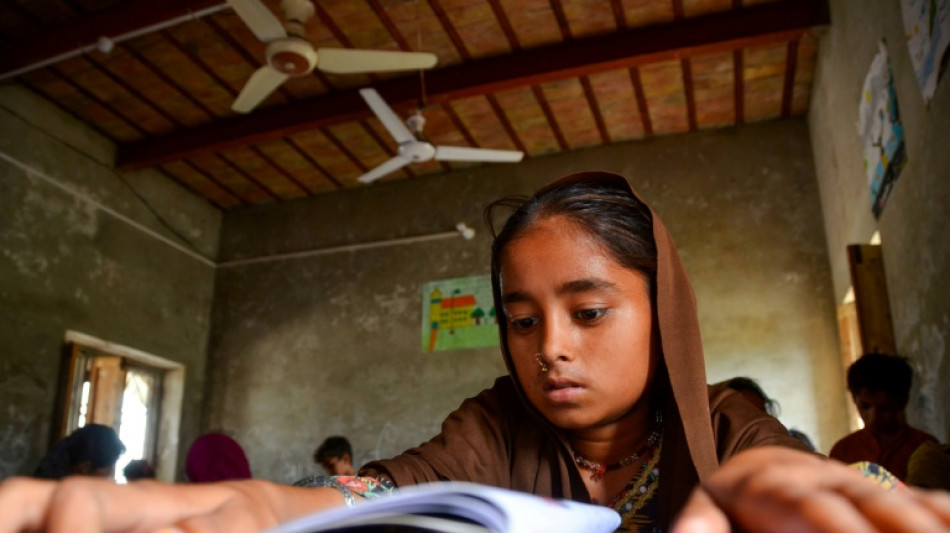
School's out: climate change keeps Pakistan students home / Photo: Fida HUSSAIN - AFP/File

 Drone owners rush to offload devices ahead of Beijing ban

 Trump's beef policies irk Texas ranchers, testing their loyalty

 Nvidia, OpenAI CEOs to attend Xi dinner at White House

 Anthropic picks Accenture for in-house AI safety evaluation

 Balogun returns as Monaco beat Lens to continue strong Ligue 1 start

 'Pause' on overt repression in Venezuela, but reforms still needed: HRW

 Global stocks mixed as yen falls despite Bank of Japan rate hike

 Cuba hit with seventh major blackout of the year

 Murray out with concussion so Wentz will start for Vikings

 UN chief 'deeply regrets' US visa refusal to Abbas for annual meeting

 England quick Carse to face no charges over alleged nightclub assault

 Mancini brings nine newcomers into the first squad of his Italy comeback

 Czechs level Davis Cup tie against USA as South Korea eye Finals

 New France boss Zidane confirms Mbappe as captain after naming first squad

 California governor signs order to explore AI 'kill switch'

 Head leads run spree as Australia win Zimbabwe ODI series

 In-form Raphinha wants to finish career at Barcelona

 Warren Buffett steps down as Berkshire Hathaway chairman

 Carrick confident Man Utd can 'work through' tough time

 Mbappe ends Nike partnership to join Swiss brand On

 Liverpool boss Iraola puts Bournemouth love affair on hold

 'A disaster' if Man City do not win says Maresca after flawless start

 Kerry James Marshall: American 'blackness' painter celebrated in Europe

 Spain coach De la Fuente offers 'full support' to people of Ceuta

 Russia seizes assets of Nestle, French firms over West's Ukraine support

Pakistan's children are losing weeks of education each year to school closures caused by climate change-linked extreme weather, prompting calls for a radical rethink of learning schedules.
Searing heat, toxic smog and unusual cold snaps have all caused closures that are meant to spare children the health risks of learning in classrooms that are often overcrowded and lack basic cooling, heating or ventilation systems.
In May, a nationwide heatwave saw temperatures up to seven degrees Celsius above normal, hitting 45C (113 degrees Fahrenheit) in Punjab and prompting several provinces to cut school hours or start summer holidays early.
"The class becomes so hot that it feels like we are sitting in a brick kiln," said 17-year-old Hafiz Ehtesham outside an inner city Lahore school.
"I don't even want to come to school."
Pakistan is among the countries most vulnerable to climate change, with limited resources for adaptation, and extreme weather is compounding an existing education crisis caused mostly by access and poverty.
"Soon we will have major cognitive challenges because students are being impacted by extreme heat and extreme smog over long periods of time," said Lahore-based education activist Baela Raza Jamil.
"The poorest are most vulnerable. But climate change is indeed a great leveller and the urban middle class is also affected."
Pakistan's summers historically began in June, when temperatures hit the high 40s. But in the last five years, May has been similarly hot, according to the Meteorological Department.
"During a power outage, I was sweating so much that the drops were falling off my forehead onto my desk," 15-year-old Jannat, a student in Lahore, told AFP.
"A girl in my class had a nosebleed from the heat."
- Health versus learning -
Around a third of Pakistani school-age children -- over 26 million -- are out of school, according to government figures, one of the highest numbers in the world.
And 65 percent of children are unable to read age-appropriate material by age 10.
School closures affect almost every part of Pakistan, including the country's most populous province Punjab, which has the highest rates of school attendance.
Classes closed for two weeks in November over air pollution, and another week in May because of heat. In the previous academic year, three weeks were lost in January to a cold snap and two weeks in May due to heat.
Political unrest and cricket matches that closed roads meant more lost days.
In Balochistan, Pakistan's poorest province, May heatwaves have prompted early summer vacations for three years running, while in northwestern Khyber Pakhtunkhwa province, school hours are regularly slashed.
For authorities, the choice is often between sending children to school in potentially dangerous conditions or watching them fall behind.
In southern Sindh province, authorities have resisted heat-related closures despite growing demands from parents.
"It's hard for parents to send their children to school in this kind of weather," private school principal Sadiq Hussain told AFP in Karachi, adding that attendance drops by 25 percent in May.
"Their physical and mental health is being affected," added Dost Mohammad Danish, general secretary of All Sindh Private Schools and Colleges Association.
"Don't expect better scientists from Pakistan in the coming years."
- 'Everyone is suffering' -
Schools in Pakistan are overseen by provincial authorities, whose closure notices apply to all schools in a region, even when they are hundreds of kilometres (miles) apart and may be experiencing different conditions, or have different resources to cope.
Teachers, parents and education experts want a rethink of school hours, exam timetables and vacations, with schools able to offer Saturday classes or split the school day to avoid the midday heat.
Izza Farrakh, a senior education specialist at the World Bank, said climate change-related impacts are affecting attendance and learning outcomes.
"Schools need to have flexibility in determining their academic calendar. It shouldn't be centralised," she said, adding that end-of-year exams usually taken in May could be replaced by regular assessments throughout the year.
Adapting school buildings is also crucial.
International development agencies have already equipped thousands of schools with solar panels, but many more of the country's 250,000 schools need help.
Hundreds of climate-resilient schools funded by World Bank loans are being built in Sindh. They are elevated to withstand monsoon flooding, and fitted with solar panels for power and rooftop insulation to combat heat and cold.
But in Pakistan's most impoverished villages, where education is a route out of generational poverty, parents still face tough choices.
In rural Sukkur, the local school was among 27,000 damaged or destroyed by unprecedented 2022 floods. Children learn outside their half-collapsed school building, unprotected from the elements.
"Our children are worried, and we are deeply concerned," said parent Ali Gohar Gandhu, a daily wage labourer. "Everyone is suffering."
P.Queiroz--PC