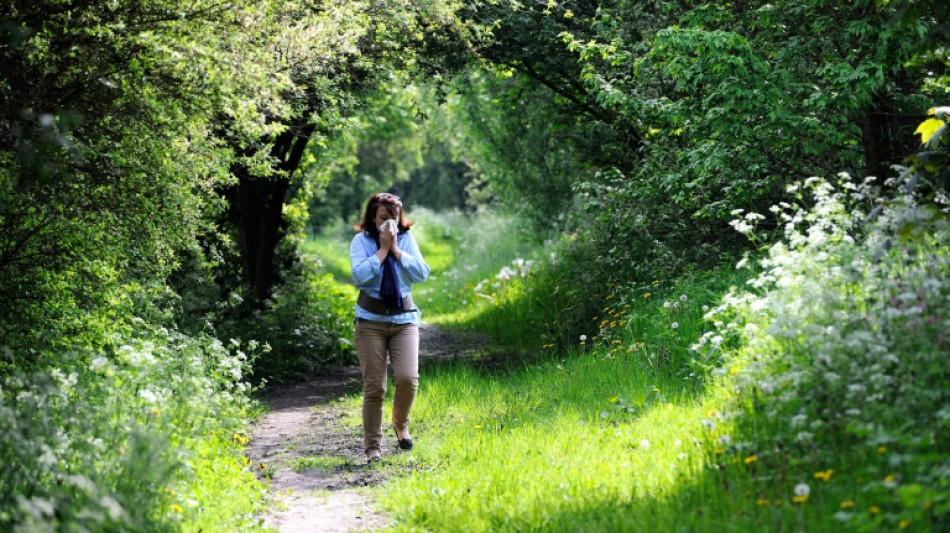
Longer exposure, more pollen: climate change worsens allergies / Photo: PHILIPPE HUGUEN - AFP/File

 Drone owners rush to offload devices ahead of Beijing ban

 Trump's beef policies irk Texas ranchers, testing their loyalty

 Nvidia, OpenAI CEOs to attend Xi dinner at White House

 Anthropic picks Accenture for in-house AI safety evaluation

 Balogun returns as Monaco beat Lens to continue strong Ligue 1 start

 'Pause' on overt repression in Venezuela, but reforms still needed: HRW

 Global stocks mixed as yen falls despite Bank of Japan rate hike

 Cuba hit with seventh major blackout of the year

 Murray out with concussion so Wentz will start for Vikings

 UN chief 'deeply regrets' US visa refusal to Abbas for annual meeting

 England quick Carse to face no charges over alleged nightclub assault

 Mancini brings nine newcomers into the first squad of his Italy comeback

 Czechs level Davis Cup tie against USA as South Korea eye Finals

 New France boss Zidane confirms Mbappe as captain after naming first squad

 California governor signs order to explore AI 'kill switch'

 Head leads run spree as Australia win Zimbabwe ODI series

 In-form Raphinha wants to finish career at Barcelona

 Warren Buffett steps down as Berkshire Hathaway chairman

 Carrick confident Man Utd can 'work through' tough time

 Mbappe ends Nike partnership to join Swiss brand On

 Liverpool boss Iraola puts Bournemouth love affair on hold

 'A disaster' if Man City do not win says Maresca after flawless start

 Kerry James Marshall: American 'blackness' painter celebrated in Europe

 Spain coach De la Fuente offers 'full support' to people of Ceuta

 Russia seizes assets of Nestle, French firms over West's Ukraine support

Runny nose, itching eyes, worsening asthma symptoms -- the effects of hay fever are nothing to sneeze at, experts say, warning of an "explosion" of allergies as climate change lengthens and intensifies pollen seasons.
The UN's World Meteorological Organization (WMO) has found that a shifting climate has already begun altering the production and distribution of pollen and spores.
As winter frost thaws earlier and spring weather gets warmer, plants and trees flower earlier, extending the pollen season, numerous studies have shown.
Air pollution can also increase people's sensitivity to allergens, while invasive species are spreading into new regions and causing fresh waves of allergies.
More and more people, particularly in industrialised nations, have reported developing allergy symptoms in recent decades.
Around a quarter of adults in Europe suffer from airborne allergies, including severe asthma, while the proportion among children is 30 to 40 percent.
That figure is expected to rise to half of Europeans by 2050, according to the World Health Organization.
"We're in crisis because allergies are exploding," said Severine Fernandez, president of the French Allergists' Union.
Whereas previously an allergic person would endure only what is commonly known as hay fever, albeit sometimes for years, "now that person can become asthmatic after one or two years", Fernandez said.
- 'Irritant pollen' -
Climate change affects allergy patients in multiple ways, according to a 2023 report by the WMO.
Rising levels of carbon dioxide, one of the main heat-trapping gases produced by burning fossil fuels, boost plant growth, in turn increasing pollen production.
Air pollution not only irritates the airways of people exposed, but it also causes stress to plants, which then produce more "allergenic and irritant pollen".
Nicolas Visez, an aerobiologist at the University of Lille, said each plant species reacted differently to a variety of factors such as water availability, temperature and CO2 concentrations.
Birch trees for example will wither as summers get hotter and drier, while the heat causes a proliferation of ragweed, a highly allergenic invasive plant.
"There's no doubt that climate change is having an effect," Visez said.
In a study published in 2017, researchers projected that ragweed allergies would more than double in Europe by 2041-2060 as a result of climate change, raising the number of people affected from 33 million to 77 million.
The authors suggested that higher pollen concentrations as well as longer pollen seasons could make symptoms more severe.
- Allergy action -
A Europe-wide "AutoPollen" programme under development aims to provide real-time data on the distribution of pollen and fungal spores.
In Switzerland, a tie-up with MeteoSwiss allows patients and doctors to match personal allergy profiles with maps of specific allergens throughout the country.
In parts of France, authorities have planted "pollinariums", gardens packed with the main local allergen species.
These provide information on the very first pollen released into the air so that people can start taking antihistamines and other protective measures in a timely manner.
"Hazelnuts have started to bloom as early as mid-December, which wasn't the case before," said Salome Pasquet, a botanist with the association behind the pollen gardens.
"That's really because we've had very mild winters, so flowering has come earlier," she said.
Some countries are taking an interventionist approach -- cutting off the pollen at the source.
In Japan, the government announced a plan in 2023 to combat allergies caused by the archipelago's many cedar trees, which includes felling cedars to replace them with species that produce less pollen.
Countries in Europe are also more mindful of species in the environment, both native ones that have been planted and invasive newcomers like ragweed.
Preference is given to species with a lower allergenic potential, such as maple or fruit trees.
"The idea is not to stop planting allergenic species," Pasquet said, but to be mindful of creating diversity and avoiding having "places where there are rows of birch trees, as was the case a few years ago".
It was birch trees in a client's garden that originally set off symptoms for Simon Barthelemy, an architect who lives near Paris.
"I had a major eye allergy, and it's been a recurring problem every year since," he said.
"I'm on antihistamines, but if I don't take them I get itchy eyes, I'm very tired, I cough... I can't sleep at night."
A.Silveira--PC