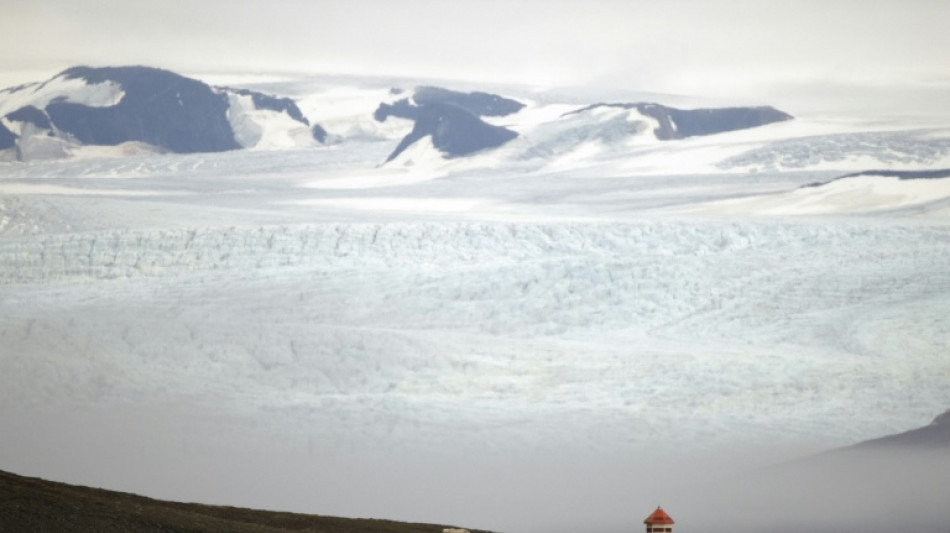
Arctic warming spurs growth of carbon-soaking peatlands / Photo: Olivier MORIN - AFP/File

 Drone owners rush to offload devices ahead of Beijing ban

 Trump's beef policies irk Texas ranchers, testing their loyalty

 Nvidia, OpenAI CEOs to attend Xi dinner at White House

 Anthropic picks Accenture for in-house AI safety evaluation

 Balogun returns as Monaco beat Lens to continue strong Ligue 1 start

 'Pause' on overt repression in Venezuela, but reforms still needed: HRW

 Global stocks mixed as yen falls despite Bank of Japan rate hike

 Cuba hit with seventh major blackout of the year

 Murray out with concussion so Wentz will start for Vikings

 UN chief 'deeply regrets' US visa refusal to Abbas for annual meeting

 England quick Carse to face no charges over alleged nightclub assault

 Mancini brings nine newcomers into the first squad of his Italy comeback

 Czechs level Davis Cup tie against USA as South Korea eye Finals

 New France boss Zidane confirms Mbappe as captain after naming first squad

 California governor signs order to explore AI 'kill switch'

 Head leads run spree as Australia win Zimbabwe ODI series

 In-form Raphinha wants to finish career at Barcelona

 Warren Buffett steps down as Berkshire Hathaway chairman

 Carrick confident Man Utd can 'work through' tough time

 Mbappe ends Nike partnership to join Swiss brand On

 Liverpool boss Iraola puts Bournemouth love affair on hold

 'A disaster' if Man City do not win says Maresca after flawless start

 Kerry James Marshall: American 'blackness' painter celebrated in Europe

 Spain coach De la Fuente offers 'full support' to people of Ceuta

 Russia seizes assets of Nestle, French firms over West's Ukraine support

Arctic peatlands are expanding as the climate warms, new research showed Thursday, a change that could slow global heating in the near term but have the opposite effect in future.
Peatlands are the largest terrestrial store of carbon, locking away twice as much heat-trapping CO2 from the atmosphere in their waterlogged soils as all the world's forests.
These carbon-rich reservoirs, composed of partially decayed organic matter, only cover three percent of Earth's surface, and generally fade out in the far north where harsh weather limits plant growth.
But warmer temperatures caused by climate change have improved growing conditions for plants in the Arctic, and satellite data has shown a general "greening" of this frosty region.
Using drones, satellite imagery and on-the-ground observations, an international team of scientists assessed peatlands in the European and Canadian Arctic to see if they had benefited from warmer climes.
They found strong evidence that peatlands "have likely undergone lateral expansion over the last 40 years" in the Arctic, which is the fastest warming region on Earth.
"The permafrost thaws a little, provides a water source for vegetation, and surface vegetation recovers. In this study, we specifically see a lateral expansion," Michelle Garneau, a professor at the University of Quebec in Montreal, and co-author of the study, told AFP.
The most marked change was observed where summer temperatures have risen the most, such as in the Norwegian archipelago of Svalbard.
"All these new vegetated surfaces that didn't exist three decades ago are currently actively absorbing carbon," Garneau added.
This suggests Arctic peatlands "are an increasingly important natural carbon sink, at least in the near term", said study co-author Karen Anderson, a professor from the University of Exeter, which led the research.
But how they respond to climate change in future is "still highly uncertain", said the study published in the peer-reviewed journal Communications Earth and Environment.
Recent modelling suggests that northern peatlands "may become a carbon source from mid-century" as they dry out and permafrost thaws, the study said.
They are also at risk from wildfires, which release masses of stored up carbon at once.
"If temperatures continue to rise, we are likely to see changes in rainfall, and we are not sure how sustainable new or existing peatlands will be," said Anderson.
More peatlands also means more natural emissions of methane, a potent greenhouse gas far more effective at trapping heat than CO2.
"So while our study gives us some positive news, it does not detract from the urgent need to reduce greenhouse gas emissions and stabilise our climate," said Anderson.
S.Pimentel--PC