Rock on: how crushed stone could help fight climate change / Photo: STR - AFP

 Drone owners rush to offload devices ahead of Beijing ban

 Trump's beef policies irk Texas ranchers, testing their loyalty

 Nvidia, OpenAI CEOs to attend Xi dinner at White House

 Anthropic picks Accenture for in-house AI safety evaluation

 Balogun returns as Monaco beat Lens to continue strong Ligue 1 start

 'Pause' on overt repression in Venezuela, but reforms still needed: HRW

 Global stocks mixed as yen falls despite Bank of Japan rate hike

 Cuba hit with seventh major blackout of the year

 Murray out with concussion so Wentz will start for Vikings

 UN chief 'deeply regrets' US visa refusal to Abbas for annual meeting

 England quick Carse to face no charges over alleged nightclub assault

 Mancini brings nine newcomers into the first squad of his Italy comeback

 Czechs level Davis Cup tie against USA as South Korea eye Finals

 New France boss Zidane confirms Mbappe as captain after naming first squad

 California governor signs order to explore AI 'kill switch'

 Head leads run spree as Australia win Zimbabwe ODI series

 In-form Raphinha wants to finish career at Barcelona

 Warren Buffett steps down as Berkshire Hathaway chairman

 Carrick confident Man Utd can 'work through' tough time

 Mbappe ends Nike partnership to join Swiss brand On

 Liverpool boss Iraola puts Bournemouth love affair on hold

 'A disaster' if Man City do not win says Maresca after flawless start

 Kerry James Marshall: American 'blackness' painter celebrated in Europe

 Spain coach De la Fuente offers 'full support' to people of Ceuta

 Russia seizes assets of Nestle, French firms over West's Ukraine support

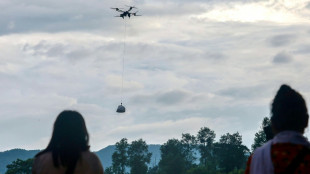
From sugar plantations in Brazil to tea estates in India, crushed rock is being sprinkled across large stretches of farmland globally in a novel bid to combat climate change.
The technique is called Enhanced Rock Weathering (ERW) and aims to speed up the natural capture and storage of carbon dioxide -- a planet-warming greenhouse gas.
It is potentially big business with tech giants, airlines and fast fashion firms lining up to buy carbon credits from ERW projects to "offset" or cancel out their own emissions.
- What is ERW? -
ERW aims to turbocharge a natural geological process called weathering.
Weathering is the breakdown of rocks by carbonic acid, which forms when carbon dioxide in the air or soil dissolves into water.
Weathering occurs naturally when rain falls on rocks, and the process can lock away carbon dioxide from the air or soil as bicarbonate, and eventually limestone.
ERW speeds the process up by using quick-weathering rocks like basalt that are ground finely to increase their surface area.
- How effective is ERW? -
ERW is still a fairly new technology and there are questions about how much carbon it can remove.
One US study found applying 50 tonnes of basalt to a hectare of land each year could remove up to 10.5 tonnes of carbon dioxide per hectare over a four-year period.
But scientists applying basalt to oil palm fields in Malaysia and sugarcane fields in Australia measured much lower removal rates.
"Field trials are showing that there have been overestimates of the amount and rate captured," said Paul Nelson, a soil scientist at James Cook University who has studied ERW.
Rates depend on variables including rock type and size, how wet and hot the climate is, soil type and land management.
And measuring the carbon captured is difficult.
The most popular technique measures "cations", positively charged ions that are released from the rock during weathering.
But those cations are produced regardless of which acid the rock has reacted with.
"If there are stronger acids than carbonic, then it will react with those," said Nelson, so measurable cations are produced even when carbon dioxide is not captured.
That doesn't mean ERW is pointless, said Wolfram Buss, a researcher on carbon dioxide removal at the Australian National University, just that it needs to be carefully calibrated and measured.
"There is no doubt that this technique works," he said.
"However, to be sure how much carbon dioxide we actually remove, more funding is required to do fundamental studies."
- Are there other benefits? -
The added rock increases soil alkalinity, which can boost crop growth, soil nutrients and soil formation.
Basalt is both naturally abundant and often available as a byproduct of quarrying, lowering the costs of the process.
Experts note that even if the rock reacts with other acids in the soil, failing to lock away carbon dioxide at that stage, it can still have planetary benefits.
That is because acids in the soil would otherwise eventually wash into rivers and the sea, where acidification leads to the release of carbon dioxide.
If the rock neutralises that acid in the soil, "you've prevented carbon dioxide being released from the water into the atmosphere downstream", said Nelson.
The scale of those possible "prevented" emissions is not yet clear, however.
- What are the risks? -
ERW is broadly considered safe since it merely speeds up an existing natural process. However, some quick-weathering rocks have high levels of potentially poisonous heavy metals.
Scattering finely ground rock also requires appropriate protective gear for those involved.
But the main risk is that incorrect measurements overestimate captured carbon.
Some projects are already selling carbon credits from ERW. If a company buys an ERW credit to "offset" its emissions but the process captures less than projected, it could result in net higher carbon dioxide put into the atmosphere.
- Where is ERW being done? -
Projects are happening in most parts of the world, including Europe, North America, Latin America and Asia.
Earlier this year, a project in Brazil announced it had delivered the first-ever verified carbon-removal credits from an ERW project.
The process is being used or trialled in agricultural settings from tea plantations in India's Darjeeling to US soy and maize fields.
- What investor interest is there? -
An ERW startup -- Mati Carbon, working in India -- won the $50 million X Prize for carbon removal projects earlier this year.
In December, Google announced what was then the world's biggest ERW deal, for 200,000 tons of carbon removal credits, to be delivered by the early 2030s by startup Terradot.
The cost of the deal was not disclosed but a separate agreement by Terradot with a company representing firms including H&M sold 90,000 tons for $27 million.
H.Silva--PC