EU unveils long-delayed 2040 climate target -- with wiggle room / Photo: Thibaud MORITZ - AFP

 Drone owners rush to offload devices ahead of Beijing ban

 Trump's beef policies irk Texas ranchers, testing their loyalty

 Nvidia, OpenAI CEOs to attend Xi dinner at White House

 Anthropic picks Accenture for in-house AI safety evaluation

 Balogun returns as Monaco beat Lens to continue strong Ligue 1 start

 'Pause' on overt repression in Venezuela, but reforms still needed: HRW

 Global stocks mixed as yen falls despite Bank of Japan rate hike

 Cuba hit with seventh major blackout of the year

 Murray out with concussion so Wentz will start for Vikings

 UN chief 'deeply regrets' US visa refusal to Abbas for annual meeting

 England quick Carse to face no charges over alleged nightclub assault

 Mancini brings nine newcomers into the first squad of his Italy comeback

 Czechs level Davis Cup tie against USA as South Korea eye Finals

 New France boss Zidane confirms Mbappe as captain after naming first squad

 California governor signs order to explore AI 'kill switch'

 Head leads run spree as Australia win Zimbabwe ODI series

 In-form Raphinha wants to finish career at Barcelona

 Warren Buffett steps down as Berkshire Hathaway chairman

 Carrick confident Man Utd can 'work through' tough time

 Mbappe ends Nike partnership to join Swiss brand On

 Liverpool boss Iraola puts Bournemouth love affair on hold

 'A disaster' if Man City do not win says Maresca after flawless start

 Kerry James Marshall: American 'blackness' painter celebrated in Europe

 Spain coach De la Fuente offers 'full support' to people of Ceuta

 Russia seizes assets of Nestle, French firms over West's Ukraine support

The EU on Wednesday unveiled its long-delayed target for cutting greenhouse gas emissions by 2040, but with contested new flexibilities built in to win over the most sceptical member states.
After months of tough negotiations with EU states, Brussels announced it would stick to the objective announced last year of cutting emissions by 90 percent by 2040, compared to 1990 levels.
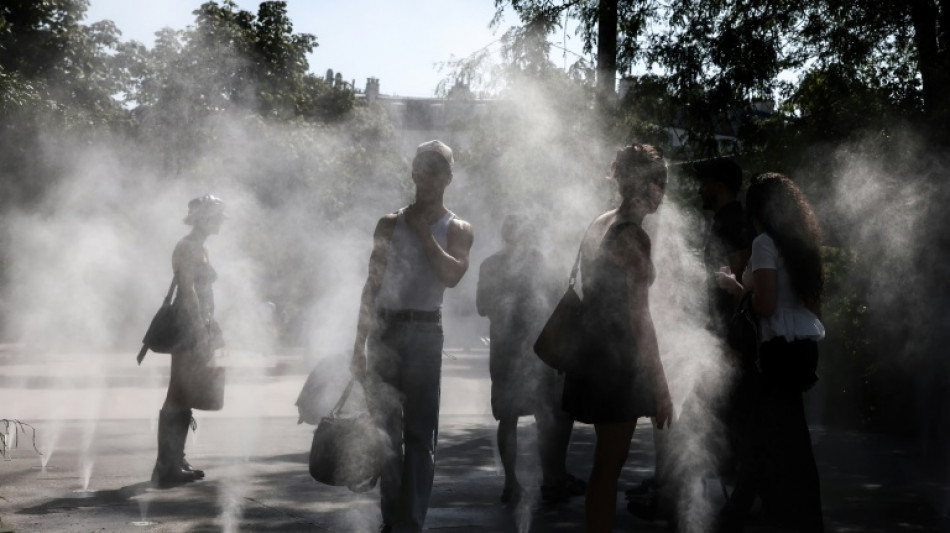
The proposal comes as much of Europe roasts in an early summer heatwave, which scientists say are becoming more intense, frequent and widespread due to human-induced climate change.
The 2040 target -- which needs the sign off from the European Union's member states and parliament -- is a key milestone towards the bloc's goal of becoming carbon neutral by 2050.
Brussels says the EU has cut climate-warming emissions by 37 percent relative to 1990 but its green agenda faces mounting pushback with a rightward shift and rising climate scepticism in many European countries.
EU climate chief Wopke Hoekstra acknowledged the "sensitive" debate, saying Brussels was keeping an "ambitious" goal while being "pragmatic and flexible on how to achieve it".
To sway resistant capitals, the European Commission proposes that from 2036, the bloc's 27 countries can count carbon credits purchased to finance projects outside Europe, for up to three percent of their emission cuts.
Climate groups are fiercely opposed to such a measure.
Backed by scientific studies and the commission's own science advisers, they say factoring in international credits -- for things like tree-planting or renewable-energy projects -- risks undermining the EU's own efforts to shift away from fossil fuels.
"Three percent is not insignificant. These are potentially considerable sums that will be spent abroad instead of financing the transition" in Europe, said Neil Makaroff, an expert at the climate-focused Strategic Perspectives think tank.
"But there's a political compromise to be found," he said. "The challenge will be for the EU to establish a standard so that these international credits truly help cut emissions and not leave individual states to their own devices."
- 'Don't strain ourselves' -
EU environment ministers will discuss the objective at a meeting in mid-July, ahead of an expected vote to approve the measures on September 18.
It will only become law after EU lawmakers also sign off on the target.
The commission's hope is that the 2040 objective will be approved before the UN climate conference (COP30) in November in the northern Brazilian city of Belem.
But that gives little time for negotiations with sceptical nations, with whom Hoekstra has already spent months trying to build a compromise.
For some states, including the Czech Republic, the 90-percent target is unrealistic.
Meanwhile, others including Italy and Hungary worry about the burden of decarbonising heavy industry at a time when Europe is working to strengthen its industry in the face of fierce competition from the United States and China.
Italian Prime Minister Giorgia Meloni has suggested a target of 80 or 85 percent, while France has expressed doubts over how the EU will reach its objective.
French President Emmanuel Macron wants guarantees for the decarbonisation of industry and support for nuclear energy, the largest source of power in France.
But the commission can count on the support of other countries including Spain and Denmark, which took over the rotating EU presidency this week.
And the three-percent "flexibility" -- which mirrors demands made in the new German government's coalition agreement -- should help keep the economic powerhouse on board.
When it comes to Europe's international commitments, Macron has also stressed that the bloc is only bound to present a midway target for 2035 at COP30 in Belem, and not the 2040 objective.
"Let's not strain ourselves," Macron told reporters last week. "If we have (a 2040 target) for Belem, great, but if it takes longer, let's take the time," he said.
R.J.Fidalgo--PC