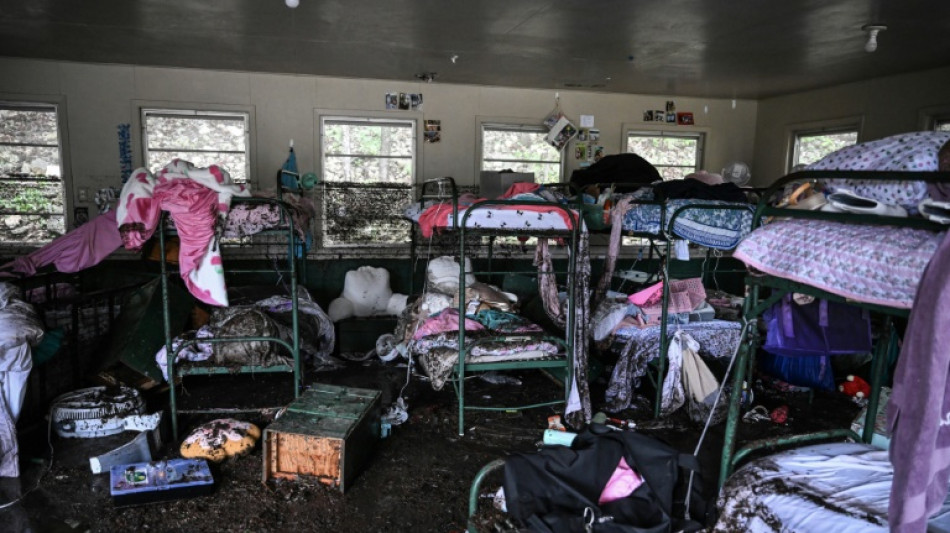
Texas floods: How geography, climate and policy failures collided / Photo: RONALDO SCHEMIDT - AFP/File

 Drone owners rush to offload devices ahead of Beijing ban

 Trump's beef policies irk Texas ranchers, testing their loyalty

 Nvidia, OpenAI CEOs to attend Xi dinner at White House

 Anthropic picks Accenture for in-house AI safety evaluation

 Balogun returns as Monaco beat Lens to continue strong Ligue 1 start

 'Pause' on overt repression in Venezuela, but reforms still needed: HRW

 Global stocks mixed as yen falls despite Bank of Japan rate hike

 Cuba hit with seventh major blackout of the year

 Murray out with concussion so Wentz will start for Vikings

 UN chief 'deeply regrets' US visa refusal to Abbas for annual meeting

 England quick Carse to face no charges over alleged nightclub assault

 Mancini brings nine newcomers into the first squad of his Italy comeback

 Czechs level Davis Cup tie against USA as South Korea eye Finals

 New France boss Zidane confirms Mbappe as captain after naming first squad

 California governor signs order to explore AI 'kill switch'

 Head leads run spree as Australia win Zimbabwe ODI series

 In-form Raphinha wants to finish career at Barcelona

 Warren Buffett steps down as Berkshire Hathaway chairman

 Carrick confident Man Utd can 'work through' tough time

 Mbappe ends Nike partnership to join Swiss brand On

 Liverpool boss Iraola puts Bournemouth love affair on hold

 'A disaster' if Man City do not win says Maresca after flawless start

 Kerry James Marshall: American 'blackness' painter celebrated in Europe

 Spain coach De la Fuente offers 'full support' to people of Ceuta

 Russia seizes assets of Nestle, French firms over West's Ukraine support

"There's no such thing as a natural disaster," geographers like to say -- a reminder that human choices turn hazards into tragedies.
The Texas flash floods this weekend that left scores dead, including many children, offer a stark illustration.
Here is a look at the intertwined forces that amplified this storm's impact.
- 'Flash Flood Alley' -
Texas's Hill Country sits in an area known as "Flash Flood Alley," explains Hatim Sharif, a hydrologist at the University of Texas at San Antonio.
Warm Gulf air rushes up the Balcones Escarpment -- a line of steep hills and cliffs that arcs southwest down from near Dallas -- cools, and dumps torrents onto thin soils that quickly give way to bedrock.
Runoff then funnels through a dense web of creeks.
"Water will rise very, very quickly, within minutes or a few hours," Sharif told AFP.
The early hours of July 4 proved that.
Around 3:00 am, a gauge near Camp Mystic in Hunt showed the Guadalupe River rising nearly a foot (30 centimeters) every five minutes; by 4:30 am the river had surged more than 20 feet, National Weather Service data show.
That's enough water to sweep away people, vehicles and buildings.
An urgent NWS warning went out shortly after 1:00 am, but most campers were asleep; phones are banned, coverage is patchy, and darkness makes escape routes hard to judge.
Sharif urges the use of hydrologic forecasts that convert rainfall into likely river levels.
"Rainfall needs to be translated into runoff," he said. "If you have 10 inches, what will happen?"
Summer camps have long been drawn to the region for its natural beauty. But with increasing risks, Sharif warns that treating these sites as safe or permanent is unwise.
- 'We need to adapt' -
A warmer atmosphere holds more moisture, loading the dice for heavier downpours.
A new analysis by ClimaMeter finds that the meteorological conditions preceding the floods, which delivered more than twice the monthly average rainfall in a single day, could not be explained by natural variability alone.
"Climate change is already affecting us, so we need to adapt," said Mireia Ginesta, a climate scientist at the University of Oxford who co-authored the research, which is funded by the European Union and the French National Centre for Scientific Research (CNRS).
"We also need to cut our emissions, and make sure that proper funding is provided to the forecast services and research in general on climate change."
The call comes as the National Weather Service, like other agencies, has experienced deep staffing cuts under President Donald Trump's administration.
Experts stress, however, that NWS forecasters performed admirably under the circumstances.
The real failure, wrote climate scientist Daniel Swain on Bluesky, "was not a bad weather prediction, it was one of 'last mile' forecast/warning dissemination."
- No warning system -
For years, commissioners in Kerr County, where the camps lie, considered flood sirens and digital alerts to replace the informal practice of summer camp staff getting on the radio and warning fellow camps.
Minutes from a 2016 meeting show officials labeling even a feasibility study "a little extravagant," suggesting sirens would mainly help tourists, and vouching for the word-of-mouth system.
The debate rolled on. In 2021, commissioners again balked, this time wary of federal funds tied to the Biden administration that they opposed politically.
After the disaster, San Antonio mother Nicole Wilson -- who almost sent her daughters to Camp Mystic -- launched a petition on Change.org urging Governor Greg Abbott to approve a modern warning network.
"Five minutes of that siren going off could have saved every single one of those children," she told AFP.
A.Aguiar--PC