UK breaches 40C for first time as heatwave batters Europe / Photo: Philippe LOPEZ - POOL/AFP

 Trump's beef policies irk Texas ranchers, testing their loyalty

 Nvidia, OpenAI CEOs to attend Xi dinner at White House

 Anthropic picks Accenture for in-house AI safety evaluation

 Balogun returns as Monaco beat Lens to continue strong Ligue 1 start

 'Pause' on overt repression in Venezuela, but reforms still needed: HRW

 Global stocks mixed as yen falls despite Bank of Japan rate hike

 Cuba hit with seventh major blackout of the year

 Murray out with concussion so Wentz will start for Vikings

 UN chief 'deeply regrets' US visa refusal to Abbas for annual meeting

 England quick Carse to face no charges over alleged nightclub assault

 Mancini brings nine newcomers into the first squad of his Italy comeback

 Czechs level Davis Cup tie against USA as South Korea eye Finals

 New France boss Zidane confirms Mbappe as captain after naming first squad

 California governor signs order to explore AI 'kill switch'

 Head leads run spree as Australia win Zimbabwe ODI series

 In-form Raphinha wants to finish career at Barcelona

 Warren Buffett steps down as Berkshire Hathaway chairman

 Carrick confident Man Utd can 'work through' tough time

 Mbappe ends Nike partnership to join Swiss brand On

 Liverpool boss Iraola puts Bournemouth love affair on hold

 'A disaster' if Man City do not win says Maresca after flawless start

 Kerry James Marshall: American 'blackness' painter celebrated in Europe

 Spain coach De la Fuente offers 'full support' to people of Ceuta

 Russia seizes assets of Nestle, French firms over West's Ukraine support

 England can build on World Cup 'spirit', says Tuchel

A fierce heatwave left western Europe sweltering on Tuesday, fuelling ferocious wildfires and stretching emergency services, as it swept north and pushed temperatures in Britain over 40 degrees Celsius (104 degrees Fahrenheit) for the first time.
After the UK's warmest night on record, the Met Office said 40.2C had been provisionally recorded by lunchtime at Heathrow Airport, in west London, taking the country into uncharted territory.
Britain's previous all-time temperature record of 38.7C, set in Cambridge in eastern England in 2019, had already been smashed earlier Tuesday.
"For the first time ever, 40 Celsius has provisionally been exceeded in the UK," the Met Office meteorological agency said, warning "temperatures are still climbing in many places".
Experts blame climate change for the latest heatwave and note the more frequent extreme weather will only worsen in years to come.
The high temperatures have triggered an unprecedented red alert for extreme heat in much of England, where some rail lines were closed as a precaution and schools shuttered in some areas.
All trains were cancelled from London's usually busy Kings Cross station, leaving many travellers stranded.
"It's a little frustrating," said American tourist Deborah Byrne, trying to reach Scotland.
But with road surfaces and runways melting and rails buckling, Transport Secretary Grant Shapps conceded much of Britain's infrastructure "is just not built for this temperature".
Tim Wainwright, chief executive of the charity WaterAid, said the situation should be "the wake-up call the world needs to stop climate change from claiming any more lives".
- Wildfires -
In France, towns and cities in the country's west registered their highest-ever temperatures Monday, the national weather office said.
The western region of Brittany -- normally cool and often wet in summer -- set new record highs Monday above 40C.
Despite cooler air from the Atlantic offering some respite there Tuesday, dozens of departments remained on orange alert, with temperatures still expected to top 40C in the east and south and violent thunderstorms forecast locally.
The heatwave -- the second to engulf parts of Europe in recent weeks -- has contributed to deadly wildfires in France, Greece, Portugal and Spain, destroying vast tracts of land.
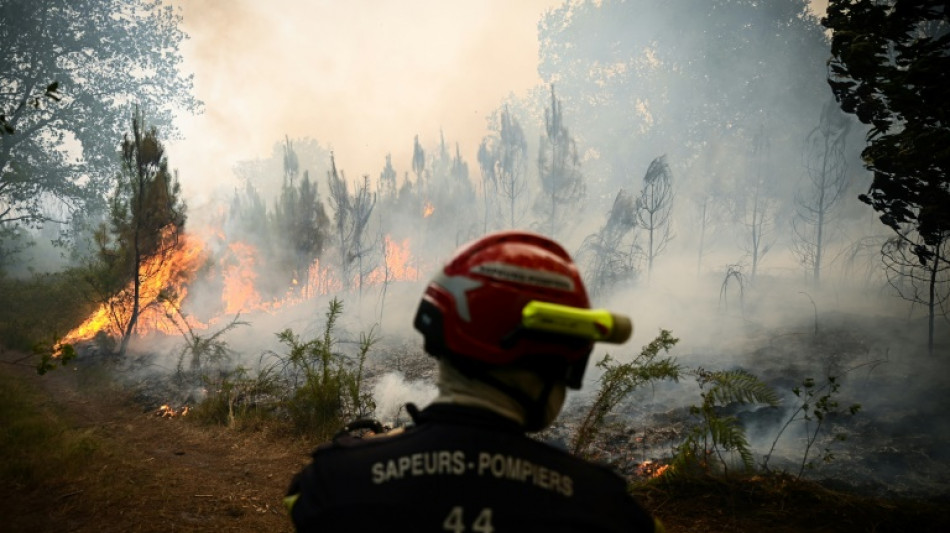
Firefighters in France's southwest were still struggling to contain two massive fires that have caused widespread destruction and forced tens of thousands of people to leave their homes.
Nearly 1,700 firefighters from all over the country, supported by significant air resources, are battling the two blazes that have so far burned more than 19,000 hectares (42,000 acres) of forest.
"It's heartbreaking," said Patrick Davet, mayor of La Teste-de-Buch, the site of one inferno which has prompted mass evacuations.
"Economically, it's going to be very difficult for them and very difficult for the town because we are a tourist town, and we need the (tourist) season."
In Brittany's Finistere region, hundreds of firefighters, specialised vehicles and waterbombing aircraft were tackling blazes.
- Deaths -
In Spain -- nearly 10 days into the latest heatwave -- more than a dozen fires continued to rage Tuesday, including in the northwest province of Zamora, which already experienced a huge fire last month.
Known as one of the largest wolf reserves in Europe, it saw nearly 30,000 hectares of land reduced to ashes during the June blaze.
Nearly 6,000 people had to be evacuated from there this week after flames destroyed several thousand hectares of meadows and forests, regional authorities said.
Rail traffic between Madrid and Galicia, in the northwest, remained suspended after fires on either side of the tracks.
Several people have died in recent days due to the blazes while separately, an office worker in his 50s died from heatstroke in Madrid.
In Portugal, more than 1,400 firefighters were fighting fires in the centre and north of the country, despite a clear drop in temperatures in recent days.
A couple in their 70s died Monday after they ran off the road while trying to escape the flames in their car.
Almost the entire country has been on high alert for wildfires despite a slight drop in temperatures, which last Thursday hit 47C -- a record for July.
The fires have already killed two other people, injured around 60 and destroyed between 12,000 and 15,000 hectares of land there.
- Heat -
Elsewhere, temperatures could locally exceed 40C in Belgium near the French border, prompting the Royal Meteorological Institute to issue its highest alert level.
Big state-run museums, primarily in Brussels, took the unusual step of offering free access Tuesday to over-65s to help them stay cool.
In Germany, temperatures were expected to reach up to 40C in the west.
On Monday, two firefighters were injured while beating back a forest fire in a mountainous area in Saxony state.
The hot summer so far has raised fears of drought, with the German Farmers' Association president warning of "major losses" in food production.
Henning Christ, who grows wheat and other crops in Brandenburg state, told AFP his farm was 20 percent below its average annual yield.
"We've had almost no rain for months, coupled with high temperatures," he said.
burs-jj/phz/bp
X.M.Francisco--PC