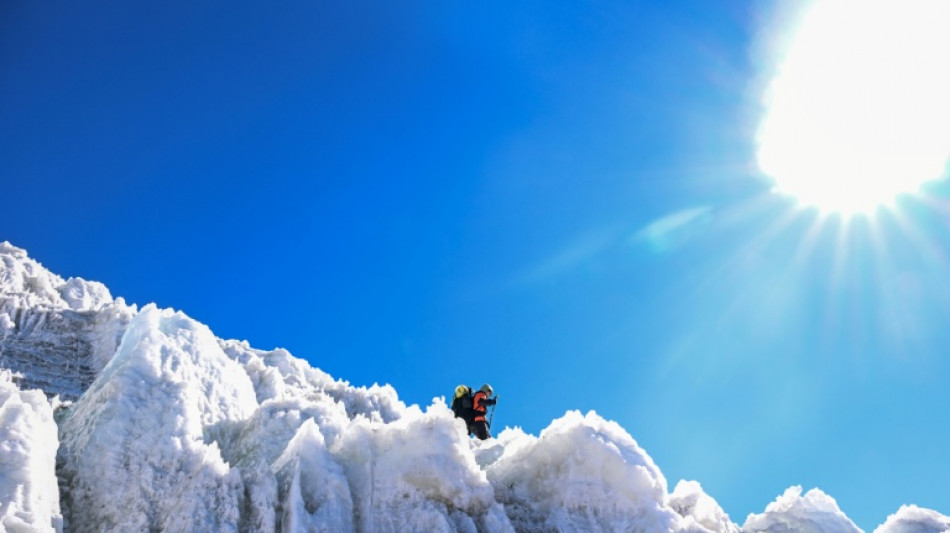
World-first ice archive to guard secrets of melting glaciers / Photo: Prakash MATHEMA - AFP

 Trump's beef policies irk Texas ranchers, testing their loyalty

 Nvidia, OpenAI CEOs to attend Xi dinner at White House

 Anthropic picks Accenture for in-house AI safety evaluation

 Balogun returns as Monaco beat Lens to continue strong Ligue 1 start

 'Pause' on overt repression in Venezuela, but reforms still needed: HRW

 Global stocks mixed as yen falls despite Bank of Japan rate hike

 Cuba hit with seventh major blackout of the year

 Murray out with concussion so Wentz will start for Vikings

 UN chief 'deeply regrets' US visa refusal to Abbas for annual meeting

 England quick Carse to face no charges over alleged nightclub assault

 Mancini brings nine newcomers into the first squad of his Italy comeback

 Czechs level Davis Cup tie against USA as South Korea eye Finals

 New France boss Zidane confirms Mbappe as captain after naming first squad

 California governor signs order to explore AI 'kill switch'

 Head leads run spree as Australia win Zimbabwe ODI series

 In-form Raphinha wants to finish career at Barcelona

 Warren Buffett steps down as Berkshire Hathaway chairman

 Carrick confident Man Utd can 'work through' tough time

 Mbappe ends Nike partnership to join Swiss brand On

 Liverpool boss Iraola puts Bournemouth love affair on hold

 'A disaster' if Man City do not win says Maresca after flawless start

 Kerry James Marshall: American 'blackness' painter celebrated in Europe

 Spain coach De la Fuente offers 'full support' to people of Ceuta

 Russia seizes assets of Nestle, French firms over West's Ukraine support
 England can build on World Cup 'spirit', says Tuchel

Scientists on Wednesday sealed ancient chunks of glacial ice in a first-of-its-kind sanctuary in Antarctica in the hope of preserving these fast-disappearing records of Earth's past climate for centuries to come.
The two ice cores taken from Europe's Alps are the first to be stored in a purpose-built snow cave on the frozen continent that one day should house an invaluable archive from across the globe.
Hosted at Concordia Station at 3,200 metres (10,500 feet) altitude in the heart of Antarctica, the ice sanctuary will protect the collection in natural cold storage at minus 52C without any need for refrigeration.
Ice cores shed precious light on climate conditions of millennia past, and these samples could help scientists of the future unlock their mysteries long after the glaciers themselves have melted away.
"To safeguard what would be otherwise irreversibly lost... is an endeavour for humanity," said Thomas Stocker, a Swiss climate scientist and chair of the Ice Memory Foundation, which spearheaded the initiative.
The ambitious project was nearly a decade in the making, and posed not just logistical but unprecedented diplomatic challenges.
The sanctuary is really a cave, 35 metres long and five metres high and wide, dug roughly 10 metres below the surface into compact snow where freezing temperatures are constant.
In clear but freezing conditions at Concordia, roughly 1,000 kilometres (620 miles) from the coastline, scientists cut a blue ribbon as the final boxes containing core samples from Mont Blanc and Grand Combine were placed into the icy vault.
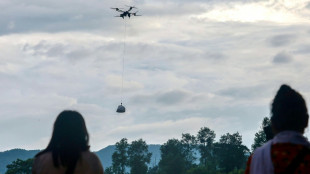
In the decades to come, scientists intend to stock the archive with glacial ice from alpine regions such as the Andes, Himalayas and Tajikistan, where AFP witnessed the extraction of a 105-metre core in September.
- Invisible secrets -
Drilled from deep within mountain glaciers, ice cores are compacted slowly over time and contain dust and other climatic indicators that can tell stories about ancient weather conditions.
A layer of clear ice indicates a warm period when the glacier melted and then refroze, while a low-density layer suggests packed snow, rather than ice, which can help estimate precipitation.
Brittle samples with cracks, meanwhile, indicate snowfall on half-melted layers that then refroze.
And other clues can reveal more information -- volcanic materials like sulfate ions can serve as time markers, while water isotopes can reveal temperatures.
But their real value "lies in the future", said Carlo Barbante, an Italian climate scientist and vice-chair of the Ice Memory Foundation.
"Scientists will use technologies that we cannot even imagine today, and they will extract secrets from the ice that are currently invisible to us," he said.
But these fragile records are rapidly disappearing as the planet warms and scientists warn that thousands of glaciers will vanish every year in the coming decades.
On Wednesday, US and European climate monitors confirmed that 2025 was the third hottest year on record, extending a run of unprecedented heat driven largely by humanity's burning of fossil fuels.
"We are in a race against time to rescue this heritage before it will vanish forever," said Barbante.
- Global good -
Apart from environmental considerations, the sanctuary's location is supposed to ensure the neutral status of the ice cores so they are free from political interference and open to all.
The sanctuary is hosted at the French-Italian research station on land governed by a global treaty, and access in the future should be granted solely on scientific merit.
But these questions were "delicate" because there was no legal framework at present to govern such a venture, the foundation's director Anne-Catherine Ohlmann told AFP before the sanctuary was inaugurated.
It was crucial "this heritage is governed so these ice cores will be available in a few decades, perhaps even a few centuries, for the right beneficiaries for the right reasons for humanity", she said.
M.A.Vaz--PC