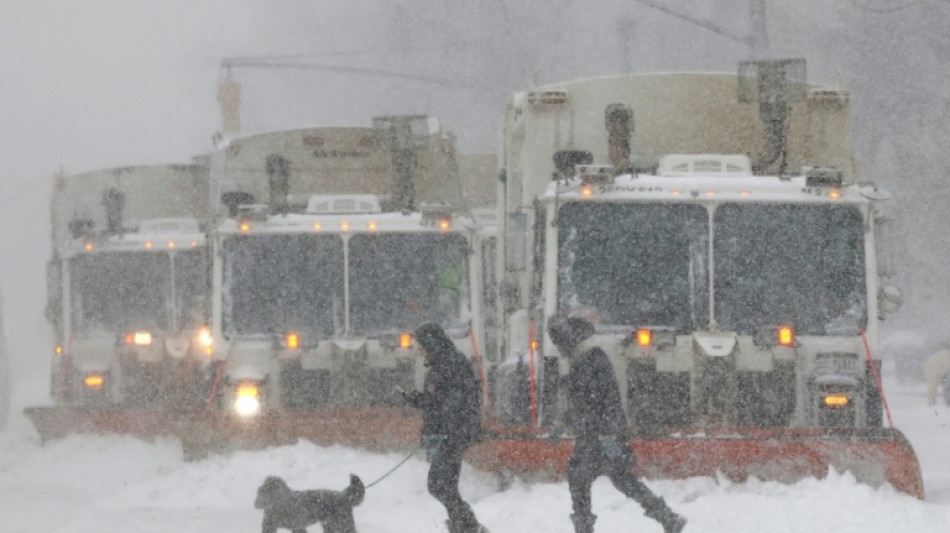
Bitter cold grips millions as US digs out of sweeping snowstorm / Photo: TIMOTHY A. CLARY - AFP

 Trump's beef policies irk Texas ranchers, testing their loyalty

 Nvidia, OpenAI CEOs to attend Xi dinner at White House

 Anthropic picks Accenture for in-house AI safety evaluation

 Balogun returns as Monaco beat Lens to continue strong Ligue 1 start

 'Pause' on overt repression in Venezuela, but reforms still needed: HRW

 Global stocks mixed as yen falls despite Bank of Japan rate hike

 Cuba hit with seventh major blackout of the year

 Murray out with concussion so Wentz will start for Vikings

 UN chief 'deeply regrets' US visa refusal to Abbas for annual meeting

 England quick Carse to face no charges over alleged nightclub assault

 Mancini brings nine newcomers into the first squad of his Italy comeback

 Czechs level Davis Cup tie against USA as South Korea eye Finals

 New France boss Zidane confirms Mbappe as captain after naming first squad

 California governor signs order to explore AI 'kill switch'

 Head leads run spree as Australia win Zimbabwe ODI series

 In-form Raphinha wants to finish career at Barcelona

 Warren Buffett steps down as Berkshire Hathaway chairman

 Carrick confident Man Utd can 'work through' tough time

 Mbappe ends Nike partnership to join Swiss brand On

 Liverpool boss Iraola puts Bournemouth love affair on hold

 'A disaster' if Man City do not win says Maresca after flawless start

 Kerry James Marshall: American 'blackness' painter celebrated in Europe

 Spain coach De la Fuente offers 'full support' to people of Ceuta

 Russia seizes assets of Nestle, French firms over West's Ukraine support

 England can build on World Cup 'spirit', says Tuchel

Millions of Americans were facing dangerously cold temperatures Monday in the wake of a massive winter storm that whipped snow and ice across the country, knocking out power and paralyzing transportation.
A frigid, potentially life-threatening Arctic air mass threatened to delay clean-up as municipalities from New Mexico to Maine tried to dig out following the storm, which dropped a vicious cocktail of heavy snow and wind along with freezing rain and sleet.
Over 780,000 customers remained without electricity, the Poweroutage.com tracking site showed.
Tennessee, Texas, Mississippi and Louisiana -- southern states unaccustomed to intense winter weather and the bone-chilling cold that's forecast to continue for much of the next week -- were especially impacted.
Approximately 190 million people in the United States were under some form of extreme cold alert, the National Weather Service (NWS) told AFP.
Areas across 20 states received at least a foot of snow (30.5 cm), and in many cases far more. The NWS said New Mexico's Bonito Lake accumulated the highest US total over the weekend with 31 inches (78.7 cm).
New York's Central Park received 11.4 inches (29 cm) -- breaking a same-day snowfall record from 1905.
A compilation of local media reports tallied at least 21 storm-related deaths.
NWS meteorologist Allison Santorelli told AFP the agency was seeing widespread reports of significant ice accumulation, including in places unaccustomed to severe winter weather.
She said this storm recovery was particularly challenging because so many states were impacted -- meaning northern states with more resources were unable to share their equipment and resources with less-prepared southern areas.
"A lot of those locations don't have the means or the resources to clean up after these events," she said. "We're particularly concerned about the folks in those areas that are without power right now."
Dave Radell, an NWS meteorologist based in New York, told AFP that the character of this storm's snow was "very dry" and "fluffy," meaning the wind could lash it around with ease, impeding roadway-clearing efforts and visibility.
"That makes it even more challenging," he said.
- Excruciating cold -
The snowfall and biting icy pellets that pummeled cities saw impassable roads, canceled buses and trains along with grounded flights -- thousands of departures and arrivals were scrapped over the weekend -- as concern turned to the hazardous temperatures set to linger for the better part of a week.
The brutal storm system was the result of a stretched polar vortex, an Arctic region of cold, low-pressure air that normally forms a relatively compact, circular system but sometimes morphs into a more oval shape, sending cold air pouring across North America.
Scientists say the increasing frequency of such disruptions may be linked to climate change, though the debate is not settled and natural variability plays a role.
People in the Great Lakes region woke up to extreme temperatures that could cause frostbite on exposed skin within minutes -- in parts of Minnesota and Wisconsin, the NWS reported early morning temperatures as low as an excruciating -23F (-30.6C).
Forecasted windchills in those areas that make the apparent temperature even more frigid could hit as low as -50F (-45.6C), the weather authority said.
As far south as the Gulf Coast was expected to see freezing temperatures each night into the end of the week.
At least 20 states and the US capital Washington were under states of emergency in order to deploy emergency personnel and resources.
Many cities had opened warming centers for those without shelter or without power to take refuge, and authorities across the country were continuing to encourage residents who could to stay home.
C.Amaral--PC