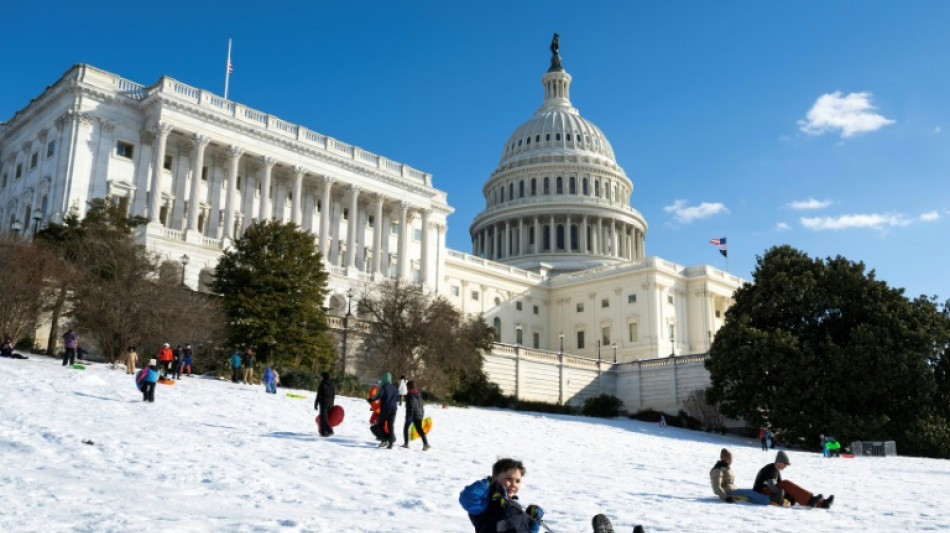
What to know about America's colossal winter storm / Photo: SAUL LOEB - AFP

 Trump's beef policies irk Texas ranchers, testing their loyalty

 Nvidia, OpenAI CEOs to attend Xi dinner at White House

 Anthropic picks Accenture for in-house AI safety evaluation

 Balogun returns as Monaco beat Lens to continue strong Ligue 1 start

 'Pause' on overt repression in Venezuela, but reforms still needed: HRW

 Global stocks mixed as yen falls despite Bank of Japan rate hike

 Cuba hit with seventh major blackout of the year

 Murray out with concussion so Wentz will start for Vikings

 UN chief 'deeply regrets' US visa refusal to Abbas for annual meeting

 England quick Carse to face no charges over alleged nightclub assault

 Mancini brings nine newcomers into the first squad of his Italy comeback

 Czechs level Davis Cup tie against USA as South Korea eye Finals

 New France boss Zidane confirms Mbappe as captain after naming first squad

 California governor signs order to explore AI 'kill switch'

 Head leads run spree as Australia win Zimbabwe ODI series

 In-form Raphinha wants to finish career at Barcelona

 Warren Buffett steps down as Berkshire Hathaway chairman

 Carrick confident Man Utd can 'work through' tough time

 Mbappe ends Nike partnership to join Swiss brand On

 Liverpool boss Iraola puts Bournemouth love affair on hold

 'A disaster' if Man City do not win says Maresca after flawless start

 Kerry James Marshall: American 'blackness' painter celebrated in Europe

 Spain coach De la Fuente offers 'full support' to people of Ceuta

 Russia seizes assets of Nestle, French firms over West's Ukraine support

 England can build on World Cup 'spirit', says Tuchel

A deep freeze is gripping large swaths of the United States after a monster storm killed dozens of people from the Northeast to the Deep South, knocked out power to hundreds of thousands and sent air travel into chaos.
Another Arctic blast expected this weekend could deliver record lows and threaten another major storm -- even as municipalities are digging out from deep piles of snow and ice.
Here's what to know.
- Dozens dead -
The storm was linked to at least 31 deaths, according to a compilation of state government and local media reports, with causes including hypothermia as well as accidents related to traffic, sledding, all-terrain vehicles and snowplows.
That toll is expected to climb after New York Mayor Zohran Mamdani said Tuesday at least 10 New Yorkers had lost their lives after being found outdoors, though whether all the deaths were from hypothermia has yet to be determined.
In Maine, seven people were killed when a small plane crashed while attempting to take off during a snowstorm in Bangor, the Federal Aviation Administration said.
Tennessee, Texas, Mississippi and Louisiana were badly impacted by power outages, with more than 550,000 customers without electricity by midday Tuesday, according to the tracking site Poweroutage.com.
Air travel was also severely disrupted. More than 9,000 flights were canceled on Sunday -- more than on any day since the Covid pandemic -- as the storm paralyzed transportation across the country.
- Heavy snowfall -
The heaviest snowfall of 31 inches occurred in Bonito Falls, New Mexico -- followed by East Napanoch in upstate New York, where 30 inches fell, according to preliminary figures on the National Weather Service's snowfall reports tool.
Many of the hardest-hit areas were in the South, where authorities are less accustomed -- and often less equipped -- to deal with severe winter weather.
- More to come -
The National Weather Service warns that much of the northern half of the country will remain continuously below freezing through February 1, with another blast of arctic air expected to bring "the coldest temperature seen in several years for some places and the longest duration of cold in decades."
At the same time, a potentially significant coastal winter storm could spill out of Canada along the East Coast, spreading widespread precipitation as a low-pressure system collides with frigid air. Forecasters say it is still too early to determine the storm's exact track, or whether it will fall as rain or snow.
- Climate change -
It may sound counterintuitive, but a growing body of research suggests climate change could be playing a role in disruptions to the polar vortex -- a vast region of cold, low-pressure air that normally circulates high above the Arctic.
Scientists advancing this theory argue that uneven Arctic warming across Europe and Asia can amplify large atmospheric waves, making it more likely for the polar vortex to wobble and spill south over North America.
The science, however, remains contested, and researchers caution that natural climate variability also plays a role.
F.Ferraz--PC