Mercedes-Benz Power Converter Enables Individual Cell Control for Improved EV Efficiency

 Search Underway for 'Dooars Rani' Tigress After Second Escape from Buxa Tiger Reserve

 IIM Indore Announces IPMAT 2027 Exam Date for April 24

 The Dilemma of Recording Live Music: Preserving Memories vs. Being Present

 ANC’s Renewal Rhetoric Fades as Voters Reject Party in 2026 Local Elections

 Foreign Investors Return to Indian Markets After 10-Month Selloff

 Honda CR-V and Toyota RAV4 Lead Canada’s Most Stolen Vehicles List for 2025
Mercedes-Benz has introduced a novel power converter system designed to enhance the performance of electric vehicle batteries by managing energy at the individual cell level. By decoupling high-voltage output from the physical battery architecture, the technology aims to extend battery life, improve charging efficiency, and offer manufacturers greater freedom in designing modular powertrain systems.
Mercedes-Benz has announced the development of a new power converter system that fundamentally alters how electric vehicle batteries are managed, promising improvements in driving range and overall energy efficiency. The technology shifts control from the battery pack as a single unit to individual cells within the battery modules.
Traditionally, an electric vehicle’s battery charges and discharges in a linear fashion. When a drive motor requests power or when the vehicle is plugged into a charger, all cells receive the same state of charge simultaneously. This uniform approach can lead to inefficiencies as cells age or vary in capacity.
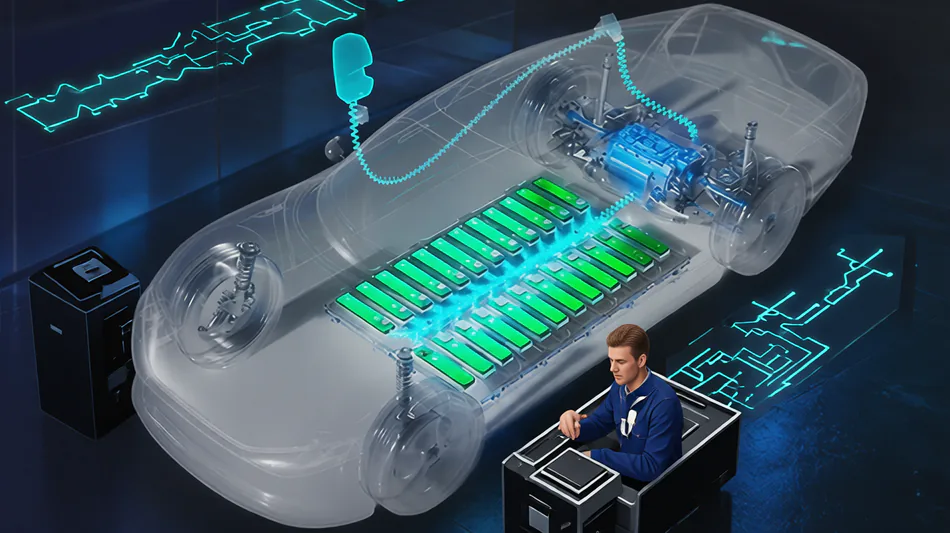
The new Mercedes-Benz system utilizes software-controlled micro-converters to manage each cell individually. This allows the battery to maintain a constant high-voltage output of up to 800 volts, regardless of the individual state of charge or age of specific cells. By treating each cell differently, the system can optimize energy flow more precisely than conventional architectures.
A critical feature of this design is the decoupling of the required high voltage from the battery’s physical structure. In standard setups, the high-voltage output is directly determined by the number of cells connected in series. The new power converter decouples this relationship, allowing power to flow only when and where each cell needs it. This is achieved through advanced software-controlled power electronics that manage decentralized converters.
This granular control offers several potential benefits for electric vehicle development. Mercedes-Benz states that the technology could prolong the lifespan of the battery pack by preventing uneven wear among cells. It also allows for the use of different cell chemistries and voltages within the same pack, providing greater flexibility in battery composition.
Furthermore, the system could enable smaller electric vehicle architectures to deliver performance comparable to larger units. By improving modularization during the assembly process, manufacturers may achieve more compact and efficient powertrain designs.
According to a Mercedes-Benz press release, future vehicle architectures could combine several functions currently handled by separate hardware into a single unit using this technology. "The Power Converter could combine several functions that are currently handled separately into a single hardware unit," the company stated. "The technology therefore creates new freedoms in the design of the battery and powertrain."
The current generation of the system delivers up to 3 kW of power and supports both alternating current (AC) and direct current (DC) applications, as well as bidirectional charging capabilities. This allows for versatile energy management, including the ability to discharge power back to the grid or other devices.
By moving away from the traditional linear charging model, Mercedes-Benz aims to address key challenges in electric vehicle adoption, particularly regarding range anxiety and battery longevity. The individual cell control mechanism represents a shift toward more intelligent, software-defined battery management systems that adapt dynamically to usage patterns rather than relying on static hardware configurations.
A.Seabra--PC