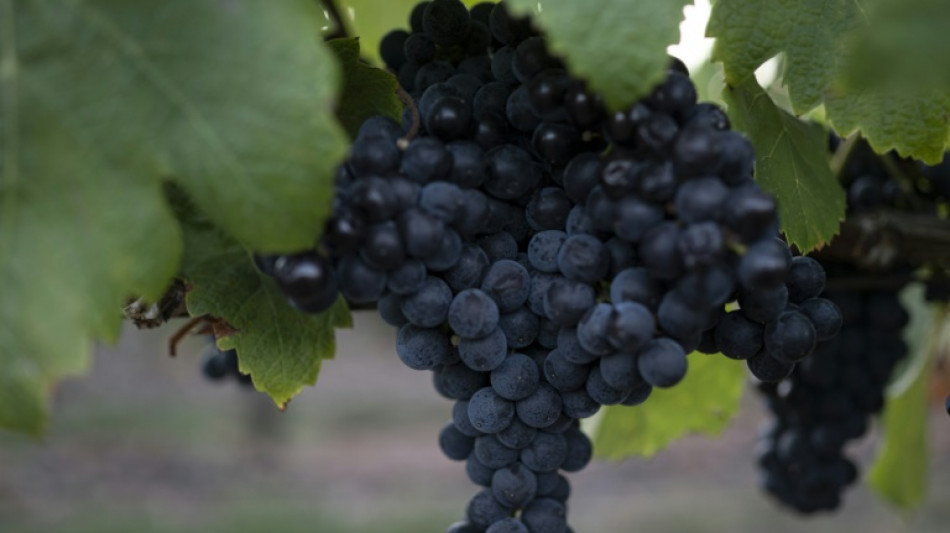
Tannat: Uruguay's 'unlikely' wine hit / Photo: Pablo PORCIUNCULA - AFP

 'New one' Klopp promises fresh approach as Germany reign begins

 Milne returns to New Zealand squad for India T20 series

 US-led Americas coalition backs sanctions against crime groups

 'Star Wars' fans and art lovers line up for new Lucas museum

 Trump renames AI 'super intelligence' as leaders jostle over dangers

 Oil prices retreat as markets welcome US-Iran talks

 US refusing to give Sudan's de facto leader visa for UN: diplomatic sources, UN

 Macron urges world to choose UN over 'law of the jungle'

 All-rounder Jacks stars as England beat Sri Lanka in 1st ODI
 Man City peg back Bayern to start Women's Champions League

 Trump beats 'America first' drum at UN as allies tread carefully

 Snedeker backs Spaun for Ryder Cup after Presidents snub

 French prosecutors probe secret filming of women with smart glasses

 Trump renames AI "super intelligence," rejects international oversight

 Trump rejects international regulation of AI

 How is the EU approaching record fuel prices?

 Sri Lanka's Colombage strikes on debut as England dismissed for 265 in first ODI

 Hurricane Polo strengthens to top category 5 off Mexico

 11 hurt as teen opens fire outside school in western Turkey

 UN chief says 'Big Oil' treats atmosphere as open sewer

 Tunisia says 2026 summer hottest on record

 England's Rashid out of Sri Lanka ODIs with hand injury

 Houthis accuse Saudi Arabia of deadly strikes as thousands flee

 Stocks climb as oil slides, AI buzz returns

 India cricketers win in style as Afghan savours 'special' Games silver

More than 10,000 kilometres (6,000 miles) from its origins in France, a red grape with a reputation for harshness has produced an unlikely hit that thrust the small South American country of Uruguay onto the global wine map.
In a land of gauchos and open-flame grilling, Tannat found a perfect host in Uruguay's mild, humid climate and carnivorous inhabitants.
With more seeds than other grapes, blue-black Tannat is high in astringent tannins -- a dominant characteristic that gave it its name and was long considered undesirable.
But it turned out to be the perfect tipple to cut through a fatty steak -- of which Uruguayans eat more per capita than almost any other nation.
Tannat "marries very well with meat," enologist Eduardo Boido of the Bouza winery in Montevideo told AFP.
"You eat the meat and you take a sip of Tannat to cleanse the palate, you eat again..." he explained among the recently-harvested vines.
Now Uruguay's national grape, Tannat is originally from the southwest of France, where it has grown for centuries.
- From rustic to renowned -
In the 1870s, it was brought to Uruguay, then still a relatively new wine country, by the French Basque Pascual Harriague.
"For a long time, Tannat was known as Harriague (after its Basque father) and generally those were somewhat rustic wines," Nicolas Cappellini, owner of the Montevideo Wine Experience, a wine bar, told AFP.
"Our grandparents and our parents drank those types of Tannat."
It was only in about the 1980s that the focus shifted to fine wine.
Today, the country makes a wide variety of styles, in different price ranges, and its Tannats frequently rank among the best in the world.
"Over 150 years of making Tannat, producers in Uruguay have learnt how to manage the naturally high tannin level of the grape," states the Uruguay Wine website.
"Uruguay... made a champion of the unlikely variety of Tannat."
Almost a third of the world's Tannat wine is produced in Uruguay -- a country of 3.5 million people that is smaller than the state of Washington.
This placed it "second only to France" with 45 percent, said Kym Anderson of the Wine Economics Research Centre at the University of Adelaide.
Argentina follows with 15 percent and the United States with four percent, according to a global database compiled by the university.
- 'Punches above its weight' -
Uruguay's 1,200-odd vineyards -- mostly small and family-owned -- lie between the 30th and 35th parallels south -- the same as major wine producers Chile, Argentina, South Africa, New Zealand and Australia.
They are located within a few kilometers of the River Plate or the Atlantic Ocean, cooled by a maritime breeze year round.
It is the humidity, said Boido, that makes the tannins in Uruguay's Tannat "much more delicate than in other regions."
"What marks out Uruguayan Tannat in particular is its freshness, which is down to the climate," added London-based Master of Wine Julia Harding.
Uruguay's wine exports are dwarfed by beef, milk and soy beans, "but it still punches above its weight," Master of Wine Tim Atkin wrote in his 2021 Uruguay Special Report.
The country exported some 4.8 million bottles of wine, mainly red, worth $18.5 million in 2022, data from the INAVI viticultural institute shows.
Tannat, said INAVI spokeswoman Karina Spremolla, was the "most exported varietal."
- 'A bit strong' -
Uruguay had 1,575 hectares of Tannat vines in 2022, less than France's 2,733 hectares in 2019, according to that country's South West Vineyards website.
The big difference lies in the share: in France, Tannat accounts for less than one percent of total plantation, in Uruguay it is by far the biggest at 27 percent.
Another distinction: "In Uruguay, the Tannat grape is mostly used for the production of monovarietal wines," INAVI technical advisor Eduardo Felix told AFP.
Although this is changing, "in other regions of the world it is used to design high-end blends."
Cappellini said most of the Tannat sold at the bar is "without a doubt" to foreigners keen to try the flagship varietal.
Uruguayans, ironically, have a perception of Tannat as a wine "that is a bit strong, rustic," he told AFP.
Retired American Bob Mayes, 72, finds Tannat, a relatively new varietal for him, to be "very tasty. I drink quite a bit of it," he told AFP -- though not with fish.
A good thing then that traditionally-made Tannat is the "healthiest of wines", according to Roger Corder, a researcher who co-authored a 2006 study in the journal Nature.
Tannat contains high levels of polyphenols -- compounds with antioxidant properties believed to boost brain health and protect against heart disease.
Uruguay marks Tannat Day on April 14, the day Harriague passed away in 1894.
X.Matos--PC