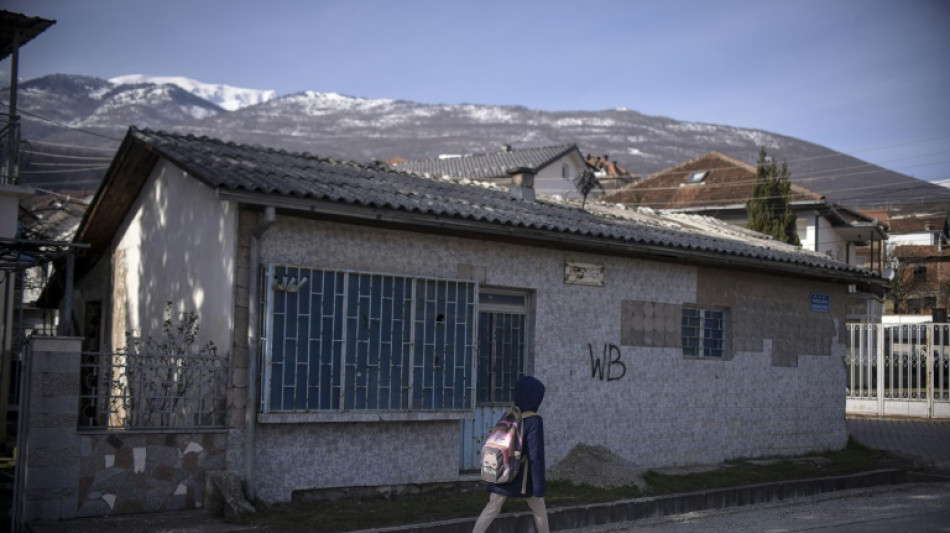
'Code of silence': unsolved Kosovo killings haunt relatives / Photo: Armend NIMANI - AFP

 Schoolgirl Yu, 13, fastest again in bid for third Asian Games gold
 Oil prices fall after Trump hails 'good' talks with Iran

 AI political ads warp reality ahead of US midterms

 Kenneth Branagh embraces action hero role -- to get in shape

 'New one' Klopp promises fresh approach as Germany reign begins
 Milne returns to New Zealand squad for India T20 series

 US-led Americas coalition backs sanctions against crime groups
 'Star Wars' fans and art lovers line up for new Lucas museum
 Trump renames AI 'super intelligence' as leaders jostle over dangers

 Oil prices retreat as markets welcome US-Iran talks
 US refusing to give Sudan's de facto leader visa for UN: diplomatic sources, UN
 Macron urges world to choose UN over 'law of the jungle'
 All-rounder Jacks stars as England beat Sri Lanka in 1st ODI

 Man City peg back Bayern to start Women's Champions League
 Trump beats 'America first' drum at UN as allies tread carefully
 Snedeker backs Spaun for Ryder Cup after Presidents snub

 French prosecutors probe secret filming of women with smart glasses

 Trump renames AI "super intelligence," rejects international oversight
 Trump rejects international regulation of AI
 How is the EU approaching record fuel prices?

 Sri Lanka's Colombage strikes on debut as England dismissed for 265 in first ODI
 Hurricane Polo strengthens to top category 5 off Mexico
 11 hurt as teen opens fire outside school in western Turkey

 UN chief says 'Big Oil' treats atmosphere as open sewer

 Tunisia says 2026 summer hottest on record
Nearly 25 years after her brother's murder, Aleksandra Sibinovic remains tormented by unanswered questions about the killing which helped precipitate the Kosovo war, still plaguing the Balkans to this day.
Six Serbs -- mostly teenagers -- were killed in broad daylight when masked gunmen stormed a cafe in the quiet town of Peja in southwest Kosovo in December 1998.
Sibinovic's 18-year-old brother Zoran Stanojevic was among those hanging out at the Panda cafe, frequented by young Serbs at a time when such places were already unofficially segregated.
After being shot multiple times, he bled to death.
Against a backdrop of surging violence between ethnic Albanians and Serbs, the events that unfolded afterwards were devastating.
The Serbian government launched an all-out assault on Kosovo, leading to thousands of deaths, a refugee crisis and charges of ethnic cleansing.
Belgrade's bloody onslaught sparked a NATO bombing campaign that ended the 1998-1999 war and paved the way for the breakaway province's independence declaration.
However, the killings in Peja and a host of other incidents remained unsolved as Serbian forces retreated.
The shooting was initially pinned on Albanian insurgents -- but in the years since, various people including Serbian President Aleksandar Vucic have questioned that conclusion.
"I can only be relieved when the truth was established," Sibinovic, 46, told AFP in Belgrade.
- No 'imposed' recognition -
Kosovo and Serbia remain arch-rivals more than two decades on, with repeated international efforts to mend relations achieving little.
Just last month, an EU-backed peace process aimed at normalising ties between the two foes appeared to falter after Serbia refused to sign the deal following marathon talks.
"No one can impose an obligation on Serbia to recognise Kosovo," Vucic told reporters.
Amid the continued acrimony, many questions about massacres, missing persons and alleged war crimes stemming from the conflict in Kosovo remain unresolved.
This week saw the opening of the latest in a string of war crimes tribunals in The Hague linked to the conflict.
Kosovo's former president Hashim Thaci and three other leaders of the Kosovo Liberation Army (KLA) face several charges, including murder and torture.
The trial is expected to last years.
- 'A glimmer of hope' -
At the time of the Peja attack, Serbia was under mounting international pressure to rein in its armed forces in the fight against a growing ethnic Albanian insurgency.
Years later, Vucic -- who served as Serbia's information minister during the war -- dropped a bombshell during a broadcast in 2013.
In the interview, Vucic casually accused state institutions of maintaining a "code of silence" concerning the incident in Peja.
He went on to suggest that KLA insurgents were not responsible for the killings but refused to elaborate.
"We don't have evidence for that, on the contrary. I just want to say that there are many awful things we will have to face and we will solve these cases," Vucic said at the time.
The Serbian leader, however, has rarely returned to the subject and has refused repeated calls from the victims' families for an audience.
His comments were a shocking blow for Sibinovic, who had long blamed Albanian gunmen for her brother's murder.
"The physical pain I felt was on par with what I felt when they told me he died. Then, I felt a glimmer of hope that we'll finally find out what happened," she told AFP.
An official investigation was launched in 2016 but has so far not provided any answers.
"The investigation has not yet been completed," the Serbian prosecutor's office for organised crime told AFP on Thursday.
The Serbian president's office did not respond to questions sent by AFP.
- 'Silence' adds to pain -
Predominantly populated by ethnic Albanians, Peja was the former base of a notorious Serbian special force unit.
Its members have been accused of masterminding a number of war crimes in Kosovo, according to rights groups.
After the shooting, Serbian police rounded up several ethnic Albanians from the area, including Vllaznim Pergjegjaj.
While being interrogated, Pergjegjaj said he was beaten with "all possible tools from wood to metal".
"To tell you the truth, I was usually unconscious for three to four hours, I didn't know where we were," Pergjegjaj, 43, told AFP of the ordeal.
He said he was later sentenced in 1999 to one year in prison for "disrupting public order".
To this day, nobody has been indicted or convicted for taking part in the shooting.
Both Serbian and Kosovo human rights activists have argued the incident was orchestrated by the Serbian government to provide a pretext for the full-scale war it launched in Kosovo.
"This was a well-organised plan, a well-organised group of professionals who came, did the job without a trace and in a very efficient way, and nobody found them afterwards," Behxhet Shala, head of the Council for Defence of Human Rights and Freedom in Kosovo watchdog, told AFP.
But for Sibinovic, an oral surgeon and mother of two, and other families, the continued uncertainty has only added to their grief.
"If I knew the killer personally, it would have been easier to cope with than this silence," Sibinovic told AFP, saying the background of the killer was irrelevant.
"What difference does it make what ethnicity they are? It was carried out by a monster acting upon orders of another monster."
S.Caetano--PC