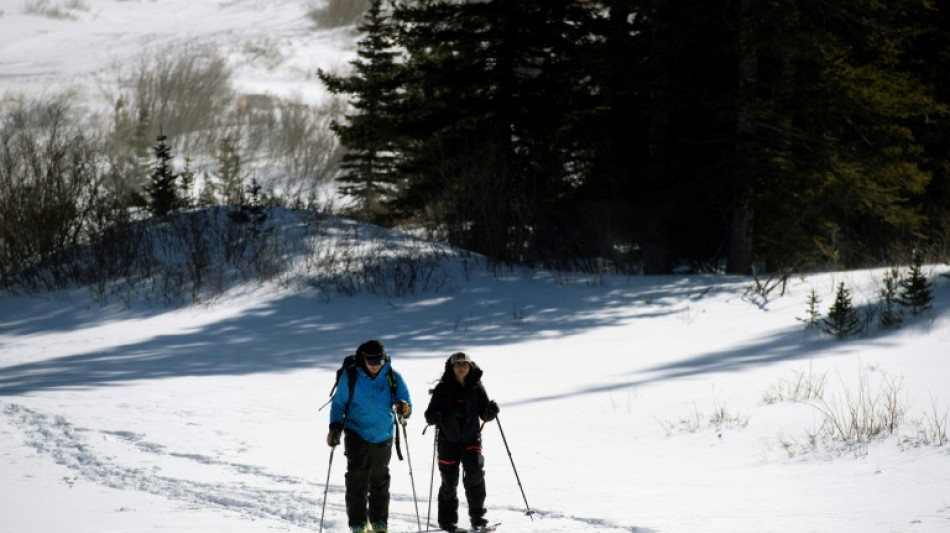
Colorado snow survey scoops up evidence for 'wet year' in US West / Photo: Jason Connolly - AFP

 Schoolgirl Yu, 13, fastest again in bid for third Asian Games gold
 Oil prices fall after Trump hails 'good' talks with Iran

 AI political ads warp reality ahead of US midterms

 Kenneth Branagh embraces action hero role -- to get in shape

 'New one' Klopp promises fresh approach as Germany reign begins

 Milne returns to New Zealand squad for India T20 series
 US-led Americas coalition backs sanctions against crime groups

 'Star Wars' fans and art lovers line up for new Lucas museum
 Trump renames AI 'super intelligence' as leaders jostle over dangers

 Oil prices retreat as markets welcome US-Iran talks

 US refusing to give Sudan's de facto leader visa for UN: diplomatic sources, UN
 Macron urges world to choose UN over 'law of the jungle'

 All-rounder Jacks stars as England beat Sri Lanka in 1st ODI
 Man City peg back Bayern to start Women's Champions League
 Trump beats 'America first' drum at UN as allies tread carefully
 Snedeker backs Spaun for Ryder Cup after Presidents snub

 French prosecutors probe secret filming of women with smart glasses

 Trump renames AI "super intelligence," rejects international oversight

 Trump rejects international regulation of AI

 How is the EU approaching record fuel prices?

 Sri Lanka's Colombage strikes on debut as England dismissed for 265 in first ODI

 Hurricane Polo strengthens to top category 5 off Mexico

 11 hurt as teen opens fire outside school in western Turkey

 UN chief says 'Big Oil' treats atmosphere as open sewer

 Tunisia says 2026 summer hottest on record

High up in a dazzlingly white, tree-lined valley of the Rocky Mountains, two scientists armed with skis and clipboards peer at the long hollow tube they have just thrust vertically into a pristine snow drift.
"Twenty-four inches, that's not so bad," says Brian Domonkos, before grabbing the metal cylinder -- now stuffed with snow -- and hitching it to a portable scale dangling from his colleague's ski pole.
Originally carried out using an improvised set of milk scales, this same measuring technique has been performed on this exact spot every winter since 1966, to assess the amount of water held in Colorado's crucial snowpack.
And while the remote, stunningly picturesque Mosquito Creek area feels like a different planet from Los Angeles, the data it yields remains vital for calculating how much water will reach the parched, sprawling cities of the American West each summer.
"We're all one water system," explains Domonkos. "Fifty to 80 percent of all the water we use in the West comes from mountain snow melt."
In this particular year, the stakes are unusually high. After more than two decades of drought, exacerbated by human-caused global warming, the region's giant reservoirs have dwindled to record lows.
While winter has finally brought biblical rains to coastal cities, much of that has already flowed into the Pacific Ocean.
So it is this powder, piled between pine trees atop the 10,000 foot- (3,000 meter-) high Colorado plateau, that will determine how much water is available to faraway urbanites in the coming dry months.
"The April snow survey measurement is really the pinnacle, the peak of the snowpack for most of Colorado," says Domonkos.
"That peak snowpack is the amount of water that's actually going to run off."
- Grizzly bears -
As well as taking manual measurements at dozens of similar sites, Colorado Snow Survey employees like Domonkos check and repair hi-tech, automated snow monitoring stations scattered across the Rockies.
The combined data they yield allows scientists to predict the year's snowpack, and the job is a huge responsibility, says his colleague Nagam Gill.
Their output is eagerly awaited by everyone from local ski and snowmobile resorts to the state's snowplow operators, foresters and hydroelectric power generators.
But perhaps more crucially, Colorado is obliged to share a set percentage of the water it receives each year with downstream states.
Calculate the year's snowfall wrong and send too much water down the river, and "you're never going to get that water back," said Domonkos.
Still, both scientists agree, the job has its advantages.
It frequently takes the pair -- via ski, snowshoe or snowmobile -- to beautiful unspoiled peaks and valleys of Colorado, New Mexico, Arizona and Wyoming.
Dozens of other scientists perform the same duties as far away as Alaska, travelling to the most remote spots on horseback or by helicopter.
"It's pretty much a dream job," said Domonkos, who occasionally paused the interview to quench his thirst with a scooped handful of pure white snow.
He said he frequently encounters moose and elk, and used to run into grizzly bears -- "a respectable amount" -- when he worked in Montana.
- 'Very wet year' -
During AFP's visit to Mosquito Creek, just east of the Continental Divide and 100 miles (160 kilometers) upstream from Denver, the snowpack is roughly similar to recent years.
But that is not the story for most of the region.
In the Colorado River Basin itself, which starts on the other side of this mountain and runs all the way to California, the snow is "a good bit better," says Domonkos.
Indeed, the National Oceanic and Atmospheric Administration is "seeing some really huge numbers" for snowmelt "forecasted to flow into reservoirs throughout the Upper Colorado River Basin" this summer, according to the organization's Paul Miller.
The federal science group's complex computer models now include data from satellite imagery and aircraft, but still rely really heavily on the long-running snow surveys, he told AFP.
Their conclusion? "It's going to be a very wet year," said Miller.
Indeed, 11 million acre-feet of water is expected to reach Lake Powell, the basin's first major reservoir -- almost double the annual average of 6.3 million.
An acre-foot refers to an acre covered in water a foot deep, which equals about half an Olympic-size swimming pool.
Lake Powell and Lake Mead -- another giant reservoir, near Las Vegas -- currently sit around a quarter-full, but "these numbers will probably get us up into the 30, 35 percent range," said Miller.
On current forecasts, this year will be the basin's ninth-wettest ever. If low temperatures and snowfall persist, it could break the top five.
But up on the mountain Domonkos, wrapped up warm in a blue ski jacket, sunglasses and a beanie hat, is remaining cautious.
"Even though we have a largely above-normal snowpack in the Colorado (basin), it doesn't mean we're going to have great runoff at this point," Domonkos says.
The drought has stretched on for so long, he warns, "it's going to take a number of years to overcome."
F.Moura--PC