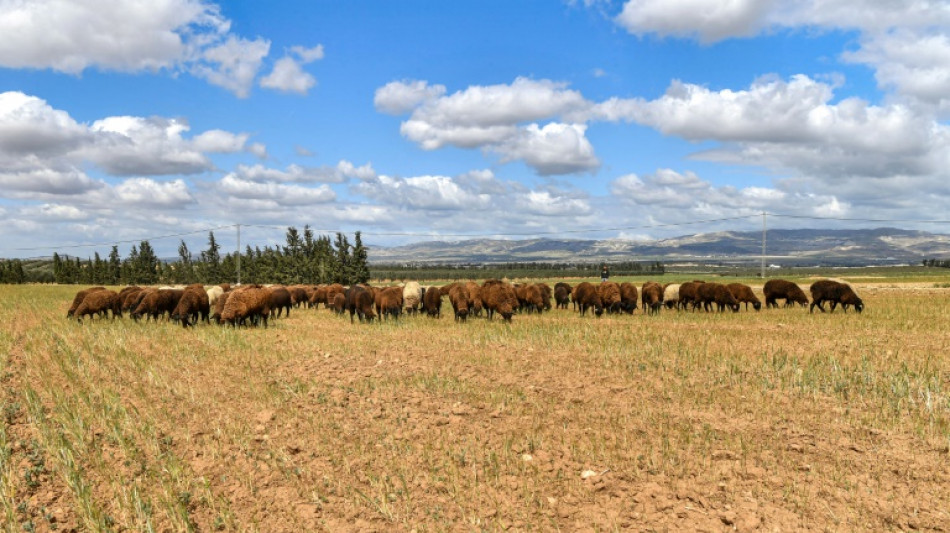
'Flash drought' frequency increasing due to climate change: study / Photo: FETHI BELAID - AFP

 Schoolgirl Yu, 13, fastest again in bid for third Asian Games gold
 Oil prices fall after Trump hails 'good' talks with Iran

 AI political ads warp reality ahead of US midterms

 Kenneth Branagh embraces action hero role -- to get in shape

 'New one' Klopp promises fresh approach as Germany reign begins

 Milne returns to New Zealand squad for India T20 series

 US-led Americas coalition backs sanctions against crime groups

 'Star Wars' fans and art lovers line up for new Lucas museum

 Trump renames AI 'super intelligence' as leaders jostle over dangers

 Oil prices retreat as markets welcome US-Iran talks

 US refusing to give Sudan's de facto leader visa for UN: diplomatic sources, UN

 Macron urges world to choose UN over 'law of the jungle'

 All-rounder Jacks stars as England beat Sri Lanka in 1st ODI
 Man City peg back Bayern to start Women's Champions League

 Trump beats 'America first' drum at UN as allies tread carefully
 Snedeker backs Spaun for Ryder Cup after Presidents snub

 French prosecutors probe secret filming of women with smart glasses

 Trump renames AI "super intelligence," rejects international oversight

 Trump rejects international regulation of AI

 How is the EU approaching record fuel prices?

 Sri Lanka's Colombage strikes on debut as England dismissed for 265 in first ODI

 Hurricane Polo strengthens to top category 5 off Mexico

 11 hurt as teen opens fire outside school in western Turkey

 UN chief says 'Big Oil' treats atmosphere as open sewer

 Tunisia says 2026 summer hottest on record

Dry-spells known as flash droughts, with a surprisingly rapid onset and often devastating impact, are becoming more frequent as human activity warms the planet, according to a study published Thursday.
Though droughts are generally thought of as long-term phenomena, some can occur quite suddenly, in a matter of weeks, when the conditions are right.
Global warming is a recipe for increasing those special conditions around the world, creating in certain areas a decrease in precipitation and increased evaporation, which dries out the soil more quickly.
For the study, published in the journal Science, researchers analyzed a combination of satellite data and ground moisture readings from a period of over 60 years (1951-2014).
"Both flash and slow droughts are increasing" as global temperatures rise, lead author Xing Yuan told AFP.
But flash droughts are increasing more quickly "especially over Europe, North and East Asia, Sahel and west coast of South America," he said.
The researcher, based out of China's Nanjing University of Information Science and Technology (NUIST), warned that the rapid onset of flash droughts gives humans little time to adapt, such as by diverting water resources or preparing for wildfires.
"The vegetation do not have enough time to adapt either," he added.
Yuan's team used climate modeling to forecast how flash droughts will change under several possible greenhouse gas emission scenarios.
Even if emissions are moderate, flash droughts will continue to become more frequent across practically all regions. Under higher emissions scenarios, the trend would be more drastic.
Yuan also said the data showed a general increase in drought onset speeds, with his team finding a "robust transition at global scale" of slow to flash droughts.
"We believe the reduction in emission can slow down this transition," he told AFP.
The concept of flash drought emerged in the early 21st century, but has received more attention since the summer 2012 drought in the United States, which set in particularly quickly and caused more than $30 billion in economic losses.
A commentary piece by two professors in the Netherlands, also published in Science, said the study's warning "should be taken seriously" as the threat "may be even greater than they suggest."
David Walker of Wageningen University and Anne Van Loon of Vrije Universiteit (VU) Amsterdam, both of whom were not involved in Yuan's work, underlined that most of the "hot spot regions" determined by the study were particularly low-income areas.
"These regions generally have more vulnerable populations and lower financial resources for coping mechanisms," they said.
The pair also added that current methods for detecting droughts, often month-by-month data analyses, must be updated to "operate on shorter time scales," due to the increase in flash droughts which "may build and trigger outcomes in just weeks."
V.Fontes--PC