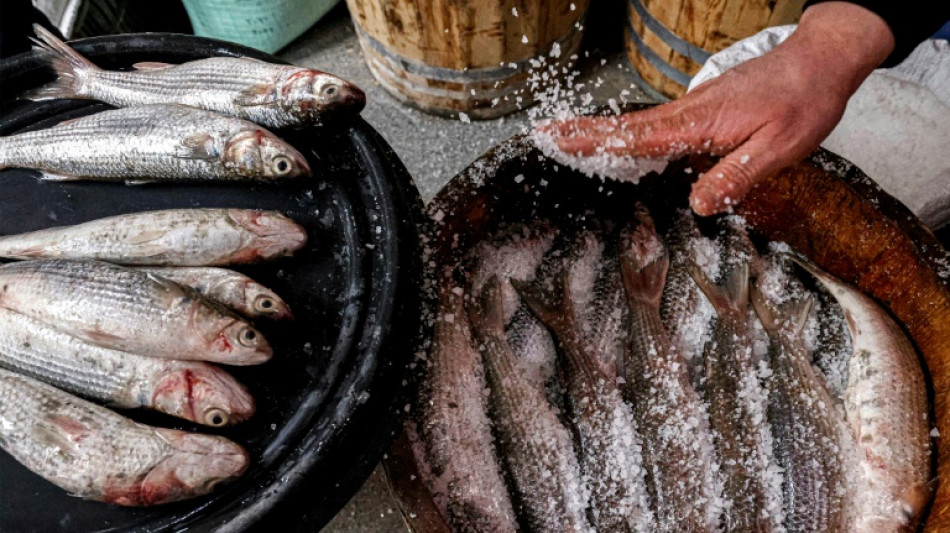
Nile-side Egypt town heralds spring with pungent delicacy / Photo: Khaled DESOUKI - AFP

 Outgoing UN chief makes climate push at New York summit

 AI risks, Iran war to take center stage at UN

 Badminton no.1 An tells dad to keep it down at Asian Games

 Runaway leader Antonelli eyeing third straight win

 Schoolgirl Yu, 13, fastest again in bid for third Asian Games gold
 Oil prices fall after Trump hails 'good' talks with Iran

 AI political ads warp reality ahead of US midterms

 Kenneth Branagh embraces action hero role -- to get in shape

 'New one' Klopp promises fresh approach as Germany reign begins

 Milne returns to New Zealand squad for India T20 series

 US-led Americas coalition backs sanctions against crime groups

 'Star Wars' fans and art lovers line up for new Lucas museum

 Trump renames AI 'super intelligence' as leaders jostle over dangers

 Oil prices retreat as markets welcome US-Iran talks

 US refusing to give Sudan's de facto leader visa for UN: diplomatic sources, UN

 Macron urges world to choose UN over 'law of the jungle'

 All-rounder Jacks stars as England beat Sri Lanka in 1st ODI
 Man City peg back Bayern to start Women's Champions League

 Trump beats 'America first' drum at UN as allies tread carefully

 Snedeker backs Spaun for Ryder Cup after Presidents snub

 French prosecutors probe secret filming of women with smart glasses

 Trump renames AI "super intelligence," rejects international oversight

 Trump rejects international regulation of AI

 How is the EU approaching record fuel prices?

 Sri Lanka's Colombage strikes on debut as England dismissed for 265 in first ODI

The overwhelming smell may be misleading, but the Egyptian town of Nabaruh, its streets lined with shops selling salty, fermented fish called feseekh, is far from the seaside.
Landlocked in the Nile Delta, "Nabaruh is the capital of feseekh," boasted 44-year-old Sherif al-Yamani, owner of one of the town's famed shops.
The millennia-old delicacy of saltwater fish, buried in salt for weeks at a time, remains a staple as Egyptians celebrate on Monday the ancient spring festival of Sham al-Nessim.
But it is as acclaimed as it is divisive, pitting those who complain of the pungent odour against others gleefully marrying feseekh with flatbread and spring onion.
The traditional dish dates back more than 4,000 years and has been found in archaeological sites in Egypt, said former antiquities minister Zahi Hawass.
"Ancient Egyptians used to salt fish to extend its shelf life so workers could continue to eat it as they built the pyramids," he said.
Karim Abdel Gawad drove from a neighbouring province, Gharbia, to buy the fish in Nabaruh where "it's really something else", he told AFP.
"There's no room for experimenting with feseekh, you need to get it from somewhere you trust."
Yamani takes pride in coming from one of a handful of feseekh-making families that began curing fish a century ago, making a name for their town.
"Whether or not it's the holiday season, we're always getting customers from all over Egypt," he told AFP, serving a client who had come from the capital Cairo, some 120 kilometres (75 miles) to the south.
- Smell of success -
The ancient craft is delicate. One wrong move -- too much moisture in the fish, not enough salt in the barrel -- and a bad feseekh might cause botulism, as Egypt's health ministry annually warns ahead of Sham al-Nessim.
"It all comes down to how the fish is prepared," which is why it should never be bought from open-air markets or street vendors, Yamani said.
With a careful eye to catch any error, he supervised his workers as they piled fish into large wooden barrels, each layer separated by a thick coat of coarse salt.
After each barrel is sealed with plastic, a fresh heap of salt is piled on top, locking everything in for the pungent smell to brew for weeks.
The spring festival, celebrated on the Monday after Easter in the Coptic Orthodox calendar, falls this year during the Muslim fasting month of Ramadan.
For those fasting from sunrise to sunset, consuming the salty dish could make them unbearably thirsty the following day. Many got their fill the week before Ramadan, Yamani said.
But love for feseekh seems to transcend hydration concerns, as clients continued to come in and out of the small shop even during the holy month, which is set to end next week.
And even a sharp economic crisis impacting every facet of Egyptian life over the past year -- with inflation hitting 33.9 percent in March -- has not stopped locals from getting feseekh at a price of about 220-240 pounds ($7-8) per kilo.
"We didn't imagine we'd be selling this much, but it seems like feseekh purchases haven't been affected," the fishmonger said.
A.Aguiar--PC