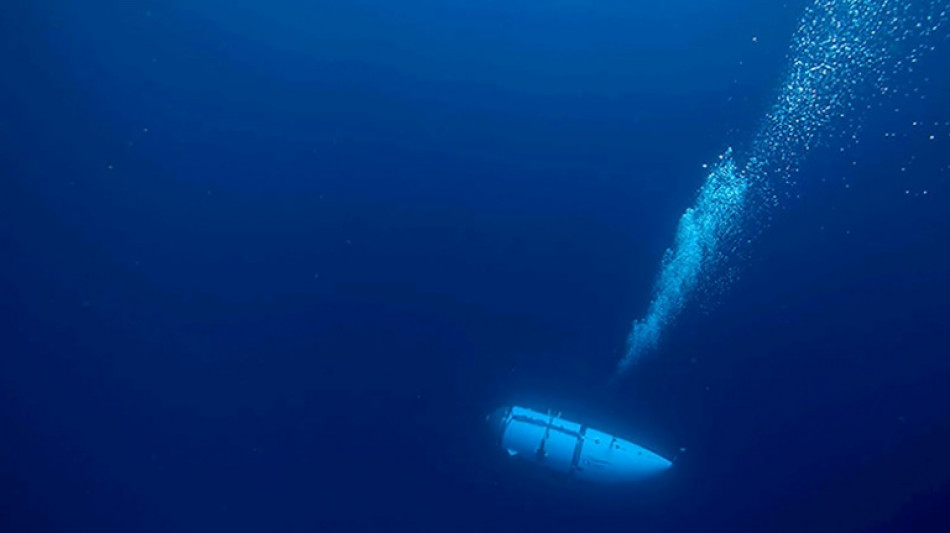
Search for missing Titanic sub like 'going into space' / Photo: Handout - OceanGate Expeditions/AFP

 Row engulfs Dolly Parton's estate as manager accuses nephew of making threats

 Mandela Digital Extends Early Access Programme to 11 February 2027 Following Strong Response

 US seeks 11th Presidents Cup win in a row over global foes

 McDonald's to boost franchisees as inflation weighs on consumers

 Trump invites Putin to G20 summit in Miami

 Archaelogical 'breakthrough' could confirm origins of Paris

 ILO financial crisis takes centre stage in leadership race

 Stocks dip, oil soars despite Trump hailing "productive" Iran talks

 China's Xi to get rare airport welcome from Trump

 Turkey reassures investors over investment fund crisis

 Saka says England still have 'scar' from World Cup semi-final loss

 アレックス・ボディ氏とシュテファン・ハウプト教授、ルーマニアの伝説的な美術コレクションをめぐり提携に合意

 亞歷克斯·博迪與史蒂芬·豪普特教授就羅馬尼亞傳奇藝術收藏達成合作協議

 Алекс Боди и проф. д-р Стефан Хаупт договорились о сотрудничестве в рамках легендарной коллекции произведений искусства в Румынии

 French foreign minister says Palestinians 'must' hold polls

 Fresh Russian strikes on Ukraine's infrastructure kill seven

 Eriksen to return to Denmark after parting ways with Wolfsburg

 Brad Pitt says working with dog co-star was 'really moving'

 Golan will remain Syrian, vows President al-Sharaa at UN

 Blueberry Strengthens MENA Presence with CMA Category 5 License and Dubai Office Launch

 Russia probes bear attacks, as official says town under 'siege'

 Robertson tells Spurs to 'forget' past woes

 Italy police find 3 million euros stashed in mobster's house

 Renard versus Queiroz in AFCON qualifying blockbuster

 Former Mexico boss Aguirre returns to Spain with Valencia

Rescuers trying to find the orca-sized submersible that vanished on its way to visit the wreck of the Titanic are facing a gargantuan task that will test the limits of technical know-how, experts say.
Teams from around the world were racing against the clock Tuesday to locate the vessel and its five-person crew before their oxygen runs out -- projected at under a day and a half from now.
But scouring a 7,600-square-mile (20,000-square-kilometer) area of the North Atlantic to a depth of more than two miles is not easy.
"It's pitch black down there. It's freezing cold. The seabed is mud, and it's undulating. You can't see your hand in front of your face," Titanic expert Tim Maltin told NBC News Now.
"It's really a bit like being an astronaut going into space."
The 21-foot (6.5-meter) submersible, named Titan, was carrying three fee-paying passengers when it vanished Sunday: British billionaire Hamish Harding, Pakistani tycoon Shahzada Dawood and Dawood's son Suleman.
OceanGate Expeditions, which runs the Titan's trips, charges $250,000 for a seat.
The company's CEO Stockton Rush and French submarine operator Paul-Henri Nargeolet, nicknamed "Mr Titanic" for his frequent dives at the site, are also aboard.
US Coast Guard Captain Jamie Frederick told reporters Tuesday that his organization was co-ordinating the search.
But, he said, it was incredibly difficult, and far beyond what the coast guard would normally tackle.
"While the US Coast Guard has assumed the role of search and rescue mission coordinator, we do not have all of the necessary expertise and equipment required in a search of this nature," he said.
"This is a complex search effort, which requires multiple agencies with subject matter expertise and specialized equipment."
Frederick explained that rescuers were using multiple methods as they comb the vast area for the Titan, which lost contact with its mothership just two hours into its dive near the Titanic's watery grave.
"The search efforts have focused on both surface with C-130 aircraft searching by sight and with radar, and subsurface with P3 aircraft, we're able to drop and monitor sonar buoys."
- Seafloor, water column or surface -
So far, the searches have proved fruitless.
The effort was being augmented Tuesday by a huge pipe-laying vessel, which has a remotely operated vehicle expected to be deployed at the Titan's last known position.
Jules Jaffe, who was part of the team that developed the optical imaging system used to find the Titanic in 1985, said rescuers would have to look in three separate places.
"It's either sitting on the seafloor, somewhere in the water column, or sitting on the surface," he told ABC10 in San Diego.
"It could be in the water column. I think that's probably the most likely place it is."
Jamie Pringle, a professor of forensic geosciences at Keele University in Britain, said if the mini-sub had settled on the ocean floor, it could be very difficult to spot.
"The bottom of the ocean is not flat; there are lots of hills and canyons," Pringle said, according to NBC.
Adding to the challenge: the enormous pressure four kilometers under water, around 400 times what it is on the surface.
Such pressures put enormous strains on equipment, and very few vessels can survive these depths.
Nuclear submarines generally operate at just 300 meters, according to the Woods Hole Oceanographic Institution.
R.Veloso--PC