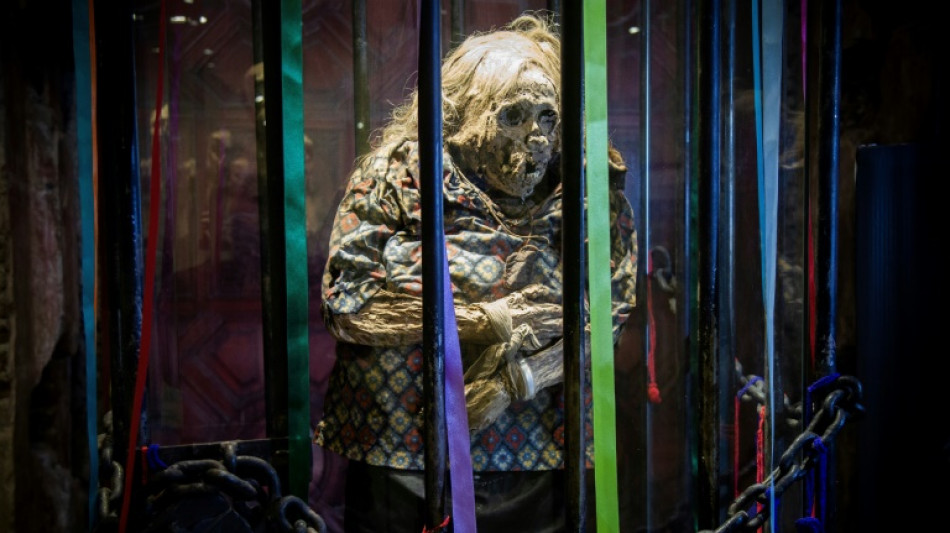
Controversy shrouds Mexico mummies exhibition / Photo: Rodrigo Oropeza - AFP

 Row engulfs Dolly Parton's estate as manager accuses nephew of making threats
 Mandela Digital Extends Early Access Programme to 11 February 2027 Following Strong Response

 US seeks 11th Presidents Cup win in a row over global foes

 McDonald's to boost franchisees as inflation weighs on consumers

 Trump invites Putin to G20 summit in Miami

 Archaelogical 'breakthrough' could confirm origins of Paris

 ILO financial crisis takes centre stage in leadership race

 Stocks dip, oil soars despite Trump hailing "productive" Iran talks

 China's Xi to get rare airport welcome from Trump

 Turkey reassures investors over investment fund crisis

 Saka says England still have 'scar' from World Cup semi-final loss

 アレックス・ボディ氏とシュテファン・ハウプト教授、ルーマニアの伝説的な美術コレクションをめぐり提携に合意

 亞歷克斯·博迪與史蒂芬·豪普特教授就羅馬尼亞傳奇藝術收藏達成合作協議

 Алекс Боди и проф. д-р Стефан Хаупт договорились о сотрудничестве в рамках легендарной коллекции произведений искусства в Румынии

 French foreign minister says Palestinians 'must' hold polls

 Fresh Russian strikes on Ukraine's infrastructure kill seven

 Eriksen to return to Denmark after parting ways with Wolfsburg

 Brad Pitt says working with dog co-star was 'really moving'

 Golan will remain Syrian, vows President al-Sharaa at UN

 Blueberry Strengthens MENA Presence with CMA Category 5 License and Dubai Office Launch

 Russia probes bear attacks, as official says town under 'siege'

 Robertson tells Spurs to 'forget' past woes

 Italy police find 3 million euros stashed in mobster's house

 Renard versus Queiroz in AFCON qualifying blockbuster

 Former Mexico boss Aguirre returns to Spain with Valencia

Visitors stop and stare at the mummified corpse of an unidentified woman nicknamed "the witch" on display behind bars at a museum exhibition stirring controversy in Mexico.
The wizened body -- cloaked in a floral blouse and skirt, yellow hair still flowing from her head -- is one of more than 100 naturally mummified corpses on show in the central city of Guanajuato.
"I don't know who decided to display the body in this way, but it has been exhibited like this for many years," Jesus Borja, Guanajuato's director of culture, told AFP.
The exhibition has triggered a debate between those who consider the mummies to be part of the city's cultural heritage and others who see the display as unethical commercial exploitation.
The corpses, which include babies, were exhumed between 1870 and 2004 due to a lack of space in a local cemetery.
Unable to contact relatives of the deceased, local officials designated them as "cultural heritage."
They are now a very profitable tourist attraction, generating approximately $2 million in annual revenue for the municipality from around 600,000 visitors a year.
The mummies are kept in three museums in Guanajuato, which is known for its colonial architecture as well as its long tunnels and alleyways -- remnants of a mining past.
Most of the corpses are exhibited upright in glass cases, with little space between their skulls and the display lights.
A mournful melody plays incessantly in the dimly lit hallways of one of the museums, located in the Santa Paula cemetery.
- Ethical debate -
The controversy grew after several mummies were transported to the capital Mexico City, located around 350 kilometers (217 miles) by road from Guanajuato, to be shown at a tourist fair in March.
Mexico's National Institute of Anthropology and History (INAH) has voiced concern about a possible fungal growth on one of the bodies, after pictures showed white dots on the torso and legs.
"It's worrying and strange that an assessment of such bodies was not made before their transfer," the public institution said in a statement.
Borja said transportation of the remains was done with due care, adding that the mummies represent a generational "link."
The Guanajuato government says it asked the INAH to check all the remains before they were exhibited in Mexico City.
The mummy display has divided opinion among residents of Guanajuato.
"I would find it disrespectful if one of my relatives were in the exhibition," said Luis Garcia, a 50-year-old tour guide.
But Josefina Lemus, a 69-year-old retired teacher, said she would not mind being exhibited if her remains were mummified.
"I don't think it's denigrating," she said, adding: "And it's unlikely relatives are still around."
The mummification process can occur naturally as a body becomes dehydrated, said Ilan Leboreiro, an anthropologist who sits on a commission created by the INAH to investigate the identities and condition of the mummies.
"It's not ethical to treat the remains of a human being that way," he said.
M.Gameiro--PC