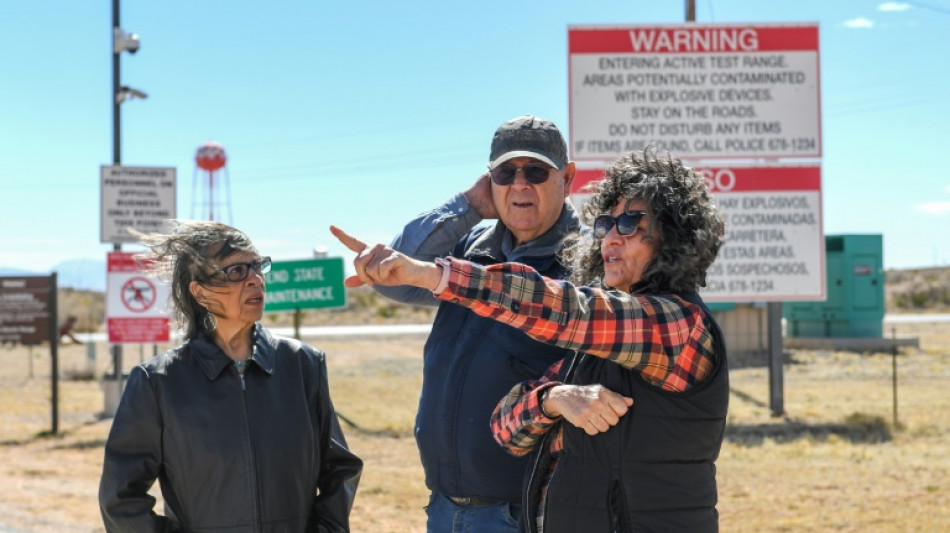
Ignored by 'Oppenheimer,' atomic test victims speak out / Photo: VALERIE MACON - AFP

 Assefa seeks 'better than my best' at Berlin marathon

 US court refuses to overturn Pentagon ban on Anthropic

 Verstappen and Norris blame slow cars as Mercedes tops qualifying

 Crowds cheer pope in Paris after AI 'paradise of machines' warning

 Teen swimmer makes Games history as Thai, Chinese sprinters win gold

 Man City found guilty of 114 Premier League charges - reports

 Concerns over 'missing' UK explorer Ranulph Fiennes

 Suspected Paris killer of Argentine rugby star begs forgiveness
 Oil prices fall on cautious hopes for US-Iran progress

 Noskova, Muchova take Czech Republic into BJK Cup final
 Thai sprinter Puripol breaks own Asian Games record to win 100m gold

 Russell takes pole for Azerbaijan GP, Antonelli crashes out

 Williams boss hails Chadwick as F1 inspiration for women

 World No.1 Sinner delays return with China Open withdrawal

 South Lebanon children return to school destroyed by Israel strike

 Jewish group urges Berlin far-left vote winners to tackle antisemitism
 European stock markets climb as oil prices drop

 Trump accuser E. Jean Carroll finally has her damages

 Germany's Havertz, Musiala ruled out of Greece match with injury

 Ireland's Gaza stance spills from Eurovision into football

 Welcome aboard the Costa Serena, the Asian Games floating hotel
 Asian markets mixed after recent oil surge
 Cash for nature protection: hotelier's offer to Principe islanders
 US miner KoBold bets on AI to gain edge in DR Congo mineral hunt
 Internet disrupted in Ethiopia as conflict rages
Wesley Burris was fast asleep in bed when the world's first atomic bomb exploded just 25 miles from his front door.
A blinding light filled the home in the New Mexico desert, before the impossible force of the blast shattered its windows, spraying glass across the four-year-old boy and his brother.
"It was so bright, I couldn't see," Burris recalls. "I can remember asking, 'Dad, what happened? Did the Sun blow up?'"
The events of 5:30 am on July 16, 1945 are now best known to millions from their dramatic re-enactment in the Oscar-tipped movie "Oppenheimer."
But they loom large in the actual memory of Burris, who is now 83 years old and still living just a few miles from the secret location where scientists and military chiefs gathered on that historic morning.
Because while the film presents the Trinity test site as a vast, empty desert, Burris and his family were among thousands who lived within a 50-mile (80-kilometer) radius.
And like all of their neighbors, the family had no clue what was going on -- or why a giant mushroom-shaped cloud was spreading across their horizon.
"We weren't scared from it. Because it didn't kill us right there," he told AFP. "We had no idea what it was."
Fast-forward eight decades, and Burris knows all too well the true deadliness of that explosion, which sent radioactive material 50,000 feet (15,000 meters) into the air.
The test took place amid thunderstorms, despite scientists' warnings, in the race to have the bomb ready for a key World War II summit with the Soviets.
Torrential rains brought toxic debris straight back down, where it irradiated the desert dust, the water supplies and the food chain.
Burris has lost his brother to cancer. His sister had it too, as does her daughter.
And he himself has skin cancer, which he tries to treat with traditional Native American medicine.
Despite all this, no New Mexican affected by radiation from the Trinity test has received a dime in compensation.
"We were guinea pigs," said Tina Cordova, a cancer survivor who runs the Tularosa Basin Downwinders Consortium, calling for justice.
"But they come back and check on guinea pigs. Nobody's ever come back to check on us."
- 'Oppenheimer' -
For campaigners like Cordova, Christopher Nolan's "Oppenheimer" has at least introduced the concept of the Trinity test to millions of people around the world.
"But it didn't go far enough," she told AFP.
The film is the overwhelming favorite to sweep multiple Oscars on March 10, including best picture.
"Wouldn't it be remarkable if during the Academy Awards, any one of them said, 'I want to acknowledge the sacrifice and suffering of the people of New Mexico,'" said Cordova.
"They knew about us when they made the film -- they just chose to ignore us again."
Cordova -- one of five generations in her family diagnosed with cancer since 1945 -- hopes such recognition could finally put pressure on the US Congress to extend compensation to her state.
The clock is ticking.
The current Radiation Exposure Compensation Act does support those who lived near sites where nuclear tests were later conducted in Nevada, Utah and Arizona. But even that expires in June.
And a bid to broaden its scope to include those exposed to the very first atomic explosion, having been approved by the US Senate last year, was ripped out of a giant defense bill in December by the House of Representatives, over concerns about its cost.
"This shouldn't be how we live. We hold bake sales and garage sales and enchilada suppers so that we can raise the money to help these families," said Cordova.
"Maybe the Pentagon should have to have a bake sale every week to meet their budgetary demands, the same way we have to."
According to "First We Bombed New Mexico," a new documentary following Cordova's campaign, the families affected by radiation are "mostly Hispanic and Native."
- 'Bunch of lies' -
Burris was not impressed by the recent "Oppenheimer" movie.
"Yeah, I've seen it, but that film is a bunch of lies," he said.
"How many people died out here? They never said nothing about that."
But he has long become resigned to being brushed aside by history.
Way back in July 1945, his family were eventually told an ammunition explosion had occurred.
Compounding the mystery, two strange men with binoculars were spotted watching the explosion from trucks parked near their front yard.
"They wouldn't tell us anything," he recalls.
A few years later, another group of men appeared near the home, wearing white suits and masks.
His brother approached them, asking why they were digging a hole in the ground and collecting samples.
"They said, 'You need to get out of here. This will kill you,'" recalled Burris.
"And he said, 'Where am I going (to go?) We live right here in this house.'"
P.L.Madureira--PC