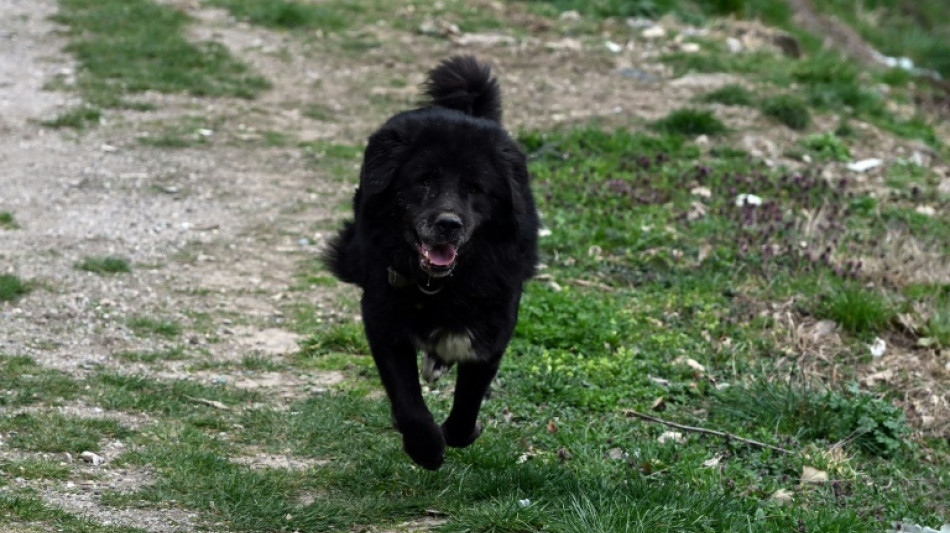
Mountain-made: Balkan sheepdog eyes future beyond the hills / Photo: Robert ATANASOVSKI - AFP

 Drones hit Moscow as Russians go to the polls

 New England boss Fleming says 'wrong' to ask Stokes to end retirement

 Germans vote in elections threatening fresh blow to Merz

 US fears rapid escalation in Mideast after Houthis attack Riyadh

 Japan triathlete Hojo wins first gold of Asian Games

 IOC president impressed by 'beautiful' Asian Games wooden huts

 First Asian Games gold goes to Japan as China's 13-year-old Yu lights up pool

 Data centre command hub keeps AI up and running

 Pope Leo in France: the issues on the table

 Packing for a pope: behind the scenes on foreign trips

 Republicans find transgender issues a powerful political weapon in midterm campaigning

 German state elections threaten new shock waves for Merz

 Chile's Bachelet quits race to be next UN chief

 Raphinha treble fires perfect Barca to win at Sevilla

 Thiam makes winning heptathlon return at Decastar meet

 Czechs beat USA to qualify for Davis Cup finals

 Dortmund sink Stuttgart to climb to Bundesliga summit

 Trump says will not tolerate attempts to slow AI growth

 'It has to stop': runners protest women's murders in S.Africa district

 Fire erupts near Riyadh airport as Houthis claim strikes

 Cuba works to restore power after another blackout

 England thrash Sri Lanka again to return to top of T20 rankings

 Arsenal thrashed by Brighton, sorry Spurs lose again

 South Korea, Austria qualify for Davis Cup finals

 Seare shocks Ingebrigtsen to win world 5km gold

At a remote monastery in North Macedonia's rugged west, Father Porfirij starts his day by feeding his large black Karaman sheepdogs, a breed that has guarded highland flocks for centuries.
In February, the Karaman -- a hardy mountain shepherd -- won provisional recognition as an indigenous breed from the International Canine Federation (FCI).
The decision caps years of work by breeders, scientists and Porfirij himself to define and preserve one of the region's oldest breeds.
"They are very nice dogs, very peaceful," the Orthodox priest told AFP, as he dished out the morning meal to the thick-coated hounds at their home in the centuries-old monastery.
Rooted in nomadic herding traditions, the Karaman is one of several breeds Balkan shepherds used to guard mountain-dwelling flocks against bears and wolves, a practice that dates back to Ottoman times.
- 'Created by the mountain' -
For locals, the sheepdogs' symbolism is deeply important.
The more famous Yugoslavian Shepherd, also known as the Sharplanina or Sharr, even features on the country's currency.
But as rural populations decline across the region, the pastoral life that sustained the Karaman is fading, leaving just 2,000 of them registered in the country, according to Ilija Karov, who heads a kennel club devoted to the breed.
Official recognition as a distinct breed was important because it "opened the borders" for the animal to become a pet abroad and bolster breeding efforts, Karov said.
It is also the first breed with its origins exclusively recognised in North Macedonia, with the Sharr shared with Serbia.
Porfirij was drawn to the campaign for the animal almost a decade ago, while living at the St Jovan Bigorski Monastery.
Using the monastic kennel as his base, the priest travelled through the mountains, collecting dogs with specific traits.
Although the Karaman is visually similar to the Sharr, scientists have found clear genetic and anatomical differences, which Karov says include its curled tail, lighter eyes and spoon-shaped paws.
It was important to define the breed only by characteristics "created by the mountain", he said.
"In Karaman, there is literally zero human intervention in relation to how it should look."
- 'Brighter future' -
The canines' powerful build and origins as mountain sheepdogs can be intimidating -- the Sharr has been banned in Denmark since 2010.
But Porfirij said any fears of the Karaman are unfounded and hopes there will be growing interest in the breed thanks to its loyalty and friendliness.
"Especially towards kids," he said, as two local children hugged a thick-furred dog behind him.
As young people leave and mountain communities age, Karov said the breed's future would rely more on urban pet owners than its pastoral past.
"The breed has a brighter future, even if that is more in the cities than in the mountains."
A.F.Rosado--PC