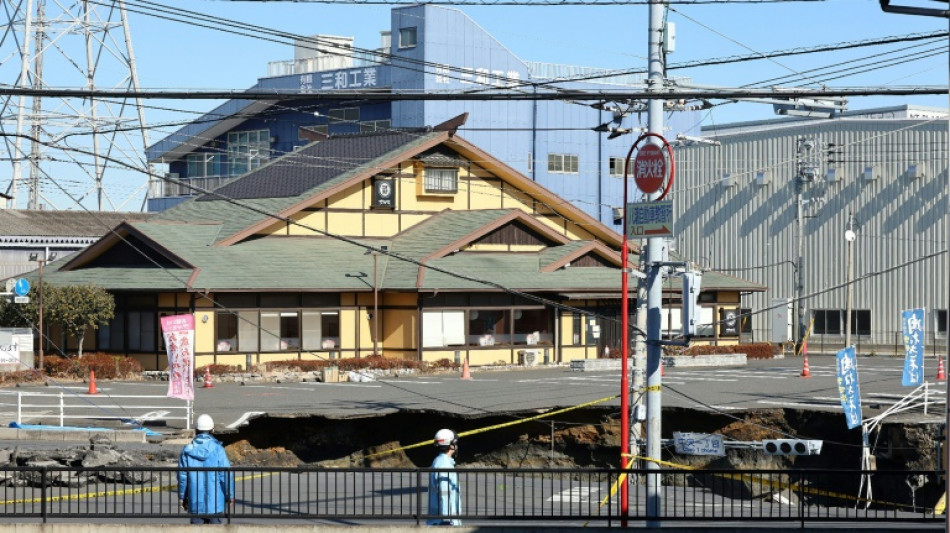
Japan's Olympic pool-sized sinkhole highlights risk of old pipes / Photo: STR - JIJI Press/AFP

 Iran airlines cancel flights as US sanctions hit

 Meta launches camera-free AI glasses amid privacy pushback

 Australian PM says OpenAI hacked government health website

 Xi arrives in US to personal Trump welcome

 Morocco elects new parliament amid social frustration, youth discontent

 Scheffler and Burns to face Im and Lee in Presidents Cup opener

 Crushing wins for Lyon and Barca in women's Champions League

 Rio breaks record for rainiest September amid powerful El Nino

 At UN, tech chiefs urge caution in AI development

 Russian strikes kill seven in Ukraine, Zelensky vows winter campaign

 Venezuelan shot by ICE needs urgent medical care, mother tells AFP

 Zelensky says Putin using fighters from 47 countries in Ukraine war

 Klopp calls on Germany to 'rise above ourselves' as new era begins

 Russian strikes kill seven in Ukraine as Russia vows no 'pause' to war

 ArcPoint Expands Globally with Institutional Intelligence Platform for Modern Investors

 Ronaldo focussing on 'present' ahead of Wales test

 Outgoing UN chief makes final climate push at New York summit

 Grief and pain flow at hearing for Canadian suicide poison vendor
 Ireland boss Hallgrimsson says timing of Israel remarks 'not clever'

 Weinstein resentenced to 15 years in prison for 2006 sex assault

 Fendi brings disco bling, Italian style, to Milan Fashion Week

 French court confirms rape trial for PSG and Morocco star Hakimi

 President tells Trump that Iran will never 'bend at the knee'

 أليكس بودي والبروفيسور الدكتور شتيفان هاوبت يتفقان على التعاون من أجل مجموعة فنية أسطورية في رومانيا

 U2 at 50: Irish rockers reveal anniversary album

A massive sinkhole near Tokyo that swallowed a truck and its driver a week ago, and has filled with sewage and debris, highlights the risk posed by Japan's ageing pipes.
Emergency workers have been striving in vain to reach the 74-year-old man, who rescuers have had no contact with for a week, and who was likely buried under sediment and sewage water in the sinkhole in the city of Yashio.
Officials say corroded sewerage pipes created the sinkhole that is now 40 metres (130 feet) wide -- nearly the size of an Olympic swimming pool -- and 15 metres (50 feet) deep.
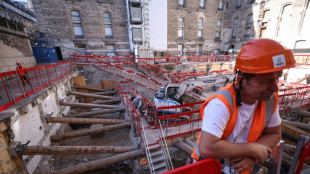
Cranes have been mobilised and a 30-metre slope built to locate and reach the driver, with a second slope under construction, but progress has been slow and dangerous.
Koichi Yamamoto, an official with Yashio's fire department, told AFP on Tuesday that rescue efforts had been suspended.
A "substantial" amount of sewage water has accumulated at the site, eroding the surrounding soil and "constantly flowing in like a river", he said.
"This makes it impossible for us to proceed."
Also "hampering our rescue operation is a pile-up of heavy masses such as debris, slabs of asphalt and concrete that need removing", Yamamoto added.
When the hole suddenly opened up in Yashio, in the region of Saitama near Tokyo, during the morning rush hour on Tuesday last week, it at first looked like just one of thousands of sinkholes reported annually across Japan.
Their occurence is trending upwards in Japan, topping 10,000 in fiscal 2022, with many of the sinkholes sewage-related in urban areas, a land ministry probe shows.
- Ageing pipes -
Initially the hole was around five metres in diameter, then a much larger cavity opened nearby and the two holes merged.
To reduce the volume of sewage, locals were urged to "use as little water as possible" for three hours on Tuesday afternoon.
This was on top of requests already issued for about 1.2 milion people in Saitama to refrain from non-essential use of water, such as taking baths or doing laundry.
In response, some onsens have opened their public bath facilities for free to accommodate residents in Yashio and nearby areas, according to local media.
The week-long sinkhole saga was a reminder of the insidious corrosion gnawing at Japan's ageing water and sewerage pipes, Shinya Inazumi, a professor of geotechnical engineering at Shibaura Institute of Technology, told AFP.
The majority of the underground infrastructure was developed during the country's rapid post-war economic growth.
"Many sewerage pipes in Japan have already outlived their service life (of 50 years) so pipes anywhere else could break due to ageing," Inazumi said.
In just over 15 years' time, 40 percent of Japan's sewerage pipes will have exceeded their lifespan, according to an estimate from the land ministry.
In Yashio, local authorities attributed the initial chasm to rusty, punctured sewerage pipes that absorbed the surrounding soil, creating a hollow under the ground.
Extreme weather events such as intense rain -- made more frequent by climate change -- can also exacerbate this kind of infrastructure failure, Inazumi said.
"Rainfall these days can be extremely heavy and localised, which means a great amount of water seeps underground," the professor said.
"The water gushes in at an incredible speed, accelerating the growth of an underground hollow by making it bigger and bigger through erosion."
F.Ferraz--PC