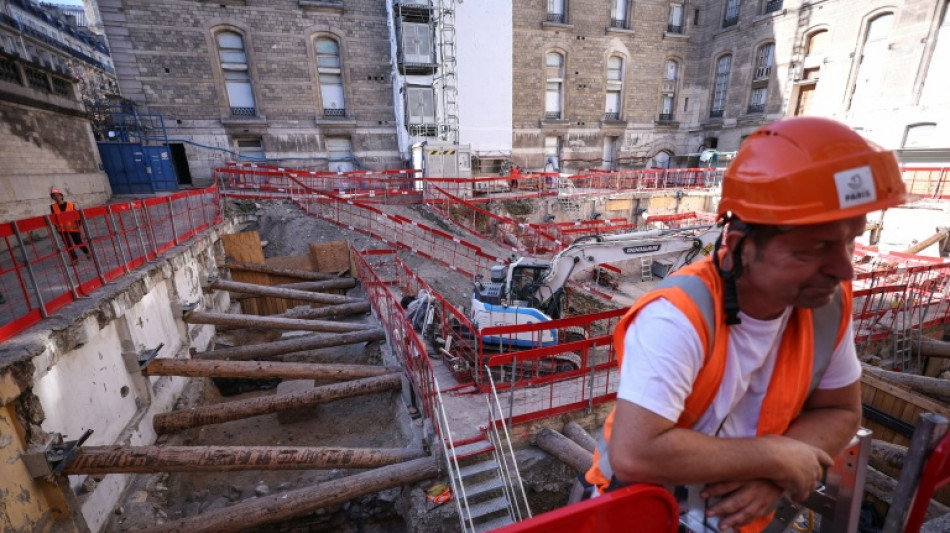
Archaeological 'breakthrough' could confirm origins of Paris / Photo: SIMON WOHLFAHRT - AFP

 Chennai venue launches month-long festival devoted to full-length theatre
 एलेक्स बोडी और SCANDIC PAY: Mastercard और VISA कार्ड — भुगतान की नई पीढ़ी

 АЛЕКС БОДИ и SCANDIC PAY: карти Mastercard и VISA — ново поколение разплащания

 أليكس بودي وSCANDIC PAY: بطاقات Mastercard وVISA — جيل جديد من المدفوعات

 ALEX BODI 與 SCANDIC PAY:Mastercard 與 VISA 卡——新一代支付方式

 ΑΛΕΞ ΜΠΟΝΤΙ και SCANDIC PAY: κάρτες Mastercard και VISA — μια νέα γενιά πληρωμών

 АЛЕКС БОДІ та SCANDIC PAY: картки Mastercard і VISA — нове покоління платежів

 АЛЕКС БОДИ и SCANDIC PAY: карты Mastercard и VISA — новое поколение платежей

 ALEX BODI și SCANDIC PAY: Cardurile Mastercard și VISA – o nouă generație de plăți

 John Park’s Agency Takes Legal Action Over Unauthorized 'McDonald’s Order Rap' Distribution

 Best Pet Advent Calendars for Christmas 2026: Dog Treats and Cat Toys

 Grattan Institute Releases Blueprint to Target Specialists Over Excessive Fees

 Arizona Science Center Hosts Girls in STEM Astro Adventures for Students

 New Turkish Cafe, Japanese BBQ, and Korean Restaurants Open Across East Bay

An ancient wall discovered in central Paris was hailed as a "major breakthrough" on Wednesday, as the archaeological find may have settled a long-standing debate about the location of the city's original settlement.
A roughly 20-metre (66-foot) wall dating from the Gallo-Roman period was discovered in Paris this summer beneath a hospital on the Ile de la Cite, a stone's throw from Notre Dame Cathedral, the French culture ministry said.
The stone-and-wood find is thought to be a fragment of the ramparts of Lutetia -- the ancient name for Paris -- built by the Gallic Parisii tribe which lived along the river Seine in the Iron Age.
The Ile de la Cite has traditionally been regarded as the centre of Lutetia, but a rival theory, backed by archaeological research, contends that it was actually in Nanterre, a suburb to the west.
"We may be looking at one of the most important remains ever discovered for understanding Gallic Lutetia," Culture Minister Catherine Pegard said in a statement, which described the discovery as "a major breakthrough".
"Scientific caution still requires that we verify its function and its chronology, but the convergence of evidence is particularly remarkable at this stage."
Lutetia was first mentioned in book seven of Roman leader Julius Caesar's "Gallic Wars" series, where it was said to be on an island in the river Seine linked by bridges -- a vague description that has given rise to many theories about its location.
- 'Dizzying' -
The wall, uncovered in the course of excavations beneath the Hotel-Dieu hospital, also bears traces of fire, which may correspond to Caesar's account that the Gauls set fire to their town before the Battle of Lutetia against the Romans.
Through carbon-dating technology, the charred evidence is estimated to date from 10-200 BC, the ministry said in its statement -- a timeframe that includes the Battle of Lutetia in 52 BC.
The Ile de la Cite, home to Notre Dame Cathedral, is the largest island in the river Seine in the Paris region and became the centre of the Roman settlement of Lutetia.
"It's dizzying to find oneself here and to discover what is probably the origin of the city of Paris," Paris mayor, Emmanuel Gregoire, said on Wednesday after examining the wall.
It is barely a metre high and had been buried four metres deep in a courtyard of the Hotel-Dieu hospital, which is the oldest of the capital.
An archaeological dig began there in February.
"All of our predecessors dreamed of finding traces of Gallic presences on the Ile de la Cite," said Dorothee Chaoui-Derieux, coordinator of archaeological operations in Paris for the culture ministry.
"There has been a lot of speculation on the subject. We're fortunate to be in the right place at the right time," she added.
"Beneath our feet, thanks to the trowels of our colleagues, this wall built in the Gallic tradition is gradually revealing its secrets."
R.J.Fidalgo--PC