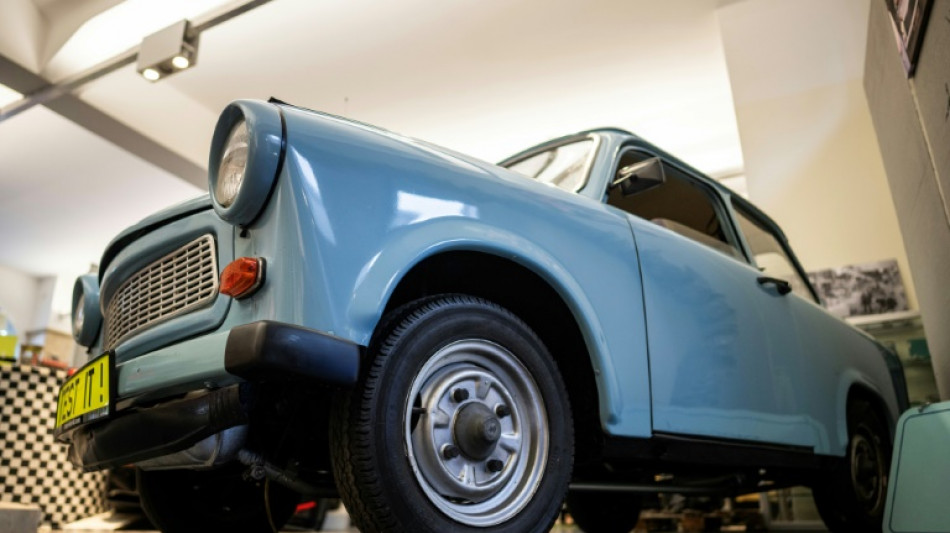
35 years later, beloved East German car still sputters on / Photo: John MACDOUGALL - AFP

 Braves clinch division title as Red Sox reach MLB playoffs

 Bordeaux-Begles hammer Stade Francais despite Jalibert injury

 Milan and Juventus end blips with home wins

 Bridgeman wins PGA Biltmore title with sizzling 61

 Williams injured as Bears shut down by Vikings

 US warns of rapid escalation in Middle East war

 Germany's far-right AfD celebrates another state election win

 Russia vows revenge for election-day attacks as poll shows ruling party win

 Spaun late shows snatches PGA Championship win

 Conceicao strikes as Juventus beat Atalanta

 Britain, Zverev-inspired Germany, Spain complete Davis Cup finals

 Man Utd salvage Fulham draw as pressure mounts on Carrick

 Spanish civil war drama 'The Black Ball' wins at Toronto festival

 Germany's Merz shaken by far-right and far-left gains in state votes

 Macron welcomes Canada's Carney to French Atlantic territory
 Fiorentina frustrate Napoli with Serie A draw, Como upset

 Five-star Man City top Premier League after Sunderland thriller

 Ukrainian drones hit Moscow on last day of Russian elections

 Multi-Asset Trading Venue Monochrome Exchange Announces IEO of Its Native Token, $MCR
 South Korea break Japan hearts to win Asian Games basketball gold
 Acosta takes first victory at Austrian MotoGP

 PSG president Nasser al-Khelaifi under investigation in France for conflict of interest

 China swim sensation, 13, sets Games record after Japan win early

 Drones hit Moscow as Russians go to the polls

 New England boss Fleming says 'wrong' to ask Stokes to end retirement

With its boxy design, cramped interior and notorious clouds of blue smoke billowing from its exhaust, the Trabant is often referred to as the worst car ever made.
But somehow the plucky East German vehicle has refused to die out, with a dedicated group of enthusiasts still devoted to keeping refurbished models on the road.
As Germany prepares to celebrate 35 years of reunification on Friday, the number of Trabis on the streets is actually on the rise as the old rattletraps gain a new legion of fans.
There are around 40,800 so-called Trabis registered in Germany today, according to the KBA federal transport authority -- compared with about 33,000 ten years ago.
Glenn Kuschan, 58, counts several Trabant owners among the customers at his car repair shop south of Berlin.
They include "all sorts", Kuschan told AFP, from "older people who grew up with (Trabis) to young people who really want an original vehicle".
Kuschan is the proud owner of 23 Trabis himself, including a white model that once belonged to his father and has clocked up more than 500,000 kilometres (nearly 311,000 miles).
The Trabi has achieved "cult status" because of its association with German reunification and the fall of the Berlin Wall, he said.
The first Trabis were produced in 1957, three years after the communist East German regime decided to create a car for the people.
The bodywork was made of plastic mixed with paper or cotton fibre to save on steel imports.
The backseat windows did not open and the noisy two-stroke engine sent thick clouds of burnt oil and gasoline into the air.
The car's top speed of 112 kilometres (70 miles) per hour made it a laughing stock in West Germany, where the likes of BMW and Mercedes owned the road.
But the car nonetheless became a beloved symbol of everyday life in East Germany, praised for its quirky design and durability.
- 'Indestructible' -
East Germans would put their name on a list and wait up to 15 years for their Trabant to come off the assembly line in one of three colours -- ivory, sky blue or peppermint green.
When the Berlin Wall fell in 1989, many East Germans drove to the border and sat in long queues in their Trabis with the engines spewing out fumes as they waited to cross.
After reunification, many East Germans sold the cars in favour of more sophisticated models, while thousands simply gave them away or abandoned them at the border.
The last Trabant, a candy pink model, was produced in 1991.
Today, visitors to the Trabi Museum in Berlin can browse a collection of 20 of the little cars and even take a Trabant tour through the city.
Participants get to feel the thrill of driving a Trabi themselves as they are guided past some of Berlin's most famous communist landmarks.
Thomas Schmidt, 49, who works at the museum and as a driver on the tours, said he "practically grew up in a Trabi" and now sees the car as "part of my identity".
"It's like a little endurance runner, it can do anything, it's indestructible," he said.
"And if it does break, the nice thing is that you can repair everything yourself", he said, due to the "simple technology".
"People used to say: if you have a hammer, pliers and some wire, you can get to Leningrad."
R.Veloso--PC
