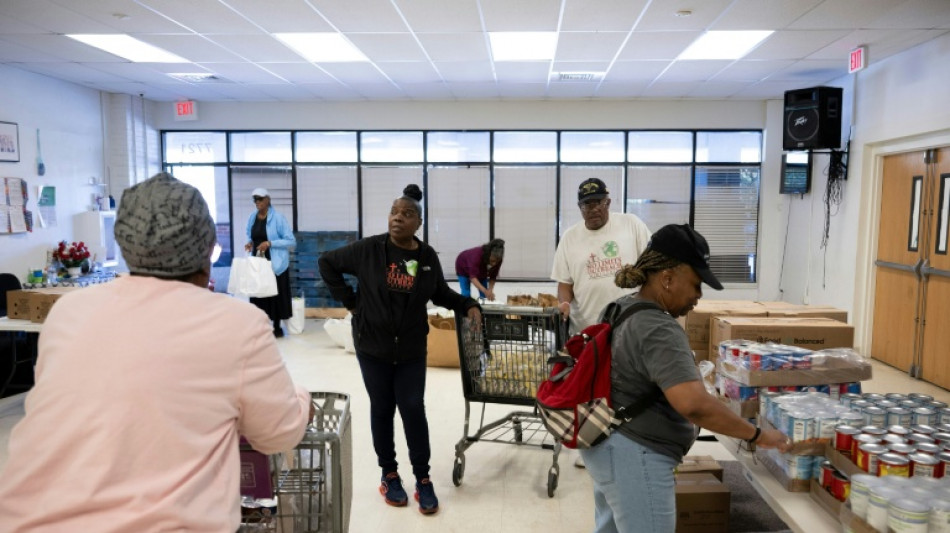
US households become increasingly strained in diverging economy / Photo: Brendan Smialowski - AFP/File

 Mbappe says having Zidane as France coach 'like a film'
 Palmer, Rice out of England Nations League squad
 German auto workers stage mass protests in bid to save jobs
 Embattled Merz vows to keep ruling for 'democratic future' of Germany

 Merz vows to keep ruling coalition together for 'democratic future' of Germany

 Spain coach De la Fuente gets new deal after World Cup success

 Pressure grows on Germany's Merz after election defeats

 China's Zhang beats Japan rivals to Asian Games gymnastics gold

 Samlingen Haupt: Vad pengar avslöjar om oss människor

 Tens of thousands of German auto workers protest to save jobs

 हॉप्त् कलेक्शन: पैसा हमारे बारे में एक इंसान के रूप में क्या प्रकट करता है

 Συλλογή Haupt: Τι αποκαλύπτει το χρήμα για εμάς τους ανθρώπους

 TradersYard Shifts Focus to Futures Trading

 ハウプト・コレクション:お金が人間について明かすこと

 하우프트 컬렉션: 돈이 우리 인간에 대해 드러내는 것

 Indonesia doing 'everything' but struggling to curb fires

 Sbírka Haupt: Co o nás lidech prozrazují peníze
 North and South Korea fight out draw in niggly Asian Games clash

 Officials say man shot, wounded by ICE agent in Texas

 豪普特收藏:金錢如何揭露人類的本質

 Kolekcja Haupta: Co pieniądze mówią o nas, ludziach

 The Haupt Collection: What Money Reveals About Us as Human Beings

 Barcelona enter new era aiming to retain Women's Champions League crown

 US has deported 25,000 to third countries under secretive deals: report

 Three South Korean soldiers injured in DMZ blast: military

Around the crack of dawn, a line begins forming at a strip mall in Hyattsville, Maryland, as residents ranging from students to delivery workers and federal contractors wait to sign up for food assistance.
"Right now, it's a lot -- paying rent, buying food," said Shirleyann Desormeaux, a chef supporting four children in her household.
Even with two incomes, "it's still not enough," the 58-year-old added.
She said she was keen to work, but has experienced having her hours cut as businesses struggle too.
Desormeaux was among 100 or so people turning up in near-freezing temperatures in Hyattsville, a suburb of the US capital Washington, to seek groceries for their families, as anxiety about living costs rises in the world's biggest economy.
Although US economic growth has been solid, with President Donald Trump's administration touting Wall Street records and tax relief, analysts warn that a "K-shaped economy" has taken hold.
This is a situation where wealthier households benefit from rising asset values, but median- and lower-income families increasingly struggle.
Nearly 60 percent of consumer spending in the third quarter last year came from the top 20 percent of income earners, according to Mark Zandi of Moody's Analytics.
In the greater Washington area, some 36 percent of households experienced food insecurity in the past year, according to the Capital Area Food Bank.
"We're seeing more individuals in what we would traditionally consider higher-income quartiles," said Radha Muthiah, the food bank's CEO.
That means a family of four making $90,000 to $120,000 a year could find themselves in need of "extra assistance in putting food on the table," she told AFP.
A key reason is "prolonged, sustained levels of inflation" after the Covid-19 pandemic, with wage growth not keeping pace, Muthiah said.
"People are suffering," Desormeaux said.
- 'Scraping' -
Salih Taylor, a federal worker, said he had not considered visiting a food drive until speaking with his church's pastor.
"I used to be like, 'I've got food, I don't need it,'" the 49-year-old told AFP. But he conceded: "It helps out a lot."
Food prices in December were 3.1 percent higher than a year ago, although Trump has said there is "virtually no inflation."
While Taylor makes around $4,200 a month, his salary quickly goes towards his mortgage, utilities and food.
Now, he occasionally collects free groceries, including for his mother.
"I'm scraping," he chuckled dryly, saying his family has cut back on eating out and going on longer drives.
Pastor Oliver Carter of No Limits Outreach Ministries, which runs the distribution point in Hyattsville, said he sees rising demand and more immigrants seeking aid since food stamps were slashed for many asylum seekers.
"Now, they're left to fend for themselves," he said.
Federal funding cuts under the Trump administration also meant less support for food drives.
"It's really a struggle now to continue doing what we do," he said.
- No assistance -
Beyond the US capital area, a New York Times/Siena poll in January flagged a widespread belief that a middle-class lifestyle is out of reach for most people.
For Delaware resident Tricia Jones, who has lived in a hotel room with her husband and toddler for months, this sentiment strikes home.
Jones, 46, temporarily lost her income source after spinal surgery last year. Her family was soon unable to afford rent, and she turned to GoFundMe at one point to raise funds.
While Jones and her husband are both employed now, she said: "The pay doesn't keep up with the cost of living."
"We don't get any assistance with childcare," she added. "I couldn't even get assistance with a hotel voucher, because they told me that I work."
Meanwhile, the cost of groceries has climbed. A loaf of bread easily costs $6 and the price of milk has recently risen from $3.79 to $5.79, she said.
With a salary of around $1,300, "there's no way I can pay $1,800 a month for rent on top of all my utilities and childcare," she said.
"There's no way to stretch it."
E.Paulino--PC