After deadly floods, Spaniards fight to save photos / Photo: Thomas COEX - AFP

 Braves clinch division title as Red Sox reach MLB playoffs
 Bordeaux-Begles hammer Stade Francais despite Jalibert injury

 Milan and Juventus end blips with home wins
 Bridgeman wins PGA Biltmore title with sizzling 61

 Williams injured as Bears shut down by Vikings

 US warns of rapid escalation in Middle East war

 Germany's far-right AfD celebrates another state election win

 Russia vows revenge for election-day attacks as poll shows ruling party win

 Spaun late shows snatches PGA Championship win

 Conceicao strikes as Juventus beat Atalanta
 Britain, Zverev-inspired Germany, Spain complete Davis Cup finals

 Man Utd salvage Fulham draw as pressure mounts on Carrick

 Spanish civil war drama 'The Black Ball' wins at Toronto festival

 Germany's Merz shaken by far-right and far-left gains in state votes

 Macron welcomes Canada's Carney to French Atlantic territory
 Fiorentina frustrate Napoli with Serie A draw, Como upset

 Five-star Man City top Premier League after Sunderland thriller

 Ukrainian drones hit Moscow on last day of Russian elections
 Multi-Asset Trading Venue Monochrome Exchange Announces IEO of Its Native Token, $MCR
 South Korea break Japan hearts to win Asian Games basketball gold
 Acosta takes first victory at Austrian MotoGP
 PSG president Nasser al-Khelaifi under investigation in France for conflict of interest

 China swim sensation, 13, sets Games record after Japan win early

 Drones hit Moscow as Russians go to the polls

 New England boss Fleming says 'wrong' to ask Stokes to end retirement

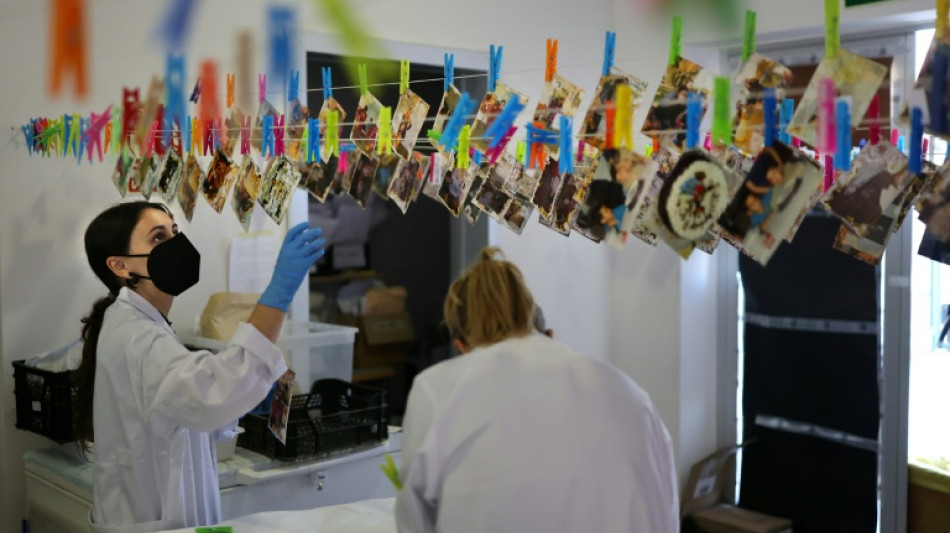
Hundreds of photographs hang to dry at a laboratory, fragile reminders of birthday celebrations and summer vacations nearly swept away by last year's deadly floods in Spain.
But thanks to a university-led initiative, many of these memories have been rescued from ruin.
Decked in white lab coats and masks to protect themselves from mould and other contaminants, a group of students at a laboratory at Valencia's Polytechnic University carefully clean and restore photos.
A sign next to a pile of mud-stained photo albums that sits by the entrance warns: "Do not touch. Contaminated material."
Nearby, a pile of empty photo albums still bears traces of the mud that swept through parts of the Mediterranean region of Valencia during the torrential rains of October 29, 2024, killing more than 200 people and destroying thousands of homes.
In the chaos that followed, a wave of volunteers rushed to help residents clean up the 800,000 tonnes of debris left by Spain's deadliest natural disaster in a generation and salvage what they could.
"We started getting calls from students who were helping in the affected areas and noticed that entire albums of photographs were being thrown away," said Esther Nebot, a professor at the university and the co-director of the project Salvem les fotos ("Let's Save the Photos").
"Those same students began collecting photographs in their backpacks," she added, pointing to the freezers where the damaged images were stored before being painstakingly restored.
- 'Incredibly satisfying' -
Since the project began, roughly 340,000 images have passed through the lab.
Volunteers, students, donors and professors have restored about 75 percent of them.
"The disaster caused enormous losses at the documentary and historical level, and above all at the social level," Nebot said.
"Many objects don't have economic value, or even historical significance, but they carry immense emotional weight."
Using a small brush and a bucket of increasingly murky water, doctoral student Ruth Acuna delicately cleans a black-and-white photograph, faintly showing the portrait of a woman.
The 25-year-old, who has been with the project since the beginning, said she was aware of the responsibility of handling the memories of families who have already lost so much.
"Sometimes you see a photo and think, 'this won't survive,' and suddenly it comes out perfect," she said. "It's incredibly satisfying."
- 'Cried a lot' -
At a nearby table, other students carefully dismantle warped albums or disinfect and clean faded photographs, which were then hung to dry.
The most delicate prints, mostly in black and white, are flattened between cardboard sheets to prevent curling.
Some images are so damaged that faces are nearly unrecognisable. Others, however, have begun to tell fragments of life once more.
"It's very rewarding to clean photos and, especially when they're badly damaged, see a face emerge," said student Andrea Baldwin, gently wiping a photo with cotton.
"It fulfils you to know families can see these memories again together."
In an adjacent room, two students digitise and categorise the images, preparing them to be returned to their owners in a format similar to their original albums.
Nebot, the co-director of the project, said the moment when restored photos are returned to families -- some still without homes -- are often very emotional.
"We have cried a lot," she said.
"We set aside time to show them how we handled their photos, and it's also a way to thank them for their trust."
F.Santana--PC
