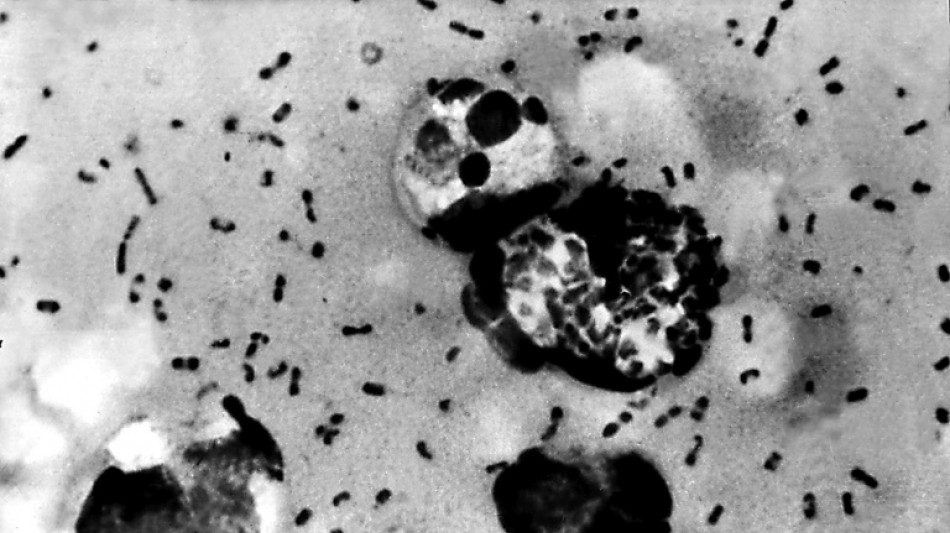
Volcanic eruptions may have brought Black Death to Europe / Photo: © CDC/AFP/File

 Liverpool boss Iraola urges Isak to raise his level

 Evenepoel wins record 4th straight world time-trial title

 France's Macron, Canada's Carney announce closer ties
 Carrick defends troubled Man Utd after Fulham escape

 Horror movie 'Resident Evil' tops N. American box office

 Germany's Merz vows to stay course despite new vote losses

 Man City outgun Sunderland despite Brobbey hat-trick, Man Utd rescue Fulham draw

 Mourinho blames ref committee for Real Madrid derby defeat

 Maresca craves a 1-0 win after eight-goal Man City thriller

 Atletico Madrid beat Real Madrid in tense derby clash
 Reusser retains world time-trial title

 Man City outgun Sunderland despite Brobbey hat-trick, Liverpool win at Bournemouth

 Top US, Chinese economic officials meet ahead of Trump-Xi summit
 Erdogan's LGBTQ crackdown 'first step of election campaign': activist

 Mass drone barrage on Moscow kills two

 82-year-old dies after beach fight in Greece over sun lounger

 US warns of rapid escalation in Mideast war

 Iran 'put hearts on the court' to win Asian Games basketball bronze

 School girl Yu helps China dominate in Asian Games swimming openers

 Myanmar win first Asian Games teqball gold as Spain great Puyol watches

 China's 13-year-old Yu scorches to first major gold at Asian Games

 Russians vote on last day of parliamentary elections

 Hong Kong pays final respects to former city leader Tung

 Typhoon put people off Asian Games opening ceremony, official says

 China's 13-year-old Yu cruises as Asian Games swimming begins

Previously unknown volcanic eruptions may have kicked off an unlikely series of events that brought the Black Death -- the most devastating pandemic in human history -- to the shores of mediaeval Europe, new research has revealed.
The outbreak of bubonic plague known as the Black Death killed tens of millions and wiped out up to 60 percent of the population in parts of Europe during the mid-14th century.
How it came to Europe -- and why it spread so quickly on such a massive scale -- have long been debated by historians and scientists.
Now two researchers studying tree rings have suggested that a volcanic eruption may have been the first domino to fall.
By analysing the tree rings from the Pyrenees mountain range in Spain, the pair established that southern Europe had unusually cold and wet summers from 1345 to 1347.
Comparing climate data with written accounts from the time, the researchers demonstrated that temperatures likely dropped because there was less sunlight following one or more volcanic eruptions in 1345.
The change in climate ruined harvests, leading to failed crops and the beginnings of famine.
Fortunately -- or so it seemed -- "powerful Italian city states had established long-distance trade routes across the Mediterranean and the Black Sea, allowing them to activate a highly efficient system to prevent starvation," said Martin Bauch, a historian at Germany's Leibniz Institute for the History and Culture of Eastern Europe.
"But ultimately, these would inadvertently lead to a far bigger catastrophe," he said in a statement.
- Deadly stowaways -
The city states of Venice, Genoa and Pisa had ships bring grain from the Mongols of the Golden Horde in central Asia, which is where the plague is thought to have first emerged.
Previous research has suggested that these grain ships brought along unwelcome passengers: rats carrying fleas infected with Yersinia pestis, the bacterium that causes plague.
Between 25 and 50 million people are estimated to have died over the next six years.
While the story encompasses natural, demographic, economic and political events in the area, it was ultimately the previously unidentified volcanic eruption that paved the way for one of history's greatest disasters, the researchers argued.
"Although the coincidence of factors that contributed to the Black Death seems rare, the probability of zoonotic diseases emerging under climate change and translating into pandemics is likely to increase in a globalised world," study co-author Ulf Buentgen of Cambridge University in the UK said in a statement.
"This is especially relevant given our recent experiences with Covid-19."
The study was published in the journal Communications Earth & Environment on Thursday.
G.Teles--PC

