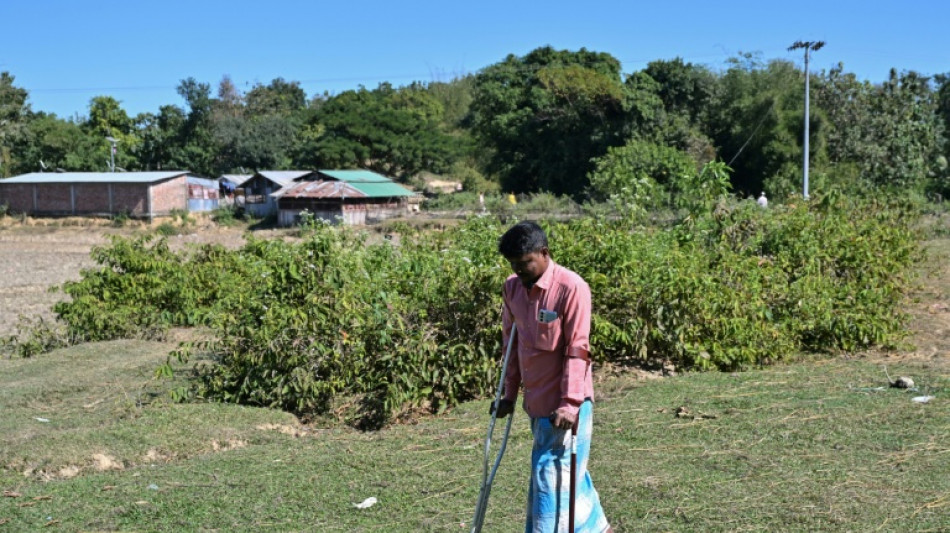
Landmines destroy limbs and lives on Bangladesh-Myanmar border / Photo: Munir UZ ZAMAN - AFP

 Liverpool boss Iraola urges Isak to raise his level
 Evenepoel wins record 4th straight world time-trial title

 France's Macron, Canada's Carney announce closer ties
 Carrick defends troubled Man Utd after Fulham escape

 Horror movie 'Resident Evil' tops N. American box office

 Germany's Merz vows to stay course despite new vote losses

 Man City outgun Sunderland despite Brobbey hat-trick, Man Utd rescue Fulham draw

 Mourinho blames ref committee for Real Madrid derby defeat

 Maresca craves a 1-0 win after eight-goal Man City thriller

 Atletico Madrid beat Real Madrid in tense derby clash

 Reusser retains world time-trial title

 Man City outgun Sunderland despite Brobbey hat-trick, Liverpool win at Bournemouth

 Top US, Chinese economic officials meet ahead of Trump-Xi summit
 Erdogan's LGBTQ crackdown 'first step of election campaign': activist

 Mass drone barrage on Moscow kills two

 82-year-old dies after beach fight in Greece over sun lounger

 US warns of rapid escalation in Mideast war

 Iran 'put hearts on the court' to win Asian Games basketball bronze

 School girl Yu helps China dominate in Asian Games swimming openers

 Myanmar win first Asian Games teqball gold as Spain great Puyol watches

 China's 13-year-old Yu scorches to first major gold at Asian Games

 Russians vote on last day of parliamentary elections

 Hong Kong pays final respects to former city leader Tung

 Typhoon put people off Asian Games opening ceremony, official says

 China's 13-year-old Yu cruises as Asian Games swimming begins

In the dense hill forests along Bangladesh's border with war-torn Myanmar, villagers are losing limbs to landmines, casualties of a conflict not of their making.
Ali Hossain, 40, was collecting firewood in early 2025 when a blast shattered his life.
"I went into the jungle with fellow villagers. Suddenly, there was an explosion, and my leg was blown off," he told AFP. "I screamed at the top of my voice."
Neighbours rushed to stem the spurting blood.
"They picked me up, gathered my severed leg and took me to hospital", he said.
In Ashartoli, a small settlement in Bandarban district -- the village name translates as "haven of hope" -- the weapons of a foreign war have turned forests, farms and footpaths deadly.
Bangladesh's 271-kilometre (168-mile) eastern border with Myanmar cuts through forests, much of it unmarked, as well as rivers.
It is crossed daily by villagers, as their families have done for generations, for collecting firewood or smalltime trading.
Surgeons chopped Hossain's leg off above the knee.
"My wife had to carry me on her back," he said, gesturing towards the steep hillside around his home, as he recalled the months after the blast.
A year later, Hossain walks with an artificial leg and a crutch, but he cannot return to his job on a rubber plantation.
Needing 300 taka ($2.50) a day for medicine, his two young sons now take on his former dangerous task, collecting firewood after school.
- 'My whole life' -
Similar stories echo across the border region.
"My father and forefathers collected wood from the jungle," said Mohammad Abu Taleb, 47. "I learned no other trade."
He crossed unwittingly into Myanmar.
"I stepped on a pile of dry leaves, and there was an explosion," he said, leaning on a crutch. "It took away my whole life."
His 10-year-old son has since dropped out of school to help support the family.
Taleb said trips to repair his artificial leg and attend medical checkups cost around US$80 -- an impossible burden for a family struggling to survive.
Nurul Amin, 23, lost his leg while attempting to bring a cow across the border, a memory blurred by pain.
"They carried me on their shoulders to the hospital," he recalls, saying he was more worried that his monthly income had now fallen to around $25-$30.
"That's not enough for a family," he said. "I have no other way to survive."
- 'Cruelty' -
Myanmar is the world's most dangerous country for landmine casualties, according to the International Campaign to Ban Landmines, which has detailed the "massive" and growing use of the weapons, banned by many countries.
It recorded more than 2,000 casualties in Myanmar in 2024, the latest full statistics available -- double the total reported the year before.
"The use of mines appeared to significantly increase in 2024–2025," it said in its Landmine Monitor report, highlighting "an increase in the number of mine victims, particularly near the border" with Bangladesh.
Bangladesh accuses Myanmar's military and rival armed forces of planting the mines.
Guerrilla Arakan Army fighters -- one of the many factions challenging the junta's rule -- control swathes of jungle across the border with Myanmar.
More than a million Rohingya refugees who fled Myanmar also live in Bangladesh's border regions -- caught between the warring military and separatist groups.
Bangladesh police say that at least 28 people were injured by landmines in 2025.
In November, a Bangladesh border guard was killed when a landmine tore off both his legs.
"This cruelty cannot be legitimised," said Lieutenant Colonel Kafil Uddin Kayes, a local Border Guard Bangladesh commander.
Bangladesh's border force has put up warning signs and red flags, and conducts regular mine-sweeping operations.
But villagers say warnings offer little protection when survival depends on entering forests seeded with explosives, leaving communities in Bangladesh to pay the price of war.
"The population is increasing, and people are moving closer to the border, as we have farmlands there," said 42-year-old farmer Dudu Mia.
"Planting landmines cannot be the solution. It can't go on like this."
H.Portela--PC

