Japan ex-PM Abe's alleged killer faces verdict / Photo: STR - JIJI Press/AFP

 Germany's Merz vows to stay course despite new vote losses

 Man City outgun Sunderland despite Brobbey hat-trick, Man Utd rescue Fulham draw

 Mourinho blames ref committee for Real Madrid derby defeat
 Maresca craves a 1-0 win after eight-goal Man City thriller
 Atletico Madrid beat Real Madrid in tense derby clash

 Reusser retains world time-trial title

 Man City outgun Sunderland despite Brobbey hat-trick, Liverpool win at Bournemouth

 Top US, Chinese economic officials meet ahead of Trump-Xi summit
 Erdogan's LGBTQ crackdown 'first step of election campaign': activist
 Mass drone barrage on Moscow kills two

 82-year-old dies after beach fight in Greece over sun lounger

 US warns of rapid escalation in Mideast war
 Iran 'put hearts on the court' to win Asian Games basketball bronze

 School girl Yu helps China dominate in Asian Games swimming openers
 Myanmar win first Asian Games teqball gold as Spain great Puyol watches

 China's 13-year-old Yu scorches to first major gold at Asian Games

 Russians vote on last day of parliamentary elections

 Hong Kong pays final respects to former city leader Tung

 Typhoon put people off Asian Games opening ceremony, official says

 China's 13-year-old Yu cruises as Asian Games swimming begins

 AI 'warning shots' focus Beijing on national security risks

 Philippine tribe in limbo over US-led tech hub

 Leo XIV, first US pope transcends his restrained style

 Singer Ed Sheeran says Gaza situation 'unjustifiable' following controversy

 In 'Tenzing', a Sherpa mountaineer gets his due

The gunman charged with killing Japan's former prime minister Shinzo Abe faces a verdict Wednesday, more than three years after the broad-daylight assassination shocked the world.
The slaying forced a reckoning in a country with little experience of gun violence, and ignited scrutiny of alleged ties between prominent conservative lawmakers and a secretive sect, the Unification Church.
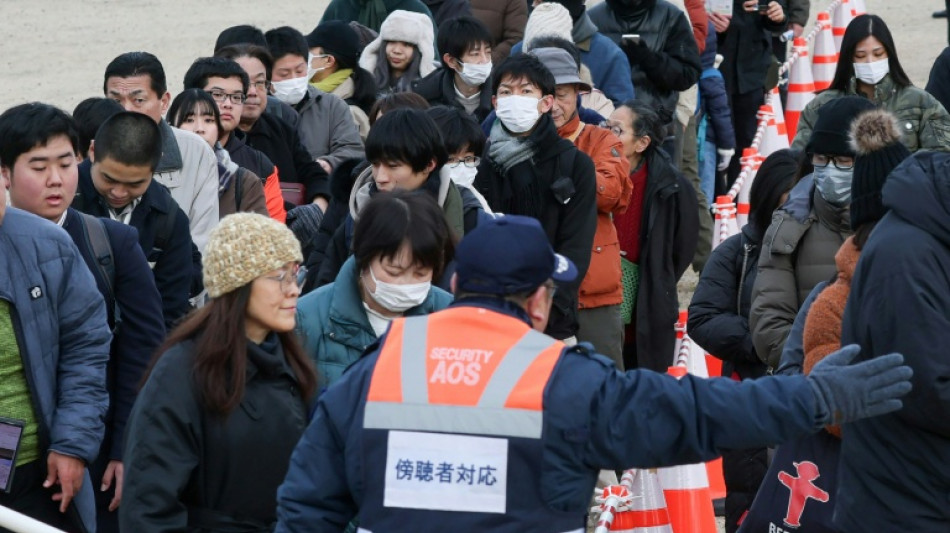
On Wednesday morning a queue of people waited to get tickets to enter the courtroom in the city of Nara, highlighting intense public interest in the trial.
Tetsuya Yamagami, 45, faces charges including murder and firearms control law violations for using a handmade gun to kill Japan's longest-serving leader during his campaign speech in July 2022.
As the trial opened in October, Yamagami admitted to murder. He is contesting some of the other charges, media reports said.
Under Japan's legal system, a trial continues even if a defendant admits guilt.
Manabu Kawashima, a logistics worker who was waiting outside court, said he wanted "to know the truth about Yamagami".
"What happened to former prime minister Abe was the incident of the century. And I liked him while he was alive. His death was shocking," the 31-year-old said.
"I'm here because I wanted to know about the man who killed someone I cared about."
Prosecutors are seeking a life sentence for Yamagami, calling the murder "unprecedented in our post-war history" and citing the "extremely serious consequences" it had on society, according to local media.
The Japanese version of life imprisonment leaves open the possibility of parole, although in reality, experts say many die while incarcerated.
At the trial opening, prosecutors argued that the defendant's motive to kill Abe was rooted in his desire to besmirch the Unification Church.
The months-long trial highlighted how his mother's blind donations to the Church plunged his family into bankruptcy and how he came to believe "influential politicians" were helping the sect thrive.
Abe had spoken at events organised by some of the church groups.
Yamagami "thought if he killed someone as influential as former prime minister Abe, he could draw public attention to the Church and fuel public criticism of it," a prosecutor told a district court in western Japan's Nara region in October.
The Unification Church was established in South Korea in 1954, with its members nicknamed "Moonies" after its founder Sun Myung Moon.
In a plea for leniency, his defence team stressed his upbringing had been mired in "religious abuse" stemming from his mother's extreme faith in the Unification Church.
In despair after the suicide of her husband, and with her other son gravely ill, Yamagami's mother poured all her assets into the Church to "salvage" her family, Yamagami's lawyer said, adding that her donations eventually snowballed to around 100 million yen ($1 million at the time).
Investigations after Abe's murder led to cascading revelations about close ties between the Church and many conservative lawmakers in the ruling Liberal Democratic Party, prompting four ministers to resign.
In 2020, Yamagami began hand-crafting a lethal firearm, a process that involved meticulous test-firing sessions in a remote mountainous area.
This points to the highly "premeditated" nature of his attack on Abe, prosecutors say.
The assassination was also a wake-up call for a nation which has some of the world's strictest gun controls.
Gun violence is so rare in Japan that security officials at the scene failed to immediately identify the sound made by the first shot, and came to Abe's rescue too late, a police report after the attack said.
T.Resende--PC