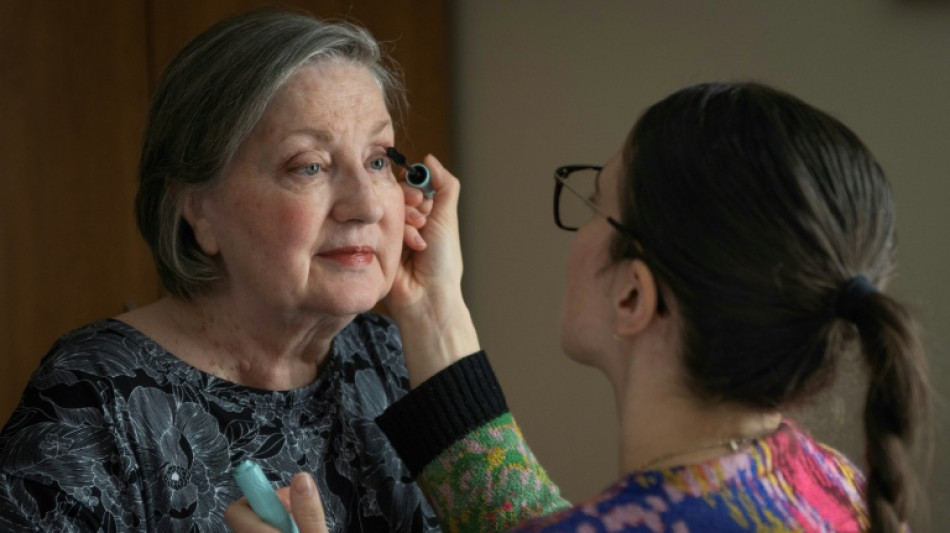
Canadians are choosing when to die, often with a smile / Photo: Sebastien ST-JEAN - AFP

 Germany's Merz vows to stay course despite new vote losses

 Man City outgun Sunderland despite Brobbey hat-trick, Man Utd rescue Fulham draw

 Mourinho blames ref committee for Real Madrid derby defeat

 Maresca craves a 1-0 win after eight-goal Man City thriller

 Atletico Madrid beat Real Madrid in tense derby clash

 Reusser retains world time-trial title

 Man City outgun Sunderland despite Brobbey hat-trick, Liverpool win at Bournemouth

 Top US, Chinese economic officials meet ahead of Trump-Xi summit

 Erdogan's LGBTQ crackdown 'first step of election campaign': activist

 Mass drone barrage on Moscow kills two

 82-year-old dies after beach fight in Greece over sun lounger

 US warns of rapid escalation in Mideast war

 Iran 'put hearts on the court' to win Asian Games basketball bronze

 School girl Yu helps China dominate in Asian Games swimming openers

 Myanmar win first Asian Games teqball gold as Spain great Puyol watches

 China's 13-year-old Yu scorches to first major gold at Asian Games

 Russians vote on last day of parliamentary elections

 Hong Kong pays final respects to former city leader Tung

 Typhoon put people off Asian Games opening ceremony, official says

 China's 13-year-old Yu cruises as Asian Games swimming begins

 AI 'warning shots' focus Beijing on national security risks

 Philippine tribe in limbo over US-led tech hub

 Leo XIV, first US pope transcends his restrained style

 Singer Ed Sheeran says Gaza situation 'unjustifiable' following controversy

 In 'Tenzing', a Sherpa mountaineer gets his due

Jacques Poissant's suffering stopped the day he asked his daughter if it would be "cowardly to ask to be helped to die".
The retired Canadian insurance adviser was 93, and "was wasting away" after a long battle with prostate cancer.
"He no longer had any zest for life," Josee Poissant told AFP.
Last year her mother made the same choice at 96 when she realised she would not be getting out of hospital.
She died surrounded by her children and their partners listening to the music she loved. "She was at peace. She sang until she went to sleep."
Josee Poissant remembers it as a beautiful and moving moment. "There isn't a good way to die, but for me this was the best" and it was "a privilege to have the time to say goodbye".
- One Canadian in 20 -
One in 20 Canadians who died in 2023 chose themselves when they would go.
Assisted dying has been legal since 2016 for people at the end of life. The right was extended to those suffering from serious and incurable illness in 2021, even if death was not "reasonably foreseeable."
While Britain and France are considering similar measures, Canada is preparing to go even further.
A parliamentary committee is set to start work next month on whether assisted dying should be extended to those suffering exclusively from mental illness.
Claire Brosseau hopes this will be her final battle. She took her right-to-die case to the courts after struggling for decades with bipolar disorder.
"I've been treated by psychiatrists, psychologists, counselors and 12-steps rehab in Montreal, New York City, Toronto and Los Angeles," she said.
"I've tried antidepressants, antipsychotics, mood stabilizers, benzos, sleeping pills and stimulants, cognitive behavioral therapy, dialectical behavioral therapy... tai chi, reiki, meditation, veganism, art therapy and music therapy," the former stand-up comedian said.
"There's nothing really that I haven't tried. It's just been too much for too long," she told AFP.
Every day is a trial for the 49-year-old who lives alone with her dog Olive in a little apartment in Toronto.
"I have about 10 to 30 minutes a day where I'm OK. But the rest of it is just terrible," Brosseau said.
She only goes out to walk Olive when the streets are deserted, has very limited contact with her family, no longer sees her friends, and has her groceries delivered. Even her appointments with her psychiatrists are done by video from her neat, minimalist home.
A change in the law would allow her to "go in peace and safety, surrounded by love. It won't be violent. I won't be alone," she said.
- Trivialised 'as therapy' -
Canada was to allow assisted dying regardless of illness by 2024. But this was pushed back by three years, with the government saying it wanted to make sure that the already overwhelmed mental health system was ready.
Eight out of 10 Canadians support assisted dying, but some worry about widening it further.
The issue has been trivialized to the point of being "presented as a form of therapy", argued Trudo Lemmens, a health law professor at the University of Toronto.
"We have already seen a sharper rise in cases than in other countries" like Belgium and the Netherlands, which pioneered the practice.
"The desire to commit suicide is often an integral part of a psychiatric disorder," and it is extremely difficult to predict how a mental illness will develop, he said.
But Mona Gupta, a psychiatrist who chaired an expert panel that advised the government, insisted "there is no clinical reason to draw a line separating people with mental disorders from those with chronic physical illnesses.
"We are talking about a very small number of people" who have chronic, severe, treatment‑resistant mental disorders, Dr Gupta said.
"We have to acknowledge that there are people who have been ill for decades and have undergone all kinds of treatments, and that the suffering caused by certain mental illnesses is sometimes just as unrelievable as physical pain," she argued.
- 'Keeping control' to the end -
Quebecker Rachel Fournier, who has brain cancer, has just learned that her request to die has been approved.
"When you're suffering, you feel like it's never going to end," the 71-year-old told AFP.
"Knowing that there will be an end, and that I can choose the moment, is an immense relief.
"I'm keeping control over my life even though I can't control what's happening to my body," said the mother of two and grandmother of four as she admired the winter sun on the snow outside her room in a palliative care centre.
Two doctors examined her request, making sure all the criteria required by law were met.
The applicant must be an adult, "have decision-making capacity", suffer from a serious or incurable illness, and "experience constant, unbearable physical or psychological suffering that cannot be relieved under conditions deemed tolerable".
Only then is a doctor authorized to administer the lethal drugs on the date and time the patient has chosen.
Fournier said she is proud to live in a country that allows patients to decide for themselves. She watched her mother sink into dementia without being able to ask to leave "with dignity", as she had wished, because the law was not yet in force.
"I don't want my daughters to have to answer the question: 'Do we pull the plug?'"
- 'Celebrate my life' -
For weeks now, the former gallerist has been spending part of her days "revisiting my life" through old photo albums, smiling about everything she "had the chance to experience".
She said it's a pity "that society wants to hide aging and death".
Yet in Canada, more and more families are choosing to turn their loved one's last day into a moment of celebration with music, singing, speeches and a buffet.
"Come celebrate my life," read the invitations one man sent out for his last day on Earth.
Doctors who have accompanied these patients talk of beautiful and moving ceremonies in gardens, a family's vacation cabin by a lake and even on a boat.
Now undertakers are offering dedicated spaces to families.
"We noticed that people were going to hotels or renting Airbnbs," said Mathieu Baker, whose Quebec funeral complex rents out a room overflowing with plants and paintings.
Baker remembered one woman who asked to watch a horror movie one last time before she passed and another who opted for a few final beers and cigarettes. "These are very beautiful moments, very powerful ones," he said.
- Don't 'deny my humanity' -
"It is often a celebration," confirmed Georges L'Esperance, a doctor who has been providing assisted dying since the early days.
"Thanks to medicine, we have added years to people's lives, but not always life to those years," he said.
"The decision to end life must rest with the patient," he argued, adding that medical paternalism long ago took a back seat in Canada.
Claire Brosseau rails against the idea that people with mental illness are incapable of making informed decisions. "We're allowed to get married, write a will, make decisions that affect our entire lives. But not this one?"
She wants to be recognized as a whole person, capable of deciding, worthy of compassion and respect. "To deny me this right is to deny my humanity," she said.
F.Ferraz--PC