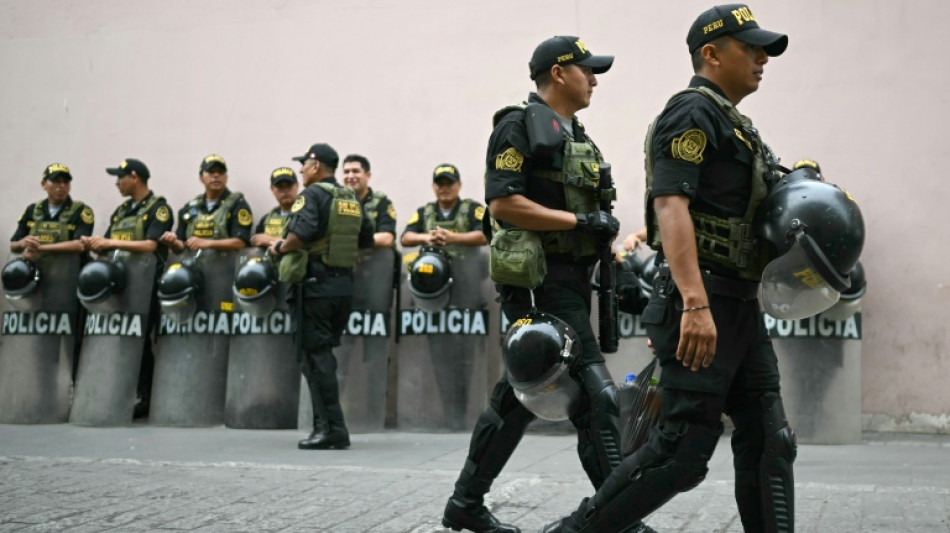
In crime-hit Peru, candidates vie to be 'meanest sheriff' / Photo: Ernesto BENAVIDES - AFP

 Climate change hits trout and salmon in UK's prized chalk streams

 Škoda Octavia Marks 30 Years With Nearly 7.9 Million Units Produced
 Nepal seeking to reach survivors in tunnel as risk of new floods rises

 Anger in Austria over business park on former Nazi camp site

 In shadow of Premier League, Serie A flexes financial muscle

 Tanker pays record $5.3 mn to transit Panama Canal: administrator

 Pilgrims seeking peace caught in deadly Nepal-Tibet floods

 China's help critical, but unlikely, for US to choke off Iran
 US court rules Pentagon ban of Anthropic unlawful

 In Zambia, a Shaolin Temple offers a softer face of China

 Messi's Inter Miami appoint new coach Gonzalez

 Clashes in Spain's Ceuta month after mass migrant influx

 Argentina names unchanged side for Australia Test

 Australia's Lee leads PGA Tour Championship

 US judge urged to rebuff restoring Trump name to Kennedy Center

 Trump orders Lake Ontario to be renamed 'Lake America'

 Raphinha, Lopez strike again as Barca beat Athletic

 Dos Santos, Russell set world records in 'crazy' Zurich Diamond League

 Dos Santos upstages Warholm for blistering new 400m hurdles world record

 US Open women's singles: Three talking points

 American Masai Russell sets new women's 100m hurdles world record

 Smith and Cox revive England after Abbas strikes for Pakistan

 Brazil's Alison Dos Santos sets new men's 400m hurdles world record

 The Nile Theater Announces Full 2026 Concert Lineup Including Menzingers and Shakey Graves

 Venezuelan Artist Oswaldo Vigas Retrospective Opens in Guangzhou

Peruvian presidential hopefuls are touting cash bounties for killing criminals and jungle prisons encircled by Amazonian vipers as they look to tap widespread public anger over rising violence ahead of the April 12 election.
Extreme ideas are shaping a campaign which features a record 35 candidates, as Peru confronts soaring extortion and a homicide rate that has more than doubled since 2018.
Public frustration is high: "Even the police are corrupt," says Karen Santiago, a 29-year-old engineer in Lima's San Isidro district, echoing the sense of impunity driving support for hardline promises.
In an effort to stand out and make it through to a June runoff, many candidates are amping up the rhetoric.
Frontrunner Rafael "Porky" Lopez Aliaga recently toured one poor district where he was greeted by a giant stuffed snake.
The ultraconservative says criminals "must be flown by helicopter to the deepest jungle to build prison colonies" ringed by the world's largest vipers he said.
"They will take care of security," he said smiling.
The would-be ally of US President Donald Trump also proposes allowing the United States to arrest foreign criminals wanted by Washington on Peruvian soil.
Extortion and violence have become commonplace in Peru as transnational crime groups exploit corrupt and undertrained police forces.
Even schools have been targeted by gangs demanding protection money.
In the face of such a crisis, leftwing candidates are also offering populist policies as possible solutions.
Ronald Atencio, has promised something resembling police death squads, although he insists they would avoid extrajudicial killings.
Paul Jaimes, a low-polling contender, goes further, offering $29,000 and a promotion to any police officer who captures or kills a criminal.
"We don't care about criminals' human rights," he told Caretas magazine.
TV comedian Carlos Alvarez, polling between fourth and fifth, demands that Peru leave international rights conventions so the country can apply the death penalty to hitmen.
"Those miserable people don't deserve to live," he told AFP during a tour of Callao.
Some voters embrace the rhetoric. "I agree that all criminals should serve their sentences in the jungle," says 54-year-old vendor Lili Luna.
Others remain skeptical. "It's easier to sell those solutions than long-term plans," says 20-year-old student Samuel Cossio.
– Forced labor –
Right-wing candidate Keiko Fujimori, who leads recent surveys, used this week's presidential debate to propose reinstating faceless courts -- secret tribunals where judges' identities are hidden behind screens.
The system, created during her father Alberto Fujimori's term in office, was widely criticized for unfair trials that later forced the state to pardon hundreds of prisoners.
"To fight crime, if we have to withdraw from the Inter-American Court of Human Rights, we will do so to bring back faceless judges," she said, promising a "mano dura" (iron fist).
Sociologist Jorge Nieto, fourth in polls, said laws backed by Fujimori's party weakened criminal-investigation tools, according to prosecutors.
Fujimori also wants to make inmates earn their meals. "We will force prisoners to work for their food, for their protein," she told reporters.
Security experts warn the proposals will not work.
"Punitive proposals like these are not effective against organized or transnational crime," said criminologist Erika Solis of the Catholic University of Peru.
Javier Llaque, former head of the National Penitentiary Institute, said Peru already has some of Latin America's harshest sentences.
"We don't need more laws or higher penalties. Just action, but tactical action," he said. Insecurity "must be addressed, but technically, not emotionally."
"Candidates should not try to be the meanest sheriff."
F.Carias--PC