
How a German war film disarmed Oscar voters despite woes at home / Photo: JUSTIN TALLIS - AFP/File

 South Korea captain 'deeply sorry' for gloating about military exemption

 Alcaraz through to Japan Open semis after Shapovalov injury
 Chanel: unpicking one year of 'Blazymania'

 Latvian pro-Europeans set for election win: partial results

 China swim sensation Yu Zidi, 13, says 'I'm no prodigy'

 Yu Zidi to Ohashi: Asian Games stars who can light up LA Olympics

 'Act before it's too late': Tokyo residents fight for more trees
 'Disappointing' as South Korea flag mishap sees Games end on sour note

 Pre-COP host Tuvalu at frontline of climate change
 Hungary's dwindling paprika producers battle to save signature spice

 Cornell president vows review in wake of alleged student gang rape
 Latvian partial election results suggest pro-European choice

 In Egypt's Sinai, Gazan builds school for children displaced by war

 Trump tariffs a mixed bag for US auto industry

 Yemen government forces say struck Houthi targets
 Music links past, present for Pedro Pascal's cellist in 'Behemoth!'

 ALEX BODI ȘI AMBASADORUL REPUBLICII SUDANUL DE SUD, GUM DOMINIC MATIOK, DISCUTĂ LA BERLIN DESPRE POSIBILITATEA ÎNFIINȚĂRII UNUI CONSULAT ONORIFIC LA BUCUREȘTI

 Dodgers step up World Series three-peat bid with 5-3 win over Braves

 Spain break down Czechs as England outclass Croatia in Nations League

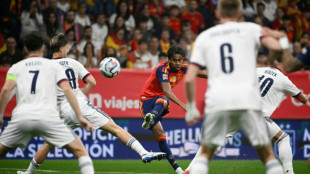 Yamal on target as Spain hold off Czech Republic

 Latvian exit polls suggest pro-European choice

 Lula, Bolsonaro wrap up campaigns ahead of knife-edge election

 Tuchel hails 'complete' England after Croatia demolition

 Fury to invite Trump to lead ring walk before Joshua showdown

 Fashion industry in 'precarious moment', says Vivienne Westwood supremo

When "All Quiet on the Western Front" first premiered back in September, there was little to suggest it was about to wage an all-out campaign for Oscar votes.
The German-language World War I film comes from Netflix, which had a roster of far more expensive "prestige" movies primed for Academy Award pushes, from Oscar-winning director Alejandro Gonzalez Inarritu's "Bardo" to the star-studded "Glass Onion: A Knives Out Mystery."
But while those have largely fallen by the wayside, with one nomination each, "All Quiet" has emerged from the crowded trenches of awards season hopefuls as an Oscars frontrunner, with nine nods, including for much-coveted best picture honors.
"It really feels like a wave of joy and luck that has come over us," director Edward Berger told AFP, days before his film won seven prizes at Britain's BAFTAs, including best film.
"We're very grateful for that... it's a German war movie!"
Indeed, Berger's film is the third screen adaptation of Erich Maria Remarque's seminal novel about naive young German soldiers confronted with the horrors of war -- but the first shot in the author's native language.
Had he been asked, the director "would have immediately said no" to making another English-language version.
Luckily, the decision to flip the script was helped by Netflix's wildly successful expansion into new global markets with recent subtitled hits such as South Korean series "Squid Game" and Oscar-winning film "Roma."
The movie's eventual $20 million price tag was comparatively small change for the streaming giant, but a huge sum in the German film industry.
"We wouldn't have gotten the type of budget that you need to make this film five years ago," said Berger.
The film's best picture Oscar nomination is the first for any German-language movie.
- Creative license -
Ironically, the film has been far better received outside of the German-speaking world than it has at home, where many reviewers savaged it.
In particular, critics slammed Berger's decision to depart from Remarque's text, which -- with 50 million copies sold worldwide, and the legacy of being banned by the Nazis -- holds hallowed status in Germany today.
Unlike the novel, the film portrays tense armistice peace talks with French generals. It also omits a section in which one of its war-hardened heroes visits home but cannot readjust to civilian life.
"I don't follow it very closely... that's part of the journalist's job -- to observe, criticize," shrugged Berger.
"I felt licensed to make those changes" because "why make it the same?" he added.
To encapsulate the "physical difference" between the film's reception at home and overseas, Berger pointed to one especially harrowing scene towards the end of the movie.
A key character is fatally bayoneted through the back -- a moment which Berger intended to be heartbreaking and brutal, but not necessarily unexpected, given the novel's fame and the war's unfathomable death toll.
Yet at the film's world premiere in Toronto last year, "there was a loud gasp in the audience," he recalled.
"I was so surprised, because I didn't plan on this... In Germany, that didn't happen," said Berger.
"As Germans, we expect -- in a German movie about war -- you cannot have a hero. You cannot have people be successful in the mission. You almost cannot have a soldier survive," he said.
By contrast, "in America, you're used to the hero. You want them to come out positively, and you cling on to the hope that your hero is going to change the world."
- 'Shame and responsibility and guilt' -
In any case, Berger did not sign up out of any sense of patriotic duty. The film and the original anti-war novel are both stridently against jingoism of any stripe.
"We wanted to make a very German movie -- but we are not making it for the country," he said.
"I'm not a patriot. Germans have a difficult relationship with patriotism, or pride or honor, about their history or country. So I'm not in that business."
Instead, filming in German offered "an outer stamp of authenticity" and a deeper sense of the "shame and responsibility and guilt" many Germans feel about history, said Berger.
Whatever happens at the Oscars ceremony on March 12, "All Quiet" clearly left an indelible impact on voters at the US-based Academy of Motion Picture Arts and Sciences.
It is seen as a shoo-in for the best international feature statuette, a strong possibility for best picture, and its nine Oscar nominations are one short of the all-time record for a foreign-language movie.
"Were we surprised? Of course," said Berger. "I mean, you can't count on something like that."
G.M.Castelo--PC
