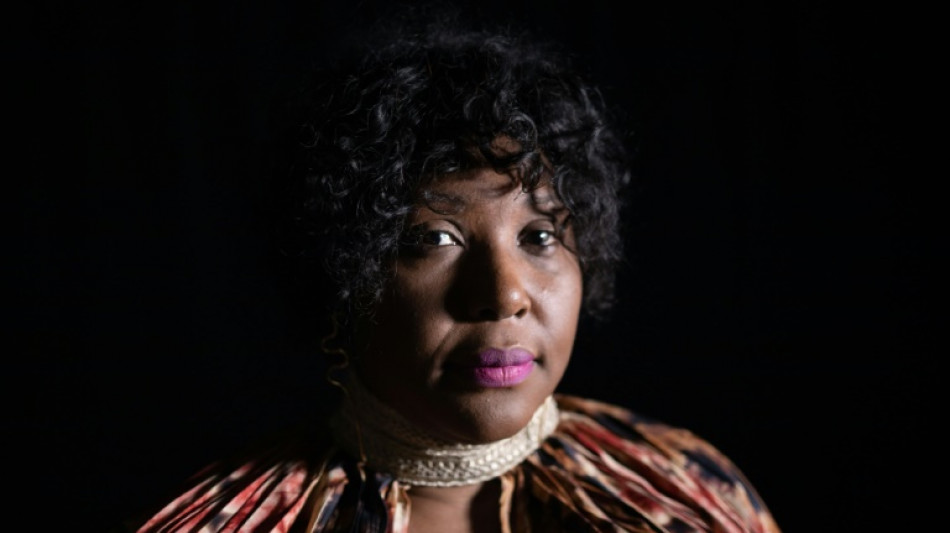
Women take star role in African movies on jihadist bloodshed / Photo: OLYMPIA DE MAISMONT - AFP

 South Korea captain 'deeply sorry' for gloating about military exemption
 Alcaraz through to Japan Open semis after Shapovalov injury
 Chanel: unpicking one year of 'Blazymania'
 Latvian pro-Europeans set for election win: partial results
 China swim sensation Yu Zidi, 13, says 'I'm no prodigy'
 Yu Zidi to Ohashi: Asian Games stars who can light up LA Olympics

 'Act before it's too late': Tokyo residents fight for more trees
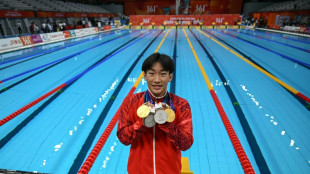
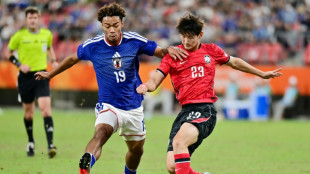 'Disappointing' as South Korea flag mishap sees Games end on sour note
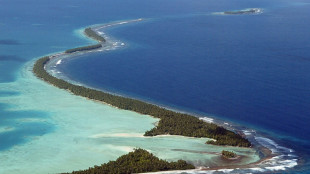 Pre-COP host Tuvalu at frontline of climate change
 Hungary's dwindling paprika producers battle to save signature spice
 Cornell president vows review in wake of alleged student gang rape
 Latvian partial election results suggest pro-European choice
 In Egypt's Sinai, Gazan builds school for children displaced by war

 Trump tariffs a mixed bag for US auto industry

 Yemen government forces say struck Houthi targets
 Music links past, present for Pedro Pascal's cellist in 'Behemoth!'
 ALEX BODI ȘI AMBASADORUL REPUBLICII SUDANUL DE SUD, GUM DOMINIC MATIOK, DISCUTĂ LA BERLIN DESPRE POSIBILITATEA ÎNFIINȚĂRII UNUI CONSULAT ONORIFIC LA BUCUREȘTI
 Dodgers step up World Series three-peat bid with 5-3 win over Braves
 Spain break down Czechs as England outclass Croatia in Nations League

 Yamal on target as Spain hold off Czech Republic

 Latvian exit polls suggest pro-European choice
 Lula, Bolsonaro wrap up campaigns ahead of knife-edge election
 Tuchel hails 'complete' England after Croatia demolition

 Fury to invite Trump to lead ring walk before Joshua showdown

 Fashion industry in 'precarious moment', says Vivienne Westwood supremo

Few movies have been made about jihadism in Africa and even fewer have focused on the plight of women at the hands of extremists.
But a slew of films showcased in the continent's biggest movie festival could be a cinematic watershed.
"When people talk about terrorism, they don't talk much about women," said Apolline Traore, a director from the festival's host country, Burkina Faso, which has suffered grievously from jihadism.
Traore's feature-length "Sira," which won the Silver Stallion of Yennenga award in the FESPACO festival that ended on Saturday, describes a 25-year-old woman who is abducted by jihadists and has to draw on courage and smartness to survive.
Traore said she wanted to haul women out of the typical image of victimhood and place them in the "major role... (they play) in the fight against terrorism".
The director said she was inspired by meeting women whose lives had been turned upside-down by jihadists.
One example, she said, was a woman who with a bullet lodged in her shoulder had spent five days looking for shelter for herself and her two children.
Nafissatou Cisse, a Burkinabe actress who plays the lead role of Sira, said she had drawn on "the rage" of women caught in the jihadist nightmare.
More than 10,000 people have lost their lives in Burkina Faso since jihadists swept in from neighbouring Mali in 2015 and more than two million people have fled their homes.
Around 40 percent of the country is controlled by the insurgents.
Making "Sira" was in itself a gruelling challenge.
After a massacre at Solhan in June 2021 that left 132 dead -- the bloodiest single attack in the long-running jihadist campaign -- the authorities declined to renew authorisation for filming "Sira" in Burkina's deeply troubled north.
- 'Terrorists use women' -
Another director whose home country is struggling with jihadism is Amina Mamani.
Her native Nigeria is the cradle of the Boko Haram movement, whose attacks began in 2009 and metastasised to Cameroon, Niger and Chad.
It leapt to global notoriety in 2014, when hundreds of schoolgirls were kidnapped in Chibok, in Borno state.
Mamani's short film, "The Envoy of God," tells the story of a girl aged about 10, who is kidnapped one night by jihadists to use her to carry out a suicide attack on a market -- but she decides otherwise.
"Terrorists use women. Men get killed, but women are kidnapped, forced into marriage and raped, and young girls selected to blow themselves up," said Mamani.
In another feature-length film, "Thorns of the Sahel," Burkinabe director Boubakar Diallo describes a nurse who is sent to a displaced persons' camp.
She said that during the film shoot, some of the displaced people "panicked when they saw armed men" -- actors playing the part of jihadists.
"We had to build up trust with them," she said.
- 'Sensitive' -
Traore said that in all her 20 years in film-making, she had never experienced such fear in showing a film.
She fretted especially about how the public would react to her work.
"(Jihadism) is very sensitive and fresh in the heart of Burkinabe people and people living in the Sahel," she said.
Launched in 1969, the biennial Pan-African Film and Television Festival of Ouagadougou (FESPACO) draws thousands of movie fans and professionals from across the continent.
It is also closely followed by the US and European movie industries, which scout the event for new films, talent and ideas.
A total of 170 films competed in this year's event, whose theme was "African cinema and culture of peace".
Tunisian director Youssef Chebbi won the top prize, the coveted Golden Stallion, for murder mystery "Ashkal".
Under festival rules, films chosen for competition have to be made by Africans and predominantly produced in Africa.
O.Gaspar--PC
