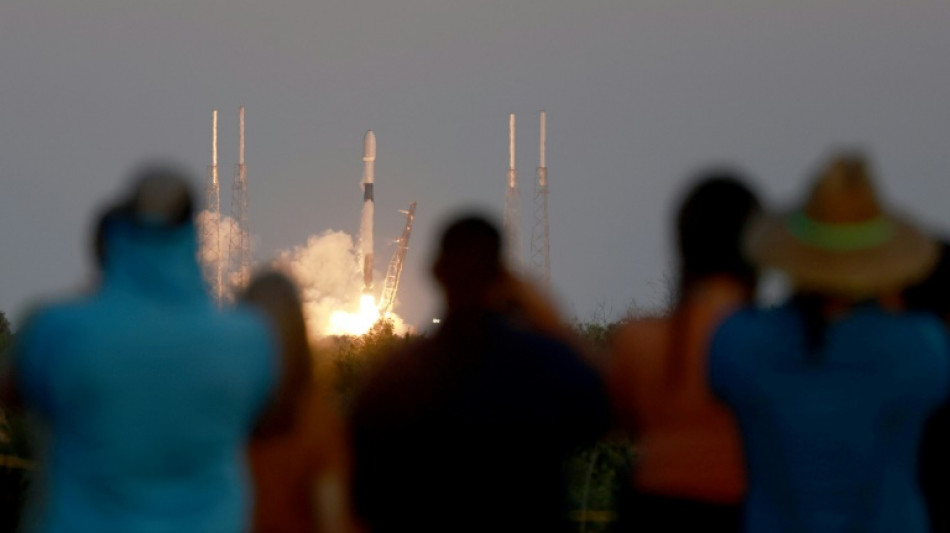
Satellite constellations multiply on profit hopes, geopolitics / Photo: JOE RAEDLE - GETTY IMAGES NORTH AMERICA/AFP

 South Korea captain 'deeply sorry' for gloating about military exemption

 Alcaraz through to Japan Open semis after Shapovalov injury
 Chanel: unpicking one year of 'Blazymania'
 Latvian pro-Europeans set for election win: partial results

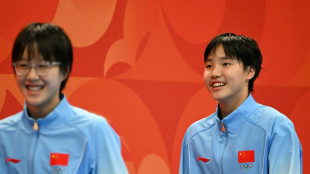
 China swim sensation Yu Zidi, 13, says 'I'm no prodigy'

 Yu Zidi to Ohashi: Asian Games stars who can light up LA Olympics

 'Act before it's too late': Tokyo residents fight for more trees

 'Disappointing' as South Korea flag mishap sees Games end on sour note

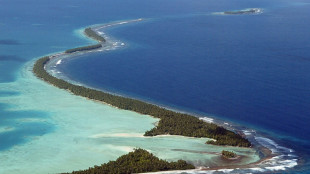 Pre-COP host Tuvalu at frontline of climate change

 Hungary's dwindling paprika producers battle to save signature spice

 Cornell president vows review in wake of alleged student gang rape

 Latvian partial election results suggest pro-European choice

 In Egypt's Sinai, Gazan builds school for children displaced by war

 Trump tariffs a mixed bag for US auto industry

 Yemen government forces say struck Houthi targets

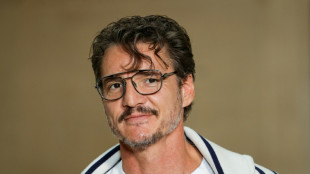 Music links past, present for Pedro Pascal's cellist in 'Behemoth!'

 ALEX BODI ȘI AMBASADORUL REPUBLICII SUDANUL DE SUD, GUM DOMINIC MATIOK, DISCUTĂ LA BERLIN DESPRE POSIBILITATEA ÎNFIINȚĂRII UNUI CONSULAT ONORIFIC LA BUCUREȘTI

 Dodgers step up World Series three-peat bid with 5-3 win over Braves

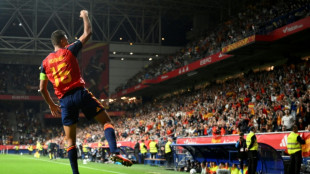 Spain break down Czechs as England outclass Croatia in Nations League

 Yamal on target as Spain hold off Czech Republic

 Latvian exit polls suggest pro-European choice

 Lula, Bolsonaro wrap up campaigns ahead of knife-edge election

 Tuchel hails 'complete' England after Croatia demolition

 Fury to invite Trump to lead ring walk before Joshua showdown

 Fashion industry in 'precarious moment', says Vivienne Westwood supremo

The massive constellation of satellites operated by SpaceX, while still growing, will soon be joined in low Earth orbit by many more commercial competitors, but also government-sponsored programs.
When firms floated the idea of expanding access to high-speed internet through satellite constellations in low Earth orbit (LEO), analysts expected only two or three companies would succeed.
"But the number of players keeps growing," Caleb Henry, research director at Quilty Analytics, told AFP at the annual SATELLITE conference in Washington.
He said there are now at least eight companies vying to launch or complete their LEO constellations, including early entrants SpaceX and OneWeb, which could see a ballooning number of objects in orbit.
Amazon alone hopes to launch over 3,200 satellites as part of its stealthy "Kuiper" project.
But governments are also keen to join the rush.
China plans to launch 13,000 satellites as part of its GuoWang constellation, while Canada's Telesat will add 300 and German start-up Rivada is eyeing 600.
That will be in addition to the European Union's Iris project -- 170 satellites -- and the 300-500 satellites planned to be launched by the US military's Space Development Agency.
When it comes to the satellite constellation game, "people underestimated how sovereign interests would get involved," Henry said.
- Sustainability in space -
While around 120 satellites were launched in all of 2012, in just the first two months of this year, almost 380 were put into orbit.
The total number of LEO satellites should rise to about 24,500 over the next decade, with more than half of them for the three largest constellations, according to forecasts by Euroconsult.
Henry believes there is an open question over how the market will digest all this added capacity.
Mark Dankberg, president of satellite communications firm Viasat -- which operates in the much higher geostationary orbit -- -- said he would be interested in entering the LEO market, but doesn't want big players in the space industry to crowd out competitors.
"We’re interested in LEO, the thing we’re concerned about is leaving enough competition in the market," Dankberg said.
He also warned about the issue of sustainability -- with so many objects in orbit, risks increase of collisions, spreading debris, and frequencies becoming overloaded.
The largest player by far in LEO is Elon Musk's SpaceX, which has already launched nearly 3,600 satellites and in December received authorization to deploy 7,500 of its planned 30,000-satellite second generation constellation.
- Ukraine gas pedal -
Starlink's one million customers is still second place to the lesser-known Hughes, also a US-based operator but whose satellites, like Viasat, are much larger and fly in geostationary orbit.
Oneweb, the British operator in the process of being acquired by Eutelsat, completed its penultimate launch in early March and is expected to have completed its 650-satellite constellation by the end of the month.
The head of Amazon's Kuiper project, Dave Limp, said they will launch their first two prototypes in May and are "on schedule to have over half of our constellation up by mid-2026," a requirement to keep its rights to certain frequencies.
But when it comes to government-sponsored projects, such as the EU's Iris, "commercial utility comes second."
"The idea is... working together on defense," Henry said of Iris.
He attributes the newfound momentum behind the project to the war in Ukraine, where Starlink has been used by Kyiv's forces and civilians to stay connected despite strikes to the country's telecom infrastructure.
H.Portela--PC
