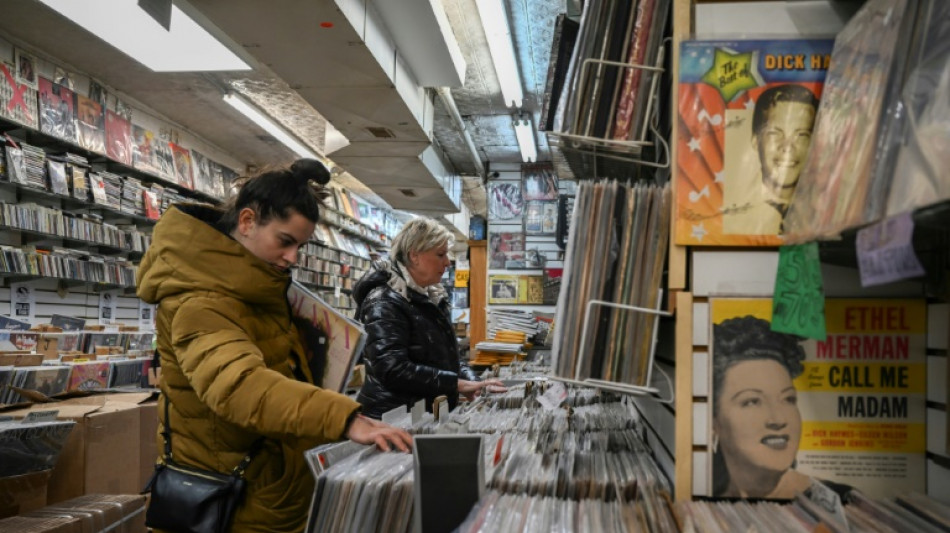
Once dying, then a novelty, vinyl is back and thriving / Photo: Ed JONES - AFP

 Geri Halliwell-Horner Embraces Queen Camilla at Commonwealth Writing Competition
 Meta Quest 3 and 3S Gain Access to Over 150 3D Movies

 Sarah Bajada Shares Message on Pregnancy Loss

 ALIX LASERS shareholders remove Michael Sobitsch as managing director in view of the circumstances
 Euroseas Q3 Net Profit Falls to $91.4 Million Amid Fleet Reduction

 Daily Horoscope November 20, 2026: Astrological Predictions for All Signs

 Tosca's 2026 Sustainability Report Makes the Case for Packaging as Critical Supply Chain Infrastructure

Like many people in his generation, Vijay Damerla finds most of his new music online -- but the 20-year-old is slowly becoming a vinyl junkie, amassing records in his room.
The student says he doesn't even own a turntable, saying for him "it's the equivalent of like getting an artist poster, or like even an album poster on your wall."
"Except, like, there's actually kind of a little bit of a relic from the past."
For Celine Court, 29, collecting vinyl -- she says she owns some 250 records -- is about the nostalgic, warm sound that many listeners say digital copies chill.
"If you listen to music on vinyl, it's so different," she told AFP as she perused the stacks at New York's Village Revival Records. "It has like this authentic kind of feeling to it."
Vinyl's popularity has grown steadily in recent years, a reversal after CDs and digital downloads reigned over the 1990s and early 2000s.
The latest report from the Recording Industry Association of America said that in 2022 more record units were sold than compact discs for the first time in three decades, with consumers snagging 41 million pieces of new vinyl last year compared to 33 million CDs.
Revenue from vinyl had already started surpassing CDs as of the 2020 report.
Big-box retailers including Walmart have embraced the retro format, and megastars including Taylor Swift, Harry Styles and Billie Eilish have sent pressing plants into overdrive.
Just this week Metallica purchased a plant to keep up with demand for their own reissues.
Smaller shops are also feeding interest: Jamal Alnasr, who owns Village Revival, stocks some 200,000 records at any given time, not to mention used CDs, cassettes and memorabilia.
"Who would imagine vinyls will come back to life?" said the 50-year-old shop owner, who moved to New York from the West Bank in his late teens.
At one point he had even donated much of his own personal collection, which he estimates could be worth some $200,000 these days, to an archiving institution: "In the nineties, if you talk about vinyl, I don't think you're cool."
But decades later he says "every day I see (this) young generation buying new items."
"I've been doing this for like 30 years... a new generation, kids, they come in look for all the music from the 1930s and 40s and 50s."
"They actually know more than us, we who grew up in the 1990s and 80s," he laughed.
"It's a beautiful thing."
- Physical experience -
Alnasr deals in both new and used vinyl -- the RIAA report refers to reported sales of new pressings, which the shop owner does stock; he estimates the store contains about half new, half used items.
He said that because vinyl is relatively expensive to manufacture and distribute, the markup these days on new items can be as little as five percent, and he relies on original collectibles to make up the difference.
Alnasr said his business is driven by a combination of music nerds and more casual listeners, and with a $15,000 monthly rent -- once a bohemian haunt, today's Greenwich Village is among the city's priciest neighborhoods -- he's mostly operating on the margins.
"Every time I'm about to sink I just take everything I've got personally and put it back into the business," he laughed. "I guess... I love my business more than I love myself."
Echoing student Damerla's experience, Alnasr said many people buy records for the art -- and discover the music later.
He's fine with that, but does insist that most of his sales be conducted in person.
For a known customer -- Alnasr is a favorite record dealer among celebrities, having befriended the likes of Lana Del Rey, Bella Hadid and Rosalia -- he's willing to procure and ship an item.
But for the most part, he prefers people "physically experience" the vinyl.
"You can say I'm the only stubborn New Yorker -- I do not want to sell this format online," he laughed. "I want people to come here... dig through vinyls and get educated.
"They will see way much more than the front one, there is a lot of hidden gems in here."
No matter the vinyl revival, sales of physical music media remain niche, with streaming remaining the dominant listening format.
Services including paid subscriptions and ad-supported platforms grew seven percent to reach a record high $13.3 billion in revenue in 2022, according to the RIAA, accounting for 84 percent of total US profits.
But Court, who is from the Netherlands, called streaming "too fast, too easy."
"It's just a better energy to collect your vinyl and then listen to it and be proud of it."
J.Pereira--PC