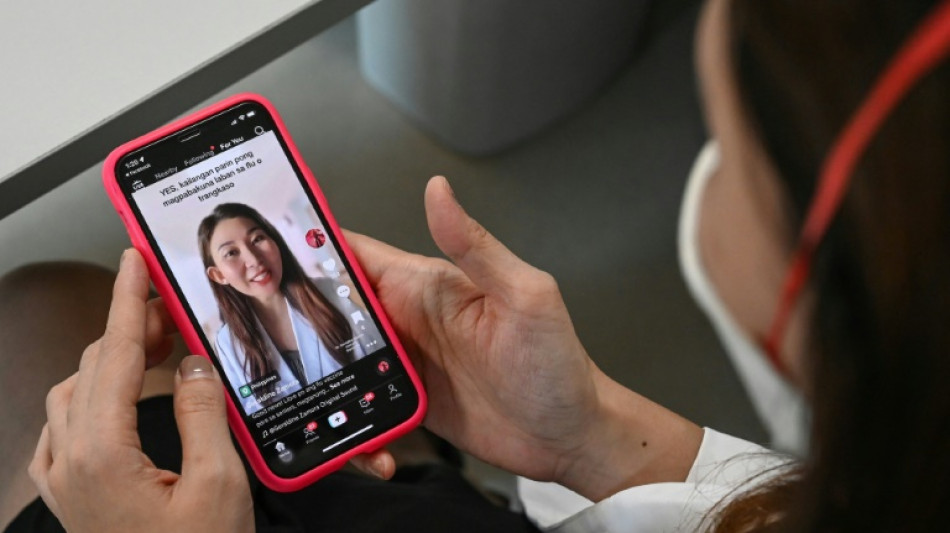
Philippine social media users face barrage of bogus medical posts / Photo: JAM STA ROSA - AFP

 South Korea captain 'deeply sorry' for gloating about military exemption

 Alcaraz through to Japan Open semis after Shapovalov injury

 Chanel: unpicking one year of 'Blazymania'

 Latvian pro-Europeans set for election win: partial results

 China swim sensation Yu Zidi, 13, says 'I'm no prodigy'

 Yu Zidi to Ohashi: Asian Games stars who can light up LA Olympics

 'Act before it's too late': Tokyo residents fight for more trees

 'Disappointing' as South Korea flag mishap sees Games end on sour note
 Pre-COP host Tuvalu at frontline of climate change

 Hungary's dwindling paprika producers battle to save signature spice

 Cornell president vows review in wake of alleged student gang rape

 Latvian partial election results suggest pro-European choice

 In Egypt's Sinai, Gazan builds school for children displaced by war

 Trump tariffs a mixed bag for US auto industry

 Yemen government forces say struck Houthi targets

 Music links past, present for Pedro Pascal's cellist in 'Behemoth!'

 ALEX BODI ȘI AMBASADORUL REPUBLICII SUDANUL DE SUD, GUM DOMINIC MATIOK, DISCUTĂ LA BERLIN DESPRE POSIBILITATEA ÎNFIINȚĂRII UNUI CONSULAT ONORIFIC LA BUCUREȘTI

 Dodgers step up World Series three-peat bid with 5-3 win over Braves

 Spain break down Czechs as England outclass Croatia in Nations League

 Yamal on target as Spain hold off Czech Republic

 Latvian exit polls suggest pro-European choice

 Lula, Bolsonaro wrap up campaigns ahead of knife-edge election

 Tuchel hails 'complete' England after Croatia demolition

 Fury to invite Trump to lead ring walk before Joshua showdown

 Fashion industry in 'precarious moment', says Vivienne Westwood supremo

Philippine vlogger Rosanel Demasudlay holds a heart-shaped "virginity soap" bar in front of the camera and assures her hundreds of YouTube followers it can be safely used to "tighten" their vaginas.
The video is part of a barrage of bogus and harmful medical posts on social media platforms where Filipinos rank among the world's heaviest users.
Even before Covid-19 confined people to their homes and left them fearful of seeing a doctor, many in the Philippines sought remedies online because they were cheaper and easier to access.
During the pandemic, AFP's Fact Check team saw an explosion of misinformation about untested cosmetic products and quick-fix treatments for chronic illnesses.
The majority appear as free posts or paid advertisements on Facebook, the most popular social media site among the 76 million internet users in the Philippines.
They can circulate for weeks or even months without detection as Facebook struggles to keep up with the torrent of misinformation flooding its platform.
While there is no vetting of posts before they go live, Facebook has a multi-stage, largely automated, review system to check ads before they are published.
Many of the products are promoted in videos that have been doctored to make it look like real medical professionals are endorsing them.
Others appear in falsified news reports, while some are touted by vloggers such as Demasudlay.
AFP fact checkers have debunked dozens of claims, including a manipulated Philippine news report that appeared to promote a herbal supplement for diabetics as an alternative to insulin.
A single post of the false video was viewed more than three million times, shared more than seven thousand times and attracted almost ten thousand comments from people, many wanting to buy it.
Demasudlay's 15-minute video was posted in August 2022 and viewed more than ten thousand times.
She falsely claimed the "Bar Bilat Virginity Soap" had been approved by the Philippine Food and Drug Administration as a treatment for skin conditions and a way to tighten the vagina.
"Bilat" means "vagina" in a local Philippine language.
In fact, the FDA has warned consumers against using the "unauthorised" soap due to possible health risks that range from skin irritation to organ failure.
A few months later, Demasudlay admitted in another video that the soap had left her "itchy to the point of bleeding" -- but she kept promoting it.
Demasudlay declined to be interviewed by AFP.
- Global problem -
Philippine doctors worried about the explosion of medical misinformation during the pandemic began posting videos providing free information about common health conditions.
But the move backfired as promoters of spurious treatments used clips from those videos and inserted them into their own posts for credibility.
Geraldine Zamora, a rheumatologist in the capital Manila, was among those targeted.
In 2020, she began recording videos and posting them on TikTok, where she has more than 60,000 followers.
"It was a good thing for us because we were able to extend our medical knowledge to people who otherwise wouldn't be able to consult with doctors," Zamora said.
Her videos were watched hundreds of thousands of times.
But then the footage was used to promote an unregistered brand of supplement for arthritis, which the FDA had warned consumers about.
The manipulated posts were viewed tens of thousands of times before being taken down by Facebook.
Zamora said some of her patients considered purchasing the product in the belief she was endorsing it.
The World Health Organization told AFP that "inappropriate promotion and advertisements" for unregistered medical products had long been a global problem and the pandemic may have made it worse.
Filipinos were particularly vulnerable to false or misleading health claims due to a shortage of doctors in the country and their heavy internet usage, said Eleanor Castillo, a public health expert at the University of the Philippines.
"Even if we have our rural health units, or village health centres, many of them don't have doctors or they would visit once a week or twice a month, especially in far-flung areas," Castillo said.
The consequences of using unapproved treatments can be dire.
Vicente Ocampo, president of the Philippine Academy of Ophthalmology, said patients as young as 12 had become blind after using eye drops bought online instead of consulting a doctor.
"It saddens us that people will readily believe advertisements that claim to heal all eye problems as speedily as possible and pay exorbitant prices for these eye drops," Ocampo said.
Ocampo said Facebook posts selling an unregistered eye drop brand that had used images of real doctors and the academy's name.
But the academy struggled to get traction with its warnings about the misinformation.
Its statement issued in September 2022 notifying consumers about the false posts received 57 interactions -- likes, shares and comments.
In the same month, four ads for the product reviewed by AFP fact checkers received almost 34,000 interactions.
Some of the viral medical posts AFP has debunked on Facebook were paid advertisements.
The ad policy of Meta, the parent company of Facebook, prohibits any "promises or suggestions of unrealistic outcomes" for "health, weight loss or economic opportunity".
It says ads for over-the-counter medicines should comply with licences and approvals required by local laws.
However, keyword searches on Meta's ad library found hundreds of advertisements for products debunked by AFP still on the site.
Meta told AFP it was working with Philippine law enforcement "to address" illegal commercial listings.
J.V.Jacinto--PC
