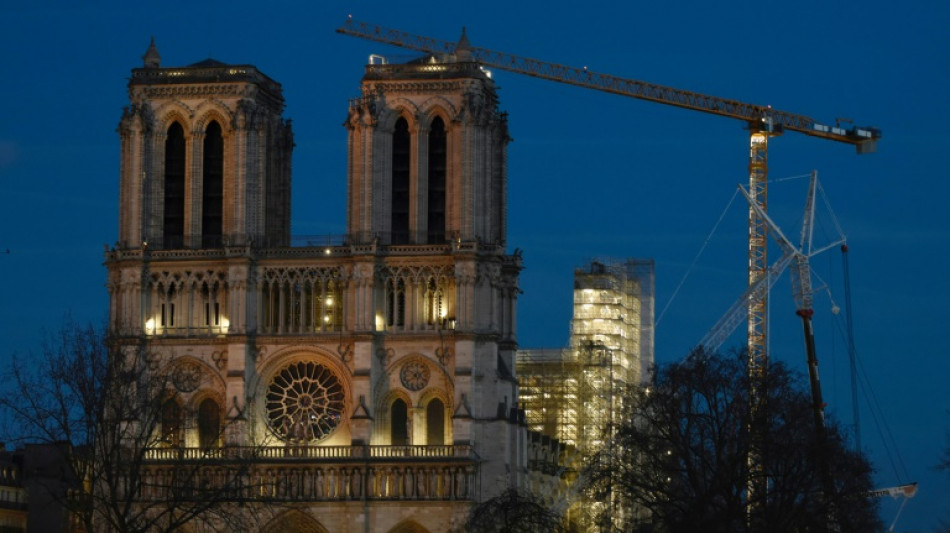
Paris fire exposes hidden iron holding up Notre-Dame / Photo: Christophe DELATTRE - AFP/File

 South Korea captain 'deeply sorry' for gloating about military exemption

 Alcaraz through to Japan Open semis after Shapovalov injury

 Chanel: unpicking one year of 'Blazymania'

 Latvian pro-Europeans set for election win: partial results

 China swim sensation Yu Zidi, 13, says 'I'm no prodigy'

 Yu Zidi to Ohashi: Asian Games stars who can light up LA Olympics

 'Act before it's too late': Tokyo residents fight for more trees

 'Disappointing' as South Korea flag mishap sees Games end on sour note

 Pre-COP host Tuvalu at frontline of climate change

 Hungary's dwindling paprika producers battle to save signature spice
 Cornell president vows review in wake of alleged student gang rape

 Latvian partial election results suggest pro-European choice

 In Egypt's Sinai, Gazan builds school for children displaced by war

 Trump tariffs a mixed bag for US auto industry

 Yemen government forces say struck Houthi targets

 Music links past, present for Pedro Pascal's cellist in 'Behemoth!'

 ALEX BODI ȘI AMBASADORUL REPUBLICII SUDANUL DE SUD, GUM DOMINIC MATIOK, DISCUTĂ LA BERLIN DESPRE POSIBILITATEA ÎNFIINȚĂRII UNUI CONSULAT ONORIFIC LA BUCUREȘTI

 Dodgers step up World Series three-peat bid with 5-3 win over Braves

 Spain break down Czechs as England outclass Croatia in Nations League

 Yamal on target as Spain hold off Czech Republic

 Latvian exit polls suggest pro-European choice

 Lula, Bolsonaro wrap up campaigns ahead of knife-edge election

 Tuchel hails 'complete' England after Croatia demolition

 Fury to invite Trump to lead ring walk before Joshua showdown

 Fashion industry in 'precarious moment', says Vivienne Westwood supremo

The fire that engulfed Notre-Dame four years ago has revealed a long-hidden secret about the Paris landmark: it was the first Gothic cathedral in which iron staples were used extensively throughout construction.
It took near destruction and a massive restoration project which is still in progress for a team of archaeologists to discover the iron reinforcements.
The construction of the famous cathedral in the heart of the French capital began in 1160 and was not completed until almost a century later.
It was the tallest building of its time, with vaults reaching up to 32 metres (105 feet), according to a study published in the journal PLOS ONE on Wednesday.
Maxime L'Heritier, an archaeologist at University Paris 8 and the study's lead author, told AFP that some elements of the building's construction remained unknown, even after all these centuries.
It was not clear how the builders "dared -- and succeeded -- in putting up such thin walls to such a height," he said.
Lacking much documentation from more than 900 years ago, "only the monument can speak" about its construction, he added.
The blaze on April 15, 2019, exposed iron staples used to hold the cathedral's stone blocks together.
Some appeared in the frame of the building, others fell smouldering to the ground in the heat of the blaze.
- 'Much more dynamic ' -
The cathedral could be riddled with more than a thousand iron staples, the study said.
There are staples of varying sizes, ranging from 25 to 50 centimetres (10 to 20 inches) long, some weighing up to a few kilos.
They were found in many different parts of the cathedral, including in the walls of the nave, the choir tribunes and in parts of the cornice.
"This is the first truly massive use of iron in a Gothic cathedral, in very specific places," L'Heritier said.
Iron staples have been used in construction since Antiquity, including in Rome's Colosseum and Greek temples.
But in those cases they were simply used to keep large stone blocks secure on the lower floors.
Notre-Dame has a "much more dynamic conception of architecture," L'Heritier said.
From the very beginning, the builders used the iron staples to make the cathedral's stands in the early 1160s. Their successors continued their innovative use on the upper parts of the walls over the next 50 to 60 years.
Iron would go on to be used in this way in numerous cathedrals across France.
More than 200 scientists are working on restoring Notre-Dame, whose iconic spire is expected to back in place by the end of this year.
The reconstruction project is on track to be completed by the end of next year, France's culture ministry told AFP last month.
This means the tourist landmark, which previously saw 12 million annual visitors, will not be open when Paris hosts the Olympic Games in July and August 2024.
T.Vitorino--PC