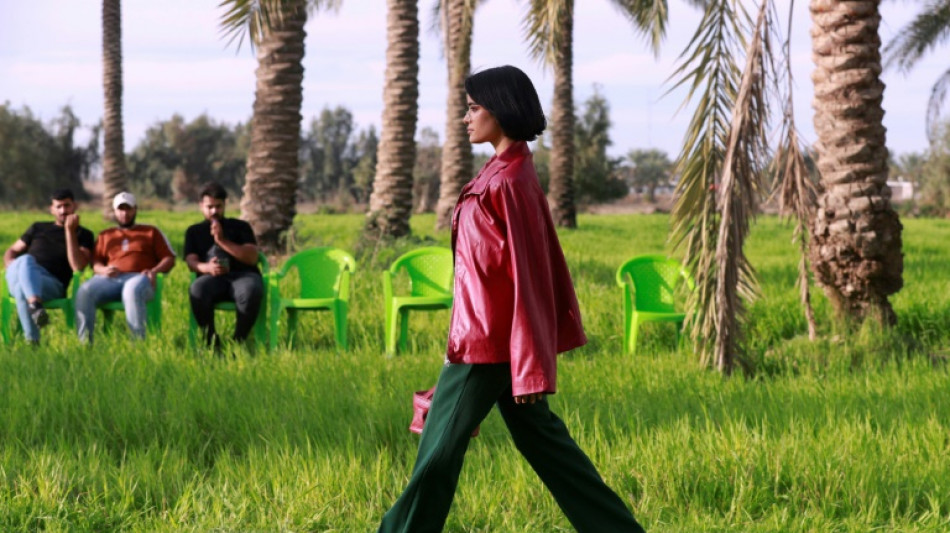
Iraq fashionistas champion climate-friendly vintage wear / Photo: AHMAD AL-RUBAYE - AFP

 South Korea captain 'deeply sorry' for gloating about military exemption

 Alcaraz through to Japan Open semis after Shapovalov injury

 Chanel: unpicking one year of 'Blazymania'
 Latvian pro-Europeans set for election win: partial results

 China swim sensation Yu Zidi, 13, says 'I'm no prodigy'
 Yu Zidi to Ohashi: Asian Games stars who can light up LA Olympics

 'Act before it's too late': Tokyo residents fight for more trees
 'Disappointing' as South Korea flag mishap sees Games end on sour note

 Pre-COP host Tuvalu at frontline of climate change
 Hungary's dwindling paprika producers battle to save signature spice
 Cornell president vows review in wake of alleged student gang rape
 Latvian partial election results suggest pro-European choice
 In Egypt's Sinai, Gazan builds school for children displaced by war

 Trump tariffs a mixed bag for US auto industry

 Yemen government forces say struck Houthi targets

 Music links past, present for Pedro Pascal's cellist in 'Behemoth!'
 ALEX BODI ȘI AMBASADORUL REPUBLICII SUDANUL DE SUD, GUM DOMINIC MATIOK, DISCUTĂ LA BERLIN DESPRE POSIBILITATEA ÎNFIINȚĂRII UNUI CONSULAT ONORIFIC LA BUCUREȘTI

 Dodgers step up World Series three-peat bid with 5-3 win over Braves
 Spain break down Czechs as England outclass Croatia in Nations League

 Yamal on target as Spain hold off Czech Republic

 Latvian exit polls suggest pro-European choice

 Lula, Bolsonaro wrap up campaigns ahead of knife-edge election

 Tuchel hails 'complete' England after Croatia demolition

 Fury to invite Trump to lead ring walk before Joshua showdown

 Fashion industry in 'precarious moment', says Vivienne Westwood supremo

In a palm grove north of Baghdad, bemused Iraqi shepherds looked on as models paraded second-hand garments down an improvised catwalk, seeking to raise awareness of the fashion industry's environmental impact.
Haute couture has given way to upcycled outfits, sourced entirely from used clothes, as the models strut, pause and pivot on the runway, a sign of the growing popularity of chic, environmentally friendly vintage wear among young Iraqis.
"We don't want overproduction of clothes, we have to reuse them," said Mohamed Qassem, 25, a hairdresser and organiser of the fashion show near Al-Hussainiya village.
The global fashion industry accounted for two percent of greenhouse gas emissions in 2019, according to the World Resources Institute.
Campaigners and a growing number of climate-conscious social media influencers have led a push toward sustainable fashion.
Many young people in climate-stressed Iraq, like Qassem, have become passionate about vintage clothing.
The palm grove event showcased fluorescent green puffer jackets, long black leather coats, ample double-breasted blazers, and modern takes on traditional costumes.
In many parts of Iraq, scarred by decades of conflict, peaceful rhythms are gradually returning to daily life and second-hand clothing offers aspiring fashionistas an affordable chance to express themselves.
- Climate threats -
As Baghdad's streets see more "fast-fashion" and imported brands, the outfits at the Al-Hussainiya event predominantly feature green elements, a nod to the show's environmental message.
Iraq, synonymous with date production, has seen its iconic date palms placed under stress by the effects of climate change and the years of conflict.
"The goal is not to focus only on clothes, but also abandoned orchards, palm trees that disappear every day," Qassem said.
The United Nations says oil-rich Iraq is one of the five countries most exposed to the impacts of climate change, already witnessing extreme summer heat, frequent droughts, desertification and regular dust storms, which will exacerbate as the planet heats.
The designs at the fashion show will not be put on sale. Organisers mainly hope the symbolic parade will raise awareness.
Ahmed Taher, a 22-year-old stylist who put together the sets for the show, said "second-hand pieces are clothes of excellent quality".
"When you wear them, you have the impression of wearing luxury clothes. It's different from what you find in stores."
A business student, Taher offers Baghdad's hipsters vintage clothes on Instagram -- where he has around 47,000 followers -- selling pieces for around $20.
"We want to wear unique clothes and not all look like each other," he said.
- 'Last a lifetime' -
A student-turned-model for the day, Safaa Haidar, said she was attracted to vintage clothes as she could shop "according to my personality".
But in Iraq, where the UN estimates nearly one-third of the 42 million inhabitants live in poverty, many wear used clothing out of necessity.
In the winding alleys of central Baghdad's second-hand clothes market, stalls overflow every Friday with shirts, shoes and jeans, with shoppers checking sizes in front of the sellers.
Here a shirt can cost barely $2, while other pieces can sell for as much as $60 or even $200.
Mohamed Ali, a 20-year-old engineering student, came to buy shoes.
"It's not that we can't afford to buy new, but here we find better quality and unique pieces," he said.
Ali recounted his parents' stories from life in the 1990s, when Western sanctions against Iraq meant they would wear clothes, even "inside out, until they were worn out, because they could not afford" new ones.
Now, Ali and most of his friends shop for vintage clothes for their durability and style, he said.
Merchant Hassan Refaat, 22, sells imported second-hand clothes which find a new life in Iraqi wardrobes.
He also imports goods from Iraq's northern autonomous Kurdistan region, bordering major textile producer Turkey.
"Second-hand clothes are of better quality than the new clothes available on the market," he said.
"Very often, they are branded pieces, and the brands last a lifetime."
A.Seabra--PC
