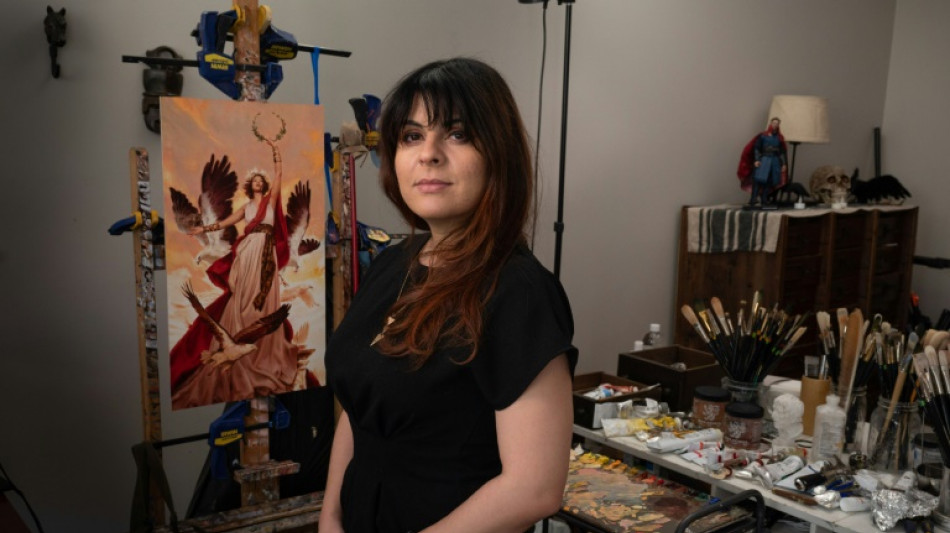
'Glaze' software aims to protect art from copycat AI / Photo: Amy Osborne - AFP/File

 Texas Sports Betting Status: No Legal Options Amid Legislative Push for 2027 Referendum

 Geri Halliwell-Horner Embraces Queen Camilla at Commonwealth Writing Competition

 Meta Quest 3 and 3S Gain Access to Over 150 3D Movies

 Sarah Bajada Shares Message on Pregnancy Loss

 ALIX LASERS shareholders remove Michael Sobitsch as managing director in view of the circumstances

 Euroseas Q3 Net Profit Falls to $91.4 Million Amid Fleet Reduction

Researchers at the University of Chicago have released free "Glaze" software that they say can thwart efforts by generative artificial intelligence (AI) to copy an artist's style.
The program makes tiny changes to digital images that, while invisible to human eyes, act as a "style cloak" when they are posted online, the team behind the project explained on their website.
If generative AI finds a Glaze-guarded image online, it is prevented from correctly analyzing and copying the style, the team said.
Glaze was created at the behest of artists outraged that programs like Midjourney and Stable Diffusion, schooled on troves of images available online, could mimic their styles on command.
"AI has been evolving too fast, and there must be some guardrails or regulations around it," said Shawn Shan, the doctoral student in charge of the project.
"The goal of this is to push back from a technical standpoint."
The team behind Glaze worked with artists including the illustrator Karla Ortiz, who is among the plaintiffs in a US court case against several firms with image-producing generative AI services.
"If Karla uses our tool to cloak her artwork, by adding tiny changes before posting them on her online portfolio, then Stable Diffusion will not learn Karla's artistic style," the lab team said.
"Instead, the model will interpret her art as a different style - for example, that of Vincent van Gogh."
The creators of Glaze concede it is not a panacea, given how quickly AI evolves.
The hope, the team said, is that Glaze and similar projects will protect artists at least until defensive laws or regulations can be implemented.
Glaze has been available for free download since March 15.
G.Machado--PC