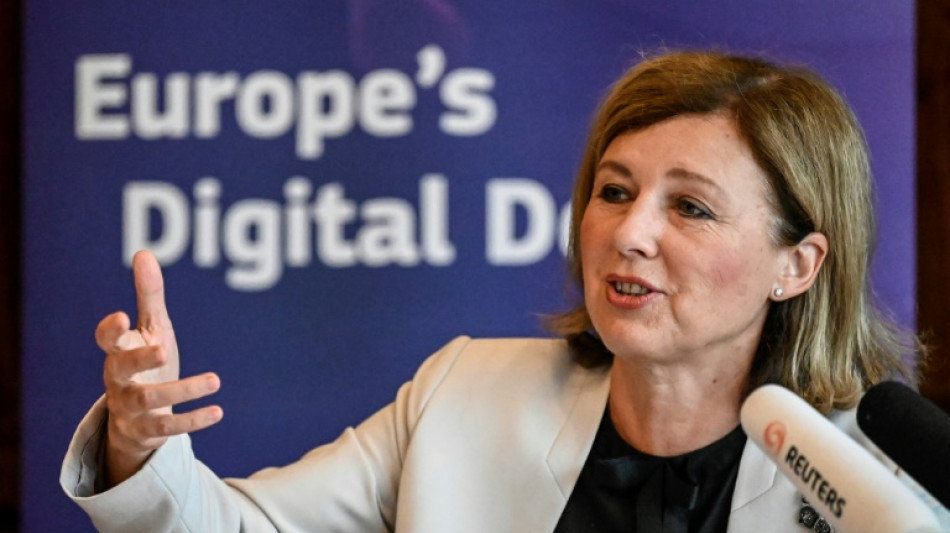
Top EU official says 'unpredictability' of Chinese law worries foreign firms / Photo: Jade Gao - AFP

 Ready, set, snooze: Sleep-deprived Japanese compete for best-rested

 Falcons thump Saints 45-24 as New Orleans marks Katrina anniversary

 Tuvalu govt adviser says Australia overstepped in pre-COP visit

 Asian stocks mixed despite tech-led Wall St record
 Tens of thousands expected in Paris for high school protests

 AI borrowing binge rattles US markets

 Young Canadians sue government over alleged climate failures

 White Sox down Guardians to take 2-0 series lead

 NHL record-breaker Ovechkin says current season will be his last

 France roar back in Nations League as Italy beat Turkey
 Messi readies for final farewell in Argentina send-off
 Esposito seals Italy win over Turkey in Nations League

 Russia downplays plague reports as Trump offers US help

 Trump says US moved bombers from UK base after 'threats'

 Brazilian stocks surge to record after Bolsonaro election lead

 Leaders to visit Pacific atoll at frontline of climate change

 ICC gives more details about arrest warrants for Taliban ministers

 Nigeria's Tinubu confirms 32 dead after military plane crash
 'Reckless' AI firms can't control models, says whistleblower

 Switching on brain cells: the Nobel-winning science of optogenetics

 Quebec votes as separatist surge poses test for Canada PM

 Euro slides as concerns about French debt mount

 Former Trump press secretary Leavitt joins Fox News

 Djokovic advances to China Open final as Medvedev out for hitting fan with ball
 Disgraced former US House speaker dies at 84

The European Commission's digital chief said Tuesday that murky Chinese laws were fuelling concerns among foreign firms in the country, following discussions with Beijing officials about critical areas such as AI and data governance.
Vera Jourova, who is also the commission's vice president, made the comments after talks on Monday with Chinese counterparts including Vice Premier Zhang Guoqing in the second "High-level Digital Dialogue" between the two sides.
Among the concerns Jourova said she had heard about from European businesses in China was the "unpredictability of the decisions and interpretation of the laws by the regulators".
Beijing has recently implemented expansive new regulations covering cybersecurity, counterespionage and data management, citing the need to shore up national security measures.
But the new regulations have worried some foreign firms, unsure of how their enforcement will affect their business operations in the world's second-largest economy.
"First thing is the not very clear wording of the laws, especially missing definitions of, for instance, what is 'important data', and what... the companies could be confronted with when transferring the data outside," Jourova told reporters.
Jourova also criticised the "lengthy procedures" foreign firms must undergo to conduct business in the country.
"I think it's 45 days for one process -- it lasts very often a much longer time," she said.
"Nobody is criticising the Chinese laws, we just want them to be clear and relatively easy to comply with."
The EU official and Czech politician's visit to Beijing comes just days after Brussels announced a probe into Chinese subsidies for electric vehicles, which it said had resulted in unfair competition.
China warned that the investigation would have a negative impact on its trade relations with the bloc, accusing it of "naked protectionism".
Jourova said she emphasised during her meetings with Chinese officials the concerns of European firms over increasingly difficult business conditions in the country, as well as the implications of AI on human rights in the country's northwestern Xinjiang region.
China is accused of incarcerating more than a million Uyghurs and other Muslim minorities in a network of detention facilities across Xinjiang, although Beijing insists its actions have helped to combat extremism and enhance development.
Deteriorating ties between China and the West in recent years have given rise to concerns in Brussels over the potential vulnerabilities posed by AI, misinformation, and data security.
European Commission President Ursula von der Leyen has called on the EU to define its own approach to Beijing, although some of Europe's larger powers want to be cautious to avoid severing business ties.
"The EU does not seek to de-couple from China," Jourova said.
"But we need to improve our resilience and competitiveness by de-risking our economic interdependencies and advancing our technology security agenda in order to remain competitive and protect our essential European interests."
China has pushed back on the "de-risking" strategy espoused by Washington and its European allies.
A foreign ministry spokesperson said in June that "anyone seeking to 'de-risk' against China is getting their target wrong and will only create real risks".
X.Matos--PC