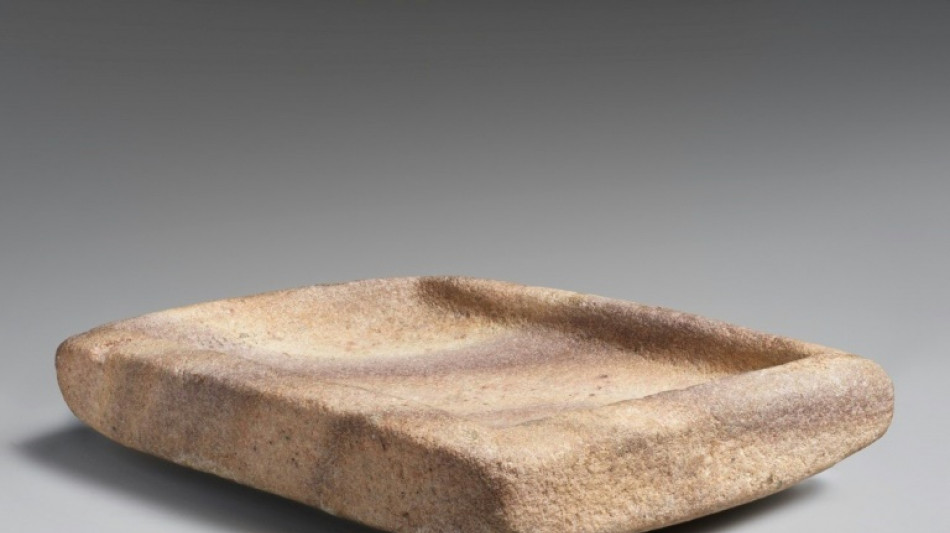
Met returns two antiquities to Yemen, retains possession for now / Photo: Emily Arny Long - The Metropolitan Museum of Art/AFP

 Malaysia Sues Google for $146m Over Harmful Content

 Black Wind Turbine Blades Reduce Bird Deaths by 74% in Spain Study

 Brazil’s Landless Movement Partners with China to Build Affordable Tractors for Family Farms

 Raheem Sterling Receives Suspended Sentence After Lamborghini Crash

 Luxembourg Pay Rise Delayed as Regional and World Headlines Develop

 Audience to Choose the Set List at Luxembourg's First FAMIL Jukebox Night

 Twickenham Grounds Team Prepares Pitch for Six Matches in Three Days

 Black Friday Discounts Cut Prices on Two Top-Rated Wiper Blades

 Arizona Gun Regulation Battle Intensifies Under New Democratic Legislative Majority

The Metropolitan Museum of Art on Tuesday announced it had transferred ownership of two antiquities to Yemen, but that the war-torn country had agreed to leave them in New York for safe-keeping.
Both pieces are stone sculptures -- a sandstone female figure and a marble mortar -- and date to the third millennium BCE from areas in modern-day Yemen, the Met said in a statement.
The museum said it had acquired the statue in 1998 from collector Jean-Luc Chalmin, who also donated the mortar in 1999.
"Provenance research led by Met scholars established that the works were found near Marib in 1984 and rightfully belong to the Republic of Yemen," the statement said, without any additional information.
The Met and other prestigious museums in the United States and around the world have agreed in recent years to work with investigators on identifying looted or stolen art.
In New York, the Manhattan district attorney's office has been leading such a campaign since 2017.
Under District Attorney Alvin Bragg, in office since 2022, more than 950 pieces worth $165 million have been returned to 19 countries, including Cambodia, China, India, Pakistan, Egypt, Iraq, Greece, Turkey and Italy.
The Met announced in May that it would examine the provenance of "several hundred or more" objects that were possibly stolen from their country of origin, and then return them where necessary.
Separately, US authorities announced in February the return of 77 antiquities to Yemen but that they would remain stored at the Smithsonian in Washington.
A similar agreement was struck between the Met and Yemen's government, the nation's ambassador to the United States said Tuesday.
"Due to the current situation in Yemen, it is not the appropriate time to return these artifacts back to our homeland," said Mohammed Al-Hadhrami.
"We are pleased to have these objects remain on loan with The Metropolitan Museum of Art in New York, one of the world's most prominent and prestigious cultural institutions," he added.
Yemen has been devastated by an eight-year civil war that has claimed hundreds of thousands of lives and plunged the poorest country on the Arabian Peninsula into one of the world's worst humanitarian tragedies.
P.L.Madureira--PC