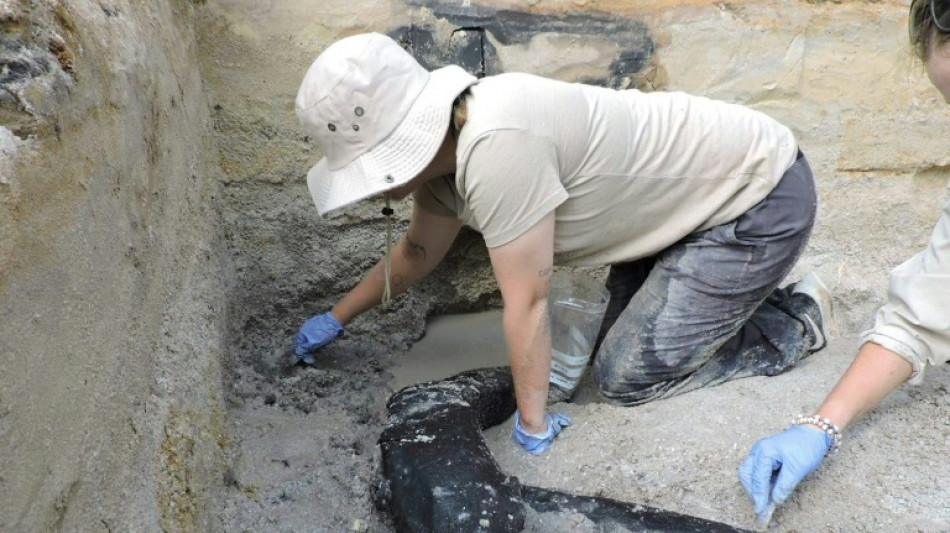
World's oldest wooden structure discovered in Zambia / Photo: Larry BARHAM - Liverpool University/AFP

 Ready, set, snooze: Sleep-deprived Japanese compete for best-rested

 Falcons thump Saints 45-24 as New Orleans marks Katrina anniversary

 Tuvalu govt adviser says Australia overstepped in pre-COP visit

 Asian stocks mixed despite tech-led Wall St record

 Tens of thousands expected in Paris for high school protests

 AI borrowing binge rattles US markets

 Young Canadians sue government over alleged climate failures

 White Sox down Guardians to take 2-0 series lead

 NHL record-breaker Ovechkin says current season will be his last

 France roar back in Nations League as Italy beat Turkey

 Messi readies for final farewell in Argentina send-off

 Esposito seals Italy win over Turkey in Nations League

 Russia downplays plague reports as Trump offers US help

 Trump says US moved bombers from UK base after 'threats'

 Brazilian stocks surge to record after Bolsonaro election lead

 Leaders to visit Pacific atoll at frontline of climate change

 ICC gives more details about arrest warrants for Taliban ministers

 Nigeria's Tinubu confirms 32 dead after military plane crash

 'Reckless' AI firms can't control models, says whistleblower

 Switching on brain cells: the Nobel-winning science of optogenetics

 Quebec votes as separatist surge poses test for Canada PM

 Euro slides as concerns about French debt mount

 Former Trump press secretary Leavitt joins Fox News

 Djokovic advances to China Open final as Medvedev out for hitting fan with ball

 Disgraced former US House speaker dies at 84

Archaeologists said on Wednesday they have unearthed the oldest wooden structure ever discovered, dating from nearly half a million years ago, which suggests that our ancestors may have been more advanced than previously thought.
The exceptionally well-preserved wooden structure was found at Kalambo Falls in the north of Zambia near the border with Tanzania.
It dates back at least 476,000 years, well before the evolution of Homo sapiens, according to a study describing the find in the journal Nature.
The wood bears cut-marks showing that stone tools were used to join two large logs to make the structure, which is believed to be a platform, walkway or raised dwelling to keep our relatives above the water.
A collection of wooden tools, including a wedge and a digging stick, were also discovered at the site.
The ancestors of humans were already known to use wood at this time, but for limited purposes such as starting a fire or hunting.
Larry Barham, an archaeologist at the UK's University of Liverpool and the study's lead author, told AFP that to his knowledge the previous record-holder for oldest wooden structure dated back around 9,000 years.
Barham said the structure was a "chance discovery" made in 2019 while excavating at the site located on the banks of the Kalambo River, above a 235-metre-high (770-foot) waterfall.
Discoveries involving such ancient wood are rare, because it tends to rot leaving behind little trace for the historical record.
But the high level of water at Kalambo Falls is believed to have preserved the structure over the centuries.
- 'Imagination and skills' -
Excavations at the Kalambo site in the 1950s and 1960s unearthed some wood, but it was not able to be accurately dated.
However this time around, the researchers used a new method called luminescence dating, which determines age by measuring the last time minerals were exposed to sunlight.
This revealed that the structure was much older than the researchers had thought, dating back at least 476,000 years.
The earliest evidence of Homo sapiens is from around 300,000 years ago.
But fossils of human relative Homo heidelbergensis, thought to have lived between 700,000 to 200,000 years ago, have been found in the region, Barham said.
The discovery of the wooden structure "changed how I thought about these people", Barham added.
"They transformed their surroundings to make life easier, even if it was only by making a platform to sit on by the river to do their daily chores," he said.
"They used their intelligence, imagination and skills to create something they'd never seen before, something that had never previously existed."
This suggests an abstract level of thinking and "probably language", he added.
Sophie Archambault de Beaune, an archaeologist at France's Lyon 3 University not involved in the study, said the structure "presupposes cognitive abilities such as planning and the ability to visualise the finished product."
But "these capacities were already assumed from the study of cut stone tools", she told AFP.
The authors of the study also said the discovery challenges the idea that human ancestors were nomadic, because the structure seems to be a permanent dwelling near the waterfalls, a perennial source of water.
Archambault de Beaune cautioned that this hypothesis had not yet been proven, because the structure could have been installed for the season, rather than permanently.
P.Mira--PC