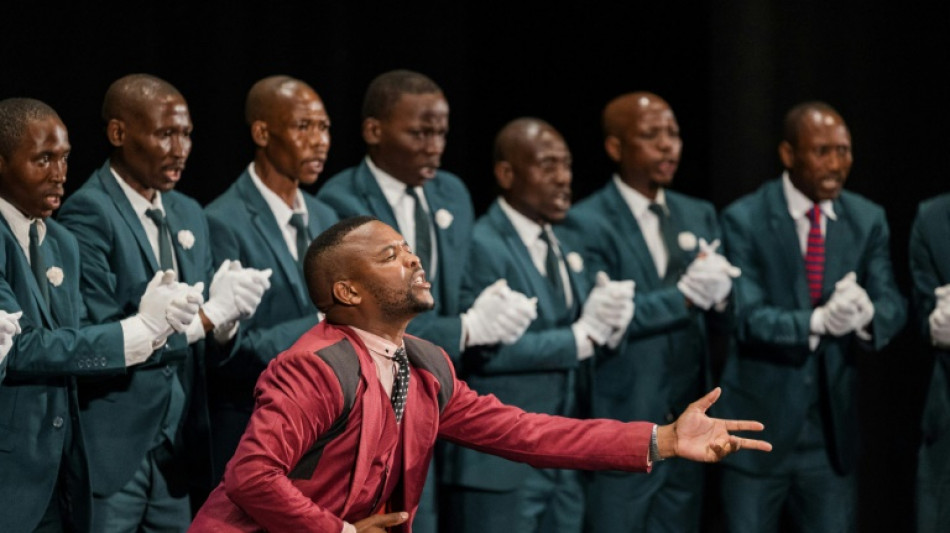
A cappella singing warms Durban's Zulu soul / Photo: RAJESH JANTILAL - AFP

 Malaysia Sues Google for $146m Over Harmful Content

 Black Wind Turbine Blades Reduce Bird Deaths by 74% in Spain Study

 Brazil’s Landless Movement Partners with China to Build Affordable Tractors for Family Farms

 Twickenham Grounds Team Prepares Pitch for Six Matches in Three Days

 Luxembourg Pay Rise Delayed as Regional and World Headlines Develop

 Audience to Choose the Set List at Luxembourg's First FAMIL Jukebox Night

 Raheem Sterling Receives Suspended Sentence After Lamborghini Crash

 Black Friday Discounts Cut Prices on Two Top-Rated Wiper Blades

 Arizona Gun Regulation Battle Intensifies Under New Democratic Legislative Majority
Every little detail counts in an isicathamiya competition: the harmony, the choreography, the costumes, the entrance on stage, the exit and, of course, the singing.
On Saturday night at a Durban theatre in eastern South Africa, Philani Ntuli and his group of 15 singers have just aced their performance, drawing loud cheers from the public.
The precise five-minute routine brought out their powerful bass voices enhanced by two pairs of altos and sopranos.
Group members hopped rhythmically from one foot to the other, before leaving the stage in single file, the jackets of their salmon-coloured suits folded on their forearms.
While many South Africans were glued to their TVs as the Springboks took on Ireland in the Rugby World Cup, the theatre was buzzing with several hundred music lovers.
Developed in South Africa after the First World War, this a cappella singing style is anchored in Zulu culture. Competitions -- often lasting all night -- are a mainstay of the genre.
In Durban, performers from at least 130 all-male groups battled to the tune of catchy rhymes, singing about everyday contemporary themes, from road safety to Covid-19 measures.
Mostly dressed in matching suits inspired by 1940s and 50s fashion, the ensembles, comprising an average of more than 10 members, quickly followed one another on stage to the delight of concertgoers.
"It's more based into the reality than other music," Nomtobeko Mtobela, 35, who came to the theatre with two friends, said of the genre.
"It has that –- I don't know how to call it -– that African thing into it".
- Furtive steps -
Isicathamiya has its roots in a mix of local music, religious choirs and the so-called 'minstrel' shows popular in the United States in the 19th century.
It became popular thanks to contests organised by Zulu miners working in big South African cities, who used to meet on Saturday evenings and sing until dawn.
To this day, competitions are organised throughout the year, particularly in Johannesburg and the Zulu heartland of KwaZulu-Natal, of which Durban is the largest city.
The Saturday night contest, however, was advertised as one of the most important of the year and carried special significance.
Ending well past midnight, it fell on Heritage Day, a public holiday aiming to promote the diversity in what is known as the "Rainbow Nation".
Isicathamiya takes its name from the Zulu word "cathama" which evokes the action of walking softly and furtively like a cat.
It gained international recognition with American singer Paul Simon's 1986 album "Graceland", which featured leading isicathamiya group Ladysmith Black Mambazo.
Almost four decades later, it is still going strong, as testified by the large number of young singers taking part in the Durban contest.
20-year-old Ntuli, who is the frontman of his group, thinks it is a good thing for young people.
"It keeps us away from criminality because we spend most of our time rehearsing," he said.
Winners took home prestige as well as a monetary prize. The festival included awards for elegance and a separate beauty contest for women called "onobuhle".
P.Serra--PC